
MTC Panel Advances $188.5M for I-680/SR-4 Interchange, East Bay Buses
Programming and Allocations Committee • Metropolitan Transportation CommissionNovember 4, 2026
Locunity is an independent informational service and is not an official government page for this commission. All information is sourced from public footage and an analysis of official agendas with the aid of responsible, fact-checked AI. to report an error or omission.
The Metropolitan Transportation Commission's Programming and Allocations Committee on Nov. 4, 2026, moved nearly $188.5 million in Regional Measure 3 (RM3) toll funds toward two Contra Costa County projects: a rebuilt I-680/State Route 4 interchange and bus-priority upgrades on the Macdonald Avenue and Cutting Boulevard corridors. The committee voted 6-0 to refer the allocation to the full Commission. Staff also reported strong Bay Area results in state and federal grant competitions, and one commissioner pushed for MTC to take a firmer hand in costly rail grade separation projects.
- $188.5M RM3 allocation advances on a 6-0 vote, with about $185M going to the I-680/SR-4 interchange
- $3M for AC Transit funds bus bulbs, signal upgrades and ADA curb ramps
- Commissioner Gina Papan floats regional standardization of bus-priority technology
- Bay Area recommended for $77M of the $309M statewide Active Transportation Program
- $111M in federal rail crossing awards recommended for four Bay Area projects
$188.5M RM3 Package Heads to Full Commission
The basics: RM3 is the regional toll program that funds a list of Bay Area capital projects. An allocation releases those dollars to a project sponsor. In this case, the sponsors are the Alameda-Contra Costa Transit District (AC Transit) and the Contra Costa Transportation Authority (CCTA).
Why it matters: The package locks in the RM3 share of a $285M funding plan for one of Contra Costa's major freeway interchanges. It also puts toll money into faster, more accessible bus service.
Where things stand: "So for November, we have 2 new allocations totaling nearly $188.5 million in our RM3 capital funds to 2 projects," said Julieth Ortiz, MTC RM3 capital team staff.
The highway piece: CCTA would receive roughly $185M for RM3 Project 19.1 at the I-680/SR-4 interchange. The work includes:
- A two-lane direct connector from southbound I-680 to eastbound SR-4
- Ramp metering
- Auxiliary lanes
- An HOV bypass lane
The project carries $209.5M in RM3 funds. A $76M state Trade Corridor Enhancement Program (TCEP) award brings the total to $285M. Ortiz said CCTA expects construction to begin in 2027 and finish by the end of 2030.
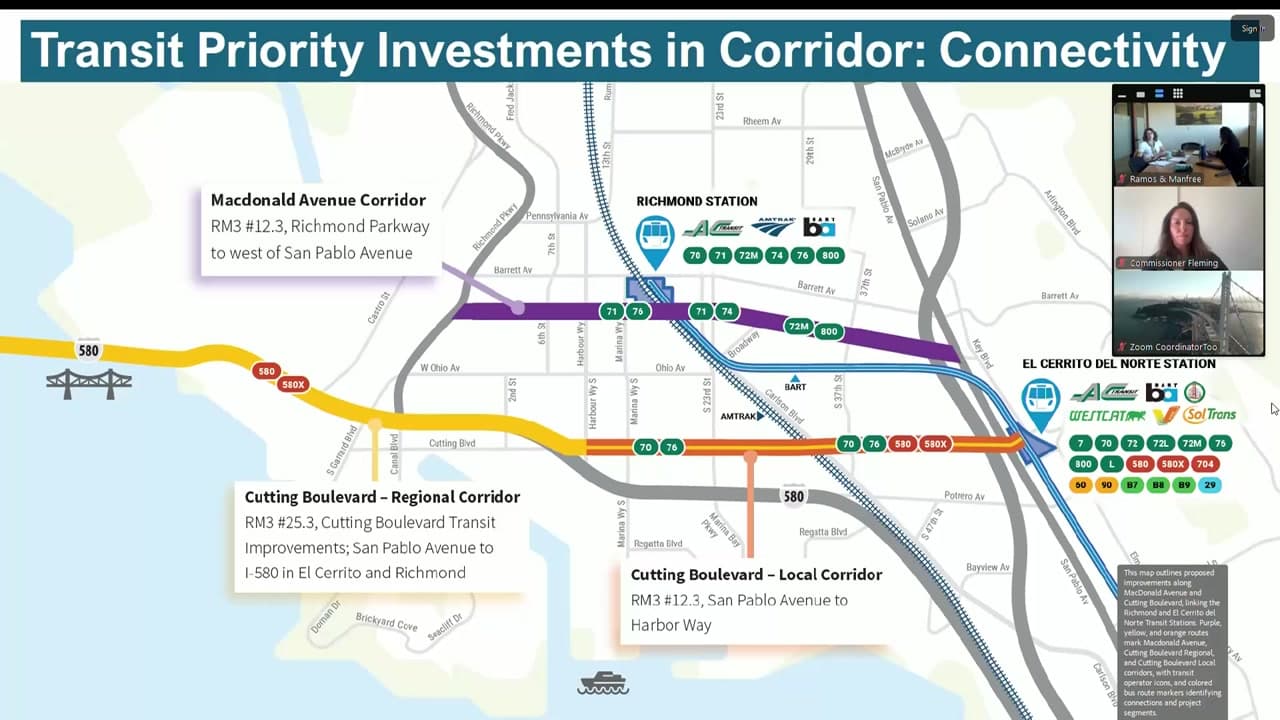
The transit piece: AC Transit would receive $3M for the Macdonald Avenue and Cutting Boulevard Transit Improvements Project, part of RM3 Project 12.3, Rapid Bus Corridor Improvements. The work includes:
- Queue-jump signal upgrades, which give buses a head start at intersections
- Bus bulbs, or curb extensions at stops, at 17 locations
- ADA curb ramps
Completion is estimated by the end of 2028. In October, the committee allocated $5.25M to the related Cutting Boulevard regional project (RM3 Project 25.3). Staff said the two corridors together represent about $15M in transit-priority investments. That total includes $9M in RM3 funds and about $4M in MTC-managed OBAG and LCTOP funds.
Spreading the technology: "Do we have other jurisdictions using that technology, or is it available?" asked Commissioner Gina Papan. Ortiz said Alameda and Contra Costa counties use similar improvements. She added, "AC Transit has been partnering with local jurisdictions to implement such improvements." Staff did not have statewide statistics.
Papan then asked how many bus operators serve the region; a response put the number at about 23. She said standardizing the technology across operators would be very interesting if it proves successful. The committee gave no formal direction on the idea.
Public voice: "Well, small items are important," said public commenter Alida Dupree. She backed the $3M AC Transit item, citing bus bulbs and ADA curb ramps with tactile strips as accessibility gains.
Decisions and stakeholder impacts: Papan moved the referral and Commissioner Margaret Abe-Koga seconded. The motion passed 6-0 (For: Chair Victoria Fleming, Vice Chair Myrna Melgar, Abe-Koga, Amber Manfree, Papan, Belia Ramos; Against: 0; Absent: Barbara Lee, Nate Miley).
- CCTA and I-680/SR-4 commuters: The agency gets its RM3 share on a 2027 construction timeline.
- AC Transit riders and riders with disabilities: They stand to gain faster trips and safer, more accessible stops.
- Other bus operators: They may eventually feel pressure to adopt common tools if Papan's standardization idea gains traction.
What's next: The resolutions, MTC Resolution Nos. 4586 Revised and 4613 Revised, go to the full Commission for approval.
Bay Area Lands Big Shares of State, Federal Grants
Why it matters: The Bay Area is capturing large shares of competitive grant dollars for street safety, trails and grade separations. Grade separations are projects that separate rail lines from road crossings.
Where things stand: Kenneth Kao, MTC Funding Policy and Programs staff, briefed the committee on the latest California Transportation Commission (CTC) meeting, held in Hanford. The CTC approved more than $162M for the SMART to Healdsburg rail extension, drawn from multiple funding sources. It also discussed draft guidelines for toll facility applications, and MTC submitted comments on them. Those guidelines matter for the region's express lane plans.
State Active Transportation Program: "I'm happy to report that of the $309 million available, the Bay Area is slated, is recommended to receive $77 million of that," Kao said. The recommended Cycle 8 awards are:
- $27M for Oakland West Grand corridor improvements
- $22M for Alameda CTC street safety improvements in Hayward
- $28M for San Francisco's Yerba Buena Island multi-use pathway
The regional portion of the program is expected to return to the Commission in early 2027.
Federal rail crossing grants: The federal Railroad Crossing Elimination program recommended $111M for four Bay Area projects. That is about 9% of $1.2 billion nationally. The projects are:
- $90.5M for Caltrain's Broadway crossing in Burlingame
- $15.5M for Mary Avenue in Sunnyvale
- $3.3M for a study of Richmond's Cutting and Carlson crossing
- $2M for a study of Sunset Avenue in Suisun City
Megaprojects, mega costs: Papan called grade separations megaprojects and noted that Caltrain has struggled to standardize designs to control costs. "I would hope that we take a little more active role in seeing how they progress or how they plan," she said. She suggested MTC could identify where its recommendations might save money.
The other side: Public commenters pushed for more ambition rather than more oversight.
- Dupree: "I'm very passionate about grade separations," she said. She suggested that, once separations are built, Caltrain could run faster than its current 79 mph limit or add express trains. She urged continued state support.
- Roland LeBrun: The public commenter pointed to Papan's standardization remarks. He described a proposal he made at an August executive committee meeting to turn the Gilroy-to-Emeryville rail alignment over to a private concession for 50 years. "And the budget is $20 billion, which, believe it or not, includes $5 billion of private capital," he said.
Decisions and stakeholder impacts: This was an information item, so no action was taken. The committee did not respond to LeBrun's proposal. Cities including Oakland, Hayward, San Francisco, Burlingame, Sunnyvale, Richmond and Suisun City stand to benefit from the recommended awards. Papan's push signals that MTC could seek a larger role in how future grade separations are designed and delivered.
What's next: The CTC meets next in early December in the Palm Springs area.
Minor Items
- Consent calendar approved: The committee approved the Oct. 14, 2026, minutes; revisions to OBAG 3, OBAG 4 and the Carbon Reduction Program; and FY 2026-27 Transportation Development Act and State Transit Assistance allocations to transit operators. Commissioner Belia Ramos seconded, no items were pulled, and the vote was declared unanimous by members present.
- General public comment: Dupree cited New York's $68 billion MTA capital plan and said highways need repair even as she favors transit. "So I ask you to continue to make the hard decisions," she said.
Looking ahead: The committee's next regular meeting is Wednesday, Dec. 9, 2026, at 9:45 a.m. at the Bay Area Metro Center, 375 Beale St., San Francisco.