
MTC Committee Advances $360M OBAG 4 Grant Plan, $184M Transit Aid
Programming and Allocations Committee • Metropolitan Transportation CommissionOctober 14, 2026
Locunity is an independent informational service and is not an official government page for this commission. All information is sourced from public footage and an analysis of official agendas with the aid of responsible, fact-checked AI. to report an error or omission.
The Metropolitan Transportation Commission's Programming and Allocations Committee on Oct. 14, 2026, approved the framework for how the Bay Area will spend $360 million in flexible federal highway money over the next grant cycle. Commissioners sent the OBAG 4 regional program and roughly $184 million in state and regional transit allocations to the full Commission, all by voice vote. The quiet votes still carried a warning: higher diesel prices are lifting state transit aid, but staff cautioned the gain may not last.
- $360M OBAG 4 regional program heads to full Commission, split across community investments, network performance and shared services.
- Commissioner Gina Papan presses for equity tracking as competitive grant calls roll out through 2027.
- State Transit Assistance pool jumps from $376M to $486M on diesel-driven revenue as a pandemic-era formula freeze ends.
- BART and Muni shares fall about 2% each under the restored state formula.
- $183.6M in allocations to SFMTA, SMART and WestCAT advance without questions from commissioners.
$360M OBAG 4 Framework Moves Forward
The basics: The One Bay Area Grant, or OBAG, is the region's main vehicle for spending Federal Highway Administration formula dollars. "OBAG is the Bay Area's primary program for investing federal highway or FHWA formula funds," said Kate Fosburgh, MTC staff.
Why it matters: This vote sets the categories and dollar amounts for the fourth OBAG cycle. Those categories will shape which local and regional projects compete for money when calls for projects open in 2027.
Where things stand: Fosburgh presented the $360 million regional program in three buckets. Just over half goes to community investments, about one-third to network performance, and the remainder to shared information and services.
Fosburgh also noted that a consent item approved earlier in the meeting, item 2c, redirected an additional $19 million in available OBAG III balances to supplement key regional programs.
Staff previewed the work the money will support:
- A regional transportation demand management (TDM) roadmap
- Regional safety and Vision Zero work, with a committee update later this year
- Quick-build projects tied to the federal SS4A safety grant
- A draft transit priority network, with bus aid guidelines expected in spring 2027
- Multimodal corridors planning beginning in early 2027
Separately, county programs are finishing their own calls for projects. Nominations are due at the end of October, and the Commission plans to select projects in early 2027.
Equity and oversight: Papan used the item to put staff on notice that she wants visibility into who gets the money. Her focus was especially on the TOC elements, the program's transit-oriented communities components.
"We want to make sure that there's some equity in how the funds are distributed or the programs go out," said Commissioner Gina Papan. She asked that the Commission be kept informed so it can see what is working before things are finalized. She tied that request to the region's upcoming Plan 2060.
Theresa Romell, MTC staff, pointed Papan to the anticipated grant schedule in the staff report's attachment. Romell said the call for projects for the TOC incentive set-aside is expected in fall 2027.
Another MTC staff member added that the committee and the Commission will approve competitive program projects once guidelines and calls for projects are complete. That answer means commissioners keep a second look before any competitive dollars are awarded.
Support from the counties: The only public comment came from James Cameron, Executive Director, Sonoma County Transportation and Climate Authorities, who spoke as this year's chair of the Bay Area County Transportation Authorities. He praised the balance between county and regional programs and the collaboration with MTC staff. He also said the TDM roadmap group has formed and welcomed plans for simplified, consolidated competitive grant calls.
"We support the staff recommendation to refer to the Commission and look forward to our continued regional collaboration," Cameron said. No opposing comments were heard.
Decisions and stakeholder impacts: Vice Chair Myrna Melgar moved to refer MTC Resolution No. 4740, Revised, to the Commission, and Commissioner Belia Ramos seconded. The motion passed by voice vote, with the chair saying it passed with all members present. No numeric tally was announced.
- County transportation agencies: They got the county-regional balance they backed.
- Cities and transit operators: They gain a clearer roadmap for 2027 competitive grants.
- Jurisdictions seeking TOC incentive money: They will wait until fall 2027.
What's next: The full Commission takes up the program next. Competitive guidelines and project awards will return to this committee and the Commission for approval.
Diesel Prices Lift State Transit Aid, but BART and Muni Lose Share
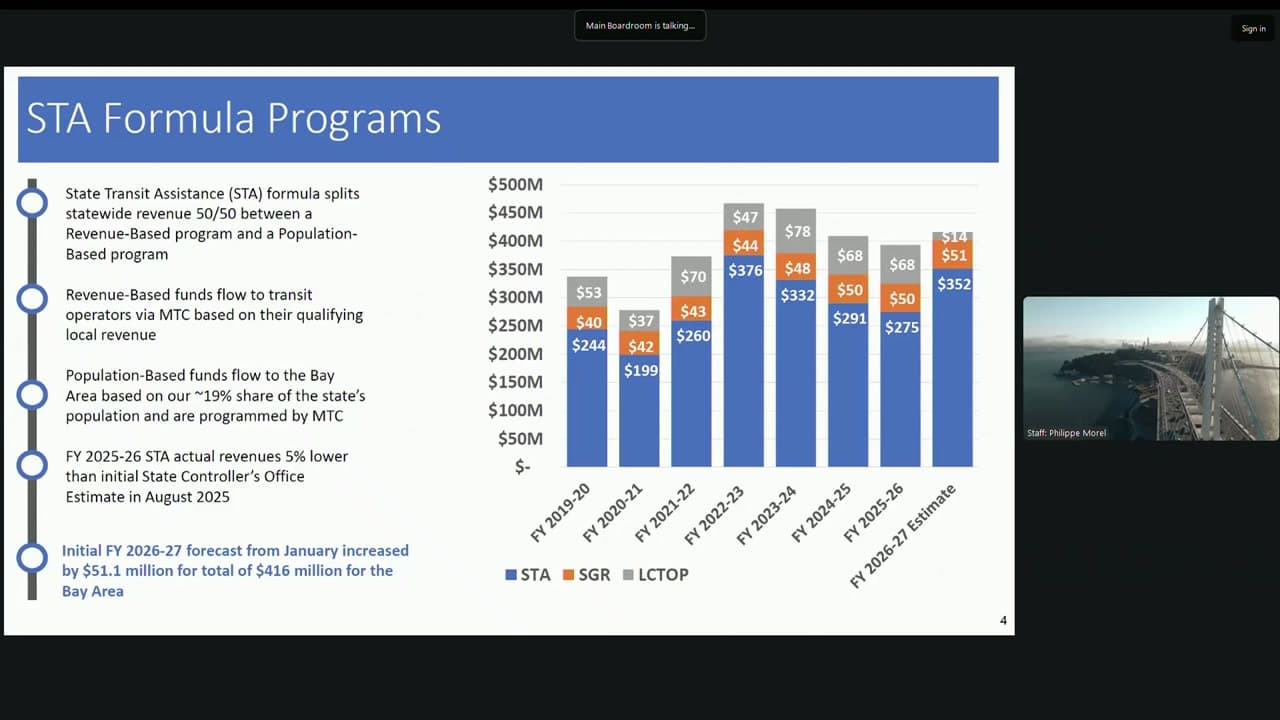
Why it matters: State Transit Assistance (STA) is a key source of operating money for Bay Area transit. A formula change and a fuel-price spike are reshuffling how much each agency gets.
Where things stand: Luis Garcia, MTC staff, walked the committee through revisions to the FY2026-27 Fund Estimate. The estimate covers Transportation Development Act (TDA), STA and AB 1107 funds and is amended twice a year.
"This increase is concentrated primarily in the State Transit Assistance Program, which is directly correlated to the high costs of diesel fuel since the beginning of the calendar year," Garcia said.
The statewide revenue-based STA estimate is revising from $376 million to $486 million, according to Garcia. Not every program is growing, though. The Low Carbon Transit Operations Program fell because of legislative changes to the state's Cap and Invest program.
The formula shift: A pandemic-era freeze on the revenue-based formula has expired. The state is returning to distributing funds by each operator's share of qualifying revenues. Under that formula:
- The Bay Area's overall share fell by less than 1%.
- BART's and Muni's shares each fell roughly 2%.
- Other large operators gained share.
Because the statewide pool grew, most operators still see more money despite the reshuffled shares. Staff warned that shares will fluctuate year to year. They also cautioned that the larger pool may not hold if diesel prices or qualifying revenues change.
The allocations: SFMTA, SMART and WestCAT requested $183.6 million in allocations from TDA, STA, Regional Measure 2 (RM2), Regional Measure 3 (RM3) and AB 1107 funds. The agenda listed the total as $184 million. The item also revises the FY2027 State of Good Repair project list, which must be submitted to Caltrans.
Decisions and stakeholder impacts: Commissioners asked no questions. Papan moved to refer MTC Resolution Nos. 4742, 4771 through 4775, and 4783, all Revised, to the Commission. Commissioner Barbara Lee seconded. The motion passed by voice vote with no opposition or abstentions noted, and no numeric tally was announced.
- SFMTA, SMART and WestCAT: Their allocations move toward final approval.
- BART and Muni: The region's two largest systems take a smaller slice of a bigger pie.
- Transit agencies generally: The windfall may not carry into future budgets.
What's next: The full Commission will consider the allocations, and the revised project list goes to Caltrans.
Minor Items
- Consent calendar approved: Items 2a–2f passed by voice vote with no public comment, on Papan's motion and Commissioner Amber Manfree's second. The chair declared the vote unanimous among members present.
- $51.3M in RM3 bridge toll capital funds approved: The money goes to the Alameda County Transportation Commission, the Bay Area Toll Authority, the Port of Oakland and VTA.
- $1.2M in RM2 capital funds reallocated to BART: The item also allocates $253,000 in RM2 funds to MTC.
- $400,000 in participatory budgeting funds programmed: Recipients are VTA, the County of Marin and the City of Vallejo.
- Page numbers missing from meeting packets: Papan asked staff to restore them. "Again, somehow we lost the page numbers," she said.
Looking Ahead
The committee next meets Wednesday, Nov. 4, 2026, at 9:45 a.m. at the Bay Area Metro Center, 375 Beale St., San Francisco. Commissioners Margaret Abe-Koga and Nguyen were recorded absent at roll call for this meeting.
Questions to watch as OBAG 4 rolls out:
- Will staff deliver the jurisdiction-by-jurisdiction equity tracking Papan requested?
- How will BART and Muni absorb a shrinking STA share if diesel prices ease?