
MTC Committee Weighs $412M State Transit Bid as Grant Money Tightens
Programming and Allocations Committee • Metropolitan Transportation CommissionSeptember 9, 2026
Locunity is an independent informational service and is not an official government page for this commission. All information is sourced from public footage and an analysis of official agendas with the aid of responsible, fact-checked AI. to report an error or omission.
The Bay Area is lining up a $412M bid for competitive state transportation dollars, led by transit upgrades and two rail extensions. On Sept. 9, 2026, the Metropolitan Transportation Commission's Programming and Allocations Committee took a voice vote on the nominations. It also previewed a smaller federal grant cycle and recommended a $13 billion, four-year project program to the full Commission.
- $412M Senate Bill 1 (SB 1) nomination slate goes to a voice vote, with conditions on Valley Link, SMART and I-680 Express Lanes
- OBAG 4 regional program set at $360M, with staff warning of "a lot less funding"
- 2027 Transportation Improvement Program (TIP) of $13B+ recommended to the Commission; federal approval expected in December
- Commissioners press for a full-Commission update on a $19M wayfinding program after Palo Alto station delays
Bay Area Stakes Claim to State Corridor Money
The basics: SB 1, California's 2017 transportation funding law, pays for two competitive programs. Solutions for Congested Corridors (SCC) funds multimodal corridor projects. The Trade Corridor Enhancement Program (TCEP) funds freight corridors. The California Transportation Commission (CTC) awards both.
Why it matters: The region is competing for roughly $1.8B in SB 1 funds. Staff's SCC slate is larger than usual because of strong transit candidates. For SCC, $524M is available statewide over two years, and staff recommended $412M in Bay Area projects.
Where things stand: Kenneth Kao, MTC funding staff, presented seven SCC projects. They include:
- Multimodal highway projects in Napa and Contra Costa counties
- SFMTA train control
- Caltrain projects
- A BART Transbay Tube power upgrade
- Valley Link and SMART extensions
Two projects come with conditions. The I-680 Express Lanes project should prioritize returning contingency savings to BATA/BAIFA. The Valley Link and SMART extensions are tied to the region's long-range plan, Plan Bay Area 2050+.
"Staff recommends that MTC nominate these projects on the condition that they complete a plan amendment by next spring," said Kao.
Two candidates missed the SCC cut. Staff said the Solano interchange is a better fit for TCEP. The Santa Clara 280/Winchester interchange was also not recommended. For TCEP, about $1.3B is expected statewide, and the region received eight projects totaling nearly $300M.
Commissioner Amber Manfree praised the prioritization of the Highway 29 American Canyon corridor. "It's one of the biggest pinch points in the region," she said.
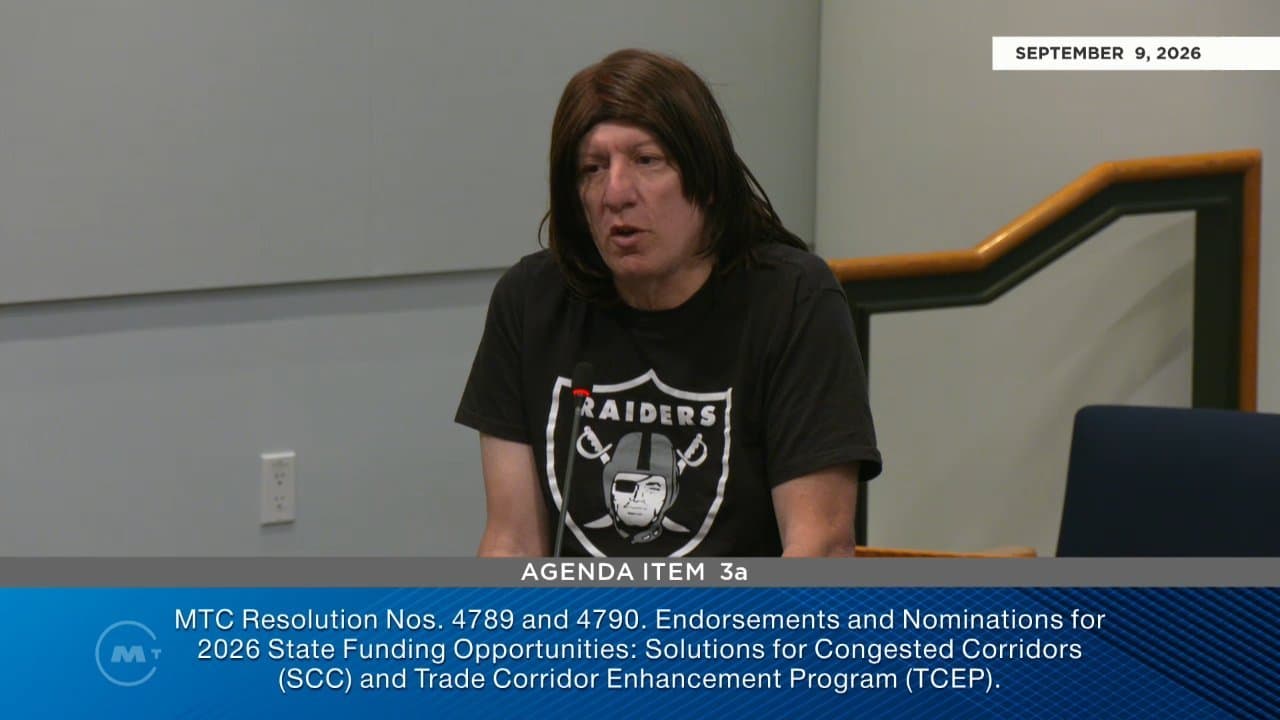
The other side: Public comment split on the transit pieces. A public commenter backed the SFMTA train control system and the BART substation upgrade as investments in resilient power. The commenter cited past substation incidents at BART and in New York. "I support SFMTA train control," the commenter said.
A second public commenter objected to the Caltrain request. "Opposed to item T2, which is $50 million to Caltrain for the advancement toward the long-range vision, which quite frankly is just smoke and mirrors," the commenter said. The commenter urged a study of how four rail operators could share the Transbay Transit Center.
Decisions and stakeholder impacts: Commissioner Manfree moved to approve MTC Resolution Nos. 4789 and 4790, and Commissioner Gina Papan seconded. After public comment, Vice Chair Myrna Melgar called for ayes. She said she saw no opposition and moved to the next item, but she did not formally announce a result. No tally was given.
The likely winners are transit operators, including SFMTA, BART, Caltrain, Valley Link and SMART. Napa and Contra Costa highway sponsors also benefit. The Solano and Santa Clara interchange sponsors must look elsewhere, with Solano steered toward TCEP. The I-680 condition means any unspent contingency would flow back to the region's toll authorities rather than stay with the project.
What's next: Staff recommended referring the resolutions to the full Commission. CTC applications are due in November. Valley Link and SMART must complete their plan amendment by next spring. Legistar Matter 26-1017
OBAG 4: A Smaller Pot, Harder Choices
The basics: The One Bay Area Grant (OBAG) program distributes federal highway formula funds, which can be used flexibly across many project types. It splits the money between county-led and regional programs.
Why it matters: OBAG 4 totals $820M over four years. Of that, $100M goes off the top to the SB 125 Transit Operations Program. The remaining $720M splits evenly: $360M for counties and $360M for regional programs. The headline change is less money overall.
"We have a lot less funding than we did in the last program," said an MTC staff member.
Where things stand: Kate Fosburgh, OBAG program manager, laid out three regional categories: community investments, network performance, and shared information and services. Nearly half the money will go out through competitive grants and about one-third through collaborative efforts. County nominations are due in October, and project selection is planned for early 2027. Commissioners praised the program's clarity and the staff's work with county transportation agencies.
The other side: Commissioner Manfree questioned the cut to walking, biking and trail funding.
"The active transportation and regional trails funding has decreased quite a bit from OBAG 3, but the need certainly hasn't decreased," she said.
Staff said counties already spend heavily on active transportation, and the state's Active Transportation Program offers another funding source.
A public commenter urged the committee to keep backing transit electrification despite problems with vehicle quality and bus charging infrastructure. "You have to stay the course," the commenter said.
Wayfinding delays surface: Commissioner Margaret Abe-Koga said it has been hard to track the timeline and funding needs for the Palo Alto station wayfinding project. She noted that MTC will hire another consultant and that implementation appears to be slipping. The project is part of a $19M mapping and wayfinding program.
"We could have time at a meeting here or at the workshop to get an update on the wayfinding program for the whole commission," she said. Another commissioner backed the request.
Staff said detailed updates go to the Regional Network Management Committee. "We certainly can find an appropriate time to bring something for the full Commission," an MTC staff member said.
Decisions and stakeholder impacts: This was an informational item, so no vote was taken. Bike, pedestrian and trail advocates face a smaller regional share. Counties will carry more of that load through their own nominations.
What's next: "We will return to this committee in October seeking approval of the OBAG-4 regional program," said Fosburgh.
$13B Project Program Clears Committee
Why it matters: The TIP is a federally required four-year list of projects. Many projects cannot move forward without it.
Where things stand: "The final TIP includes more than 400 projects representing over $13 billion in committed funding through 2030," said Mallory Atkinson, MTC staff. Transit receives the largest share of the funding, while bicycle and pedestrian projects make up the largest number of projects.
Sponsors requested minor revisions, which staff said did not change project scopes, costs or air quality findings. The accompanying conformity analysis found that the TIP and Plan Bay Area 2050+ meet federal air quality requirements and regional emissions budgets. The public comment period ran from July 14 to Aug. 13 and drew 45 comments.
The other side: No commissioner raised questions. A public commenter described air quality as the heart of the TIP. The commenter pointed to particulates and asthma near highways and bus yards and urged approval.
Decisions and stakeholder impacts: Commissioner Abe-Koga moved to recommend MTC Resolution Nos. 4785 and 4786, and Commissioner Barbara Lee seconded. The motion passed by voice vote with no opposition voiced; no tally was announced. The vote is a referral, not final Commission or federal approval. Transit agencies and local sponsors gain a clearer path to federal dollars.
What's next: The TIP goes to the full Commission, then to Caltrans and federal reviewers. Federal approval is expected in December. Legistar Matter 26-1023
Minor Items
- Consent calendar (items 2a–2h) passed unanimously by voice vote. It included a Regional Measure 3 goods movement amendment and OBAG 3 carbon reduction revisions.
- Bike share question: Commissioner Abe-Koga asked whether a $1.5M second OBAG 3 grant round could fund a pilot in Palo Alto or Mountain View. Staff said "there's not been any eligibility criteria established yet, but there may be in the future."
- State update: "The CTC approved over $300 million in state and federal funds for SR 37," said Kao. The money covers flood and congestion fixes, including the Novato Creek Bridge.
- Transit loan: The CTC received its first status report on the $590M AB 117 loan for Bay Area transit operations.
- Leadership: Chair Fleming was absent, and Vice Chair Melgar presided.
Looking Ahead
The committee next meets Wednesday, Oct. 14, at the Bay Area Metro Center, where it is expected to take up OBAG 4 approval. The CTC meets in mid-October in Hanford, and SB 1 applications are due in November.