Romania Pushes Black Sea Ceasefire to Protect Global Grain Supply
Press Briefings • United NationsSeptember 24, 2026
Locunity is an independent informational service and is not an official government page for this commission. All information is sourced from public footage and an analysis of official agendas with the aid of responsible, fact-checked AI. to report an error or omission.
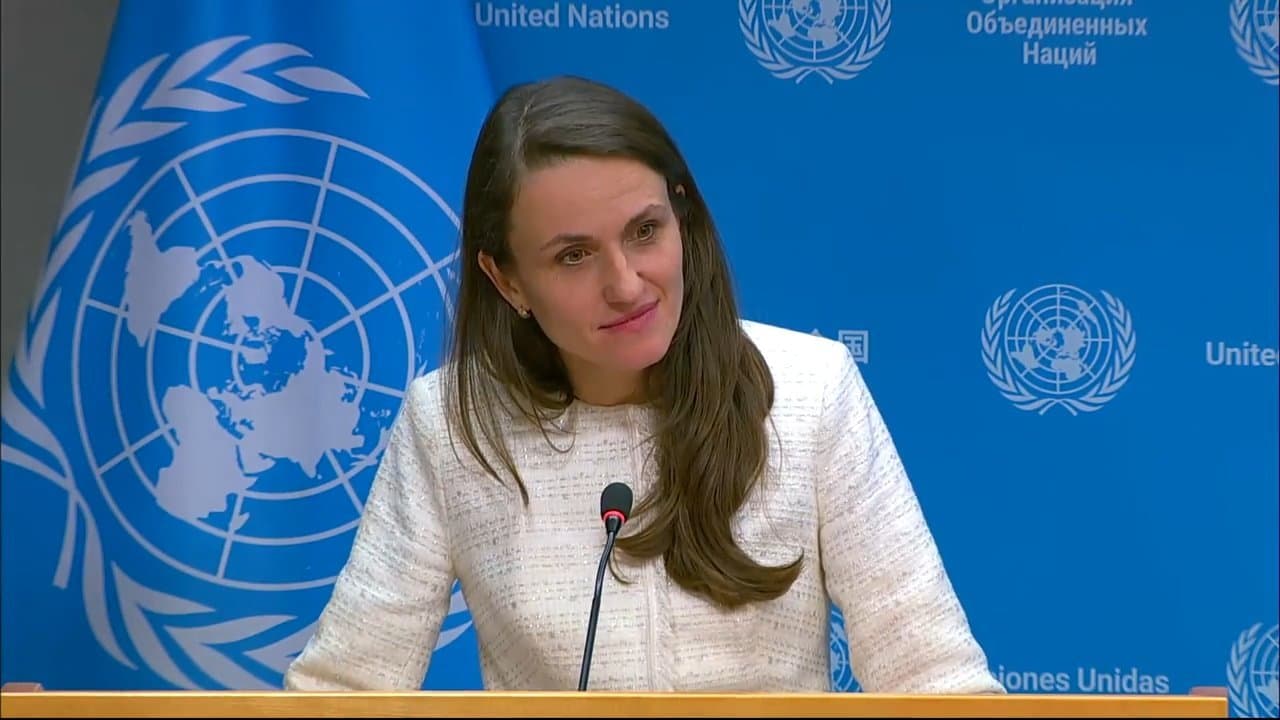
Romania's foreign minister used the sidelines of the UN General Assembly to make the case that the Black Sea — now, by Bucharest's account, the deadliest waterway in the world for commercial shipping — demands an immediate moratorium on attacks that threaten food exports. The press conference doubled as a sweeping policy brief, with Minister Oana-Silvia Ţoiu laying out Romania's energy independence roadmap, record NATO defence spending, and new cybersecurity alliances with Ukraine and Moldova.
- Romania proposes a moratorium on Black Sea attacks affecting food exports, calling it a confidence-building step — not a substitute for peace talks
- Black Sea declared "one of the deadliest maritime globally" for merchant ships and seafarers in 2026
- 80% surge in natural gas production expected next year from the Neptune Deep offshore project
- 3.7% of GDP now goes to defence, with plans to hit NATO's 5% target ahead of schedule
- "Odessa Triangle" cybersecurity pact with Ukraine and Moldova announced to counter hybrid threats
- Romania condemns Iran's IRGC and its drone partnership with Russia
Bread Can Never Be Weaponized
Why it matters: The Black Sea is the main corridor for Ukrainian grain reaching import-dependent nations in Africa, the Middle East, and Asia. Russian attacks on ports and maritime infrastructure have turned it into a security crisis that ripples through global food prices.
Where things stand: Minister Ţoiu described the escalating danger bluntly: "Currently, the Black Sea in 2026 is one of the deadliest maritime globally for merchants and seafarers," she said, pointing to Russian strikes on Ukrainian ports and near-miss security incidents along Romania's own Danube border.
Romania, together with Bulgaria, has proposed an EU Maritime Security Hub split between the ports of Constanța and Varna to bolster analytical capacity and first-responder coordination. Romania has already expanded logistics at the Port of Constanța and the Lower Danube under EU Solidarity Lanes, coordinating with Ukraine, Moldova, and the European Commission to keep grain moving.
The centerpiece of the minister's pitch is a proposed moratorium on attacks affecting food exports — framed carefully as a stepping stone, not a solution. "As a confidence-building measure, not as a replacement of the peace negotiations, but rather as a confidence-building measure and the preparation in that direction," Minister Ţoiu said. She added: "Bread can never be weaponized, and access to food is absolutely essential everywhere in the world."
Romania is the EU's top grain exporter, with more than 10 million tonnes on the market. Minister Ţoiu argued that the scope of any ceasefire must go beyond energy infrastructure to cover all critical systems — including food supply chains. She reported high international interest in the moratorium but no confirmed agreement.
"We believe the Black Sea is not just a regional topic; it matters to the world," she said.
What's next: Romania will continue diplomatic conversations with Ukraine and other partners to build support for the moratorium. The EU Maritime Security Hub proposal remains under discussion with Brussels and Sofia.
Romania Bets on Gas, Nuclear, and Solar to Cut Russian Energy Ties
The basics: Romania stopped importing Russian natural gas years ago and is now positioning itself as a net energy exporter to help the EU break its dependence on Moscow.
Why it matters: With the Neptune Deep project in the Black Sea, Romania expects to become a major EU natural gas producer — giving Brussels an alternative to Russian supply at a moment when pipeline politics remain volatile.
Where things stand: "Next year, we're going to have an increase in our volume by 80%," Minister Ţoiu said of Romania's offshore gas production. She added: "Romania has stopped importing natural gas from Russia years ago. That is why we have also supported the United States' call towards the European Union members to stop buying Russian gas."
On nuclear power, Romania plans to build reactors 3 and 4 at Cernavodă with a multinational consortium from Canada, Japan, South Korea, and the United States — extending a 50-year partnership with Canada. Romania also committed €50 million to the Fund of Funds through the Free Seas Initiative for strategic energy investments.
Solar energy, meanwhile, is delivering a quiet revolution. When a nuclear reactor at Cernavodă was taken offline because Danube drought conditions disrupted its cooling system, distributed rooftop solar picked up the slack. "At the peak moment, we have seen those small sources of solar energy collectively insert energy into the grid that was in a higher volume than the nuclear reactor," Minister Ţoiu said — an unplanned stress test that demonstrated the resilience of Romania's fast-growing small-scale solar fleet.
Romania has also accelerated grid interconnections with Ukraine and Moldova, creating mutual backstops during peak demand or emergencies and further reducing the region's exposure to Russian energy leverage.
3.7% of GDP and Climbing: Romania's Defence Push
Why it matters: Romania sits on NATO's eastern flank, directly across from the conflict zone. Its defence trajectory — both spending and industrial capacity — is a bellwether for whether the alliance can credibly deter further Russian aggression.
Where things stand: "On Romania's side, we are allocating, for example, this year 3.7% from the GDP, and we're going to reach our 5% NATO target ahead of time," Minister Ţoiu said, referencing commitments made at the Ankara Summit.
Romania is not just writing checks — it is building an arms industry. Through the EU SAFE financing mechanism, Bucharest is standing up domestic production lines: ammunition with U.S. partners, equipment with German partners, and separate cooperation with France. A strategic partnership agreement between President Nicușa Ordan and President Volodymyr Zelensky has produced a joint program to build drone and anti-drone systems using Romanian know-how. Romania's new naval capabilities come from Türkiye, showcased at Constanța during August naval exercises.
Asked whether the EU could defend itself without the United States, Minister Ţoiu emphasized NATO as Romania's primary security guarantee while supporting EU burden-sharing under the NATO 3.0 framework.
Minor Items
- UNGA opening: Romania reaffirmed support for the UN80 Agenda, the two-state solution for the Israeli-Palestinian conflict, and condemned Russia's war in Ukraine. Romania holds the presidency of the UNDP/UNFPA/UNOPS Executive Board and participated in the Princeton Group on UN reform.
- AI governance: Romania joined the AI Opportunity Statement and the Call for Control Frontier AI Models, seeking to balance economic growth with security.
- Cybersecurity: Minister Ţoiu announced the "Odessa Triangle" — a trilateral cybersecurity partnership with Ukraine and Moldova, revealed at the Munich Security Conference — to counter hybrid threats. Romania also supplies NATO cybersecurity procurement and works with U.S. private-sector tech firms. "We've announced at the Munich Security Conference the trilateral partnership in the Odessa Triangle between Romania, Ukraine, and Moldova on cybersecurity," she said.
- Iran: Romania condemned the IRGC and its drone partnership with Russia. "We are in the European Union, of course, condemning IRGC and also the partnership that exists between Iran and Russia on drone production," Minister Ţoiu said.
- Constanța port expansion: Romania is pursuing national, EU, and multilateral financing — including U.S.-based institutions — to increase storage and transport capacity at Constanța. The port has finalized international partnerships for digitalization and practice exchange. Romania considers Constanța eligible for strategic investment designation in future EU budget negotiations.
- Pakistan mediation: Minister Ţoiu expressed appreciation for Pakistan's mediation role during bilateral conversations with Pakistan's foreign minister.