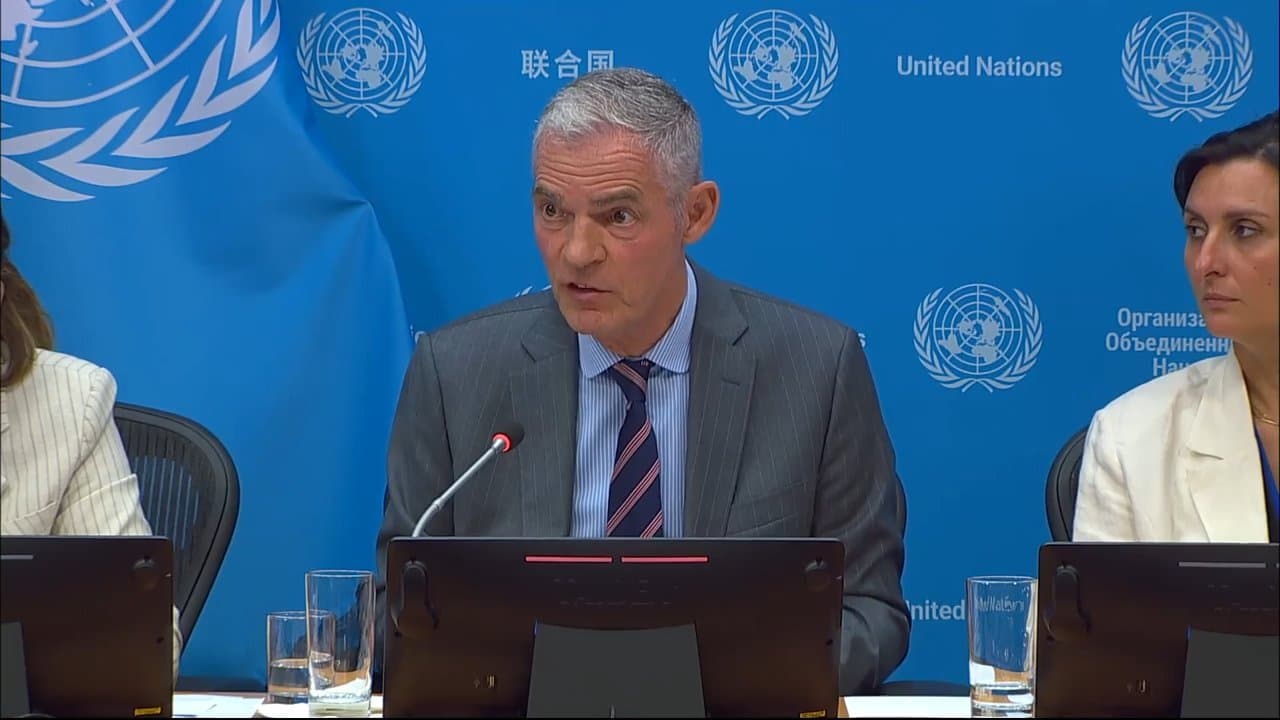
Press Conference: Jérôme Bonnafont, Permanent Representative of France to the UN and President of the Security Council for the month of September 2026 on the programme of work of the Security Council
Press Briefings • United NationsSeptember 1, 2026
Locunity is a independent informational service and is not an official government page for this commission.We use AI-assisted analysis and human editorial review to publish information.
France Sets Packed Security Council Agenda on Ukraine, Gaza, Lebanon and Next UN Chief
France's ambassador to the United Nations used a Sept. 1 press conference to lay out an ambitious September presidency spanning binding votes on Sudan sanctions, Haiti's security force, and Iran's nuclear file — all timed to coincide with the General Assembly's High-Level Week. Ambassador Jérôme Bonnafont signaled France will use the month to press for a Ukraine ceasefire, push accountability on Gaza, negotiate Lebanon's post-UNIFIL future, and advance the selection of the next secretary-general.
France calls for immediate Ukraine ceasefire and security guarantees through the Coalition of the Willing to prevent a repeat of 2014 and 2022
Israel-Palestine dual track outlined: General Assembly support for Palestinian statehood paired with Security Council enforcement of Resolution 2803 on ceasefire, Hamas disarmament, and humanitarian access — while condemning unchecked settler violence
Lebanon's post-UNIFIL architecture takes shape as France, Italy, and the EU negotiate a coalition to support the Lebanese Armed Forces and restore sovereignty
Three binding votes scheduled on Sudan sanctions renewal, Haiti's GSF mandate, and restoration of the Iran 1929 Panel of Experts
Secretary-general selection advances with two straw polls completed and France evaluating candidates on peace leadership, development vision, and management skill
Taliban treatment of women called "entirely unacceptable" ahead of UNAMA debate featuring Afghan civil society
Ukraine: Ceasefire Push and Security Guarantees
Why it matters: France is using its presidency to sustain diplomatic pressure on Russia during the year's highest-profile diplomatic window, signaling that a ceasefire and sovereignty-respecting peace process remain non-negotiable for Paris.
Where things stand: Asked by Valeria Obecker of Ansa Newswire whether France expects a Security Council meeting on Ukraine during the High-Level Week, Ambassador Bonnafont confirmed one is planned and condemned Russian strikes on civilian infrastructure as causing "repeated humanitarian disasters."
Speaking in France's national capacity, Bonnafont called for an immediate ceasefire — a demand he said the secretary-general and the "absolute majority" of Council members share. He stressed that any peace process must respect Ukraine's sovereignty and territorial integrity.
Volodymyr Ichinko of the National News Agency of Ukraine pressed on whether France would promote a draft Security Council resolution calling for an immediate ceasefire. Bonnafont did not confirm a specific draft but said France supports "whatever will allow us to get closer to this goal."
He pointed to the Coalition of the Willing — including a recent virtual heads-of-state session — as the vehicle for security assurances. "The idea is to give Ukraine the assurance that its security will be guaranteed when it enters into durable peace negotiations with Russia, so that in the future what has happened in 2014 and 2022 does not happen again," said Ambassador Bonnafont, Permanent Representative of France.
What's next: A Ukraine-focused Security Council session is expected during the High-Level Week, though no draft resolution has been publicly confirmed.
Israel-Palestine: Two-State Solution, Gaza, and Settler Violence
Why it matters: With a Resolution 2803 implementation review scheduled for later this month, France's public posture signals how it will push for accountability on ceasefire compliance, humanitarian access, and settlement expansion in the West Bank.
Where things stand: Abdul Hamid Sayam of Al-Quds Al-Arabi challenged France directly, citing an investigative report alleging 25 arms shipments to Israel while Paris offered verbal support to Palestinians. Ambassador Bonnafont focused his response on the Security Council's role, recalling the New York Declaration adopted a year prior with 142 votes reaffirming the two-state solution, followed by President Trump's peace plan and Resolution 2803 in November.
He outlined France's dual-track approach: the General Assembly to reaffirm Palestinian statehood rights and Israel's right to security, and the Security Council to address the armed conflict. On Gaza, he reiterated France's insistence on Hamas disarmament, a comprehensive ceasefire, full humanitarian access, and implementation of all provisions of Resolution 2803 leading to peace, rebuilding, and restoring the Palestinian Authority in Gaza.
On the West Bank, Bonnafont was blunt, condemning "the settlers' violence, which is brutally act and not being impeded by the Israeli security forces, and they take land where they have no right to it." He noted these issues would be discussed at the end-of-month Resolution 2803 review.
What's next: The Security Council's scheduled Resolution 2803 review will test whether member states can align on enforcement measures covering ceasefire compliance and settlement activity.
Lebanon: Negotiating Life After UNIFIL
Why it matters: UNIFIL's mandate is expiring, and the outcome will determine whether southern Lebanon is secured by a multinational force, a coalition, or a combination — with direct implications for Hezbollah's disarmament under Resolution 1701.
Where things stand: Adela Massoud of The National asked whether France would join an EU military and civilian mission to train Lebanese forces. Ambassador Bonnafont described recent closed consultations where senior UN officials briefed on the ground situation and outlined several options under discussion: UNIFIL continuation, a new force, or a combination of UN presence plus a France-Italy coalition supporting the Lebanese Armed Forces, potentially joined by an EU mission.
The central principle, Bonnafont said, is Resolution 1701. "This is at the core of our action, to restore the sovereignty of the Lebanese state on their own territory, be it vis-à-vis a foreign presence or an armed militia which needs to be disarmed," he said.
What's next: France is engaging Security Council members, troop-contributing countries, and regional states this month to determine UNIFIL's successor arrangement.
Afghanistan: Spotlighting Women's Rights and UNAMA's Future
Why it matters: Five years after the Taliban takeover, this debate tests whether Security Council members can still align on sanctions and human rights pressure as the mandate for the UN Assistance Mission in Afghanistan comes up for review.
A journalist asked what France hoped to achieve on Afghanistan that hadn't been accomplished in five years. Ambassador Bonnafont acknowledged that the Taliban has not heeded the international community's appeals but said the debate serves a clear purpose.
"Afghanistan is a matter of grave concern for the international community due to the entirely unacceptable regime imposed on women and girls and as a result of the overall situation in the country, which in no way contributes to international peace and security or to development," he said.
The Council will hear from Afghan civil society for on-the-ground perspectives as it decides UNAMA's future.
Iran: Nuclear File, Hormuz, and Repression
The basics: The Security Council is scheduled to vote on restoring the Iran 1929 Panel of Experts mandate, which was revived in September 2025 after Iran's nuclear non-compliance.
Why it matters: France is linking Iran's nuclear, maritime, and human rights records into a single diplomatic pressure point — arguing the nuclear file cannot be considered in isolation.
Ambassador Bonnafont said the nuclear issue is at the heart of September's Iran discussions but added the context cannot be ignored: full freedom of navigation has not been restored in the Strait of Hormuz, adversely affecting developing countries' economies and global food security. He also acknowledged the civilian population's suffering from what he called years of mass repression by Iranian authorities.
Syria: Kurdish Rights and National Reconciliation
Why it matters: Damascus is actively dismantling Kurdish-language education, making France's position on minority rights a live test of international leverage over Syria's post-Assad transition.
Namo Abdullah of Rudaw Media Network highlighted Kurdish protests against the decision to reduce Kurdish from a language of instruction to a taught foreign language. Ambassador Bonnafont acknowledged language as a crucial component of community identity and said France sees a path forward for Syria to treat its population "radically differently."
"The rights of citizens belonging to each and every community are respected. Consequently, for us, what the new Syrian authorities therefore now have to do is through discussion, dialogue, negotiation, through peaceful democratic channels, build this relationship between the Syrian state and Syrian citizens belonging to various groups of Syrian society," he said, referencing Kurds, Alawites, Christians, and Druze.
Next Secretary-General: France Lays Out Three Criteria
Why it matters: Two straw polls have already taken place, and France's criteria signal which candidates may secure its crucial P5 support before the General Assembly vote.
Asked by Aziz Rami of MAP Agency about France's preferences, Ambassador Bonnafont outlined three areas of responsibility: maintaining international peace and security and conflict prevention; overseeing development, human rights, and global affairs; and serving as head of the UN administration capable of guiding reforms and managing financial challenges.
"The Secretary General has an immense responsibility, and it is in the Charter described rather briefly. But in practice, the activity of the Secretary General covers three major axes," Ambassador Bonnafont said. He added that France is in dialogue with candidates, aiming to arrive at a recommendation early enough for the selected person to prepare.
Minor Items
September programme structure: France organized the month into three tracks — decision meetings (Sudan sanctions under Resolution 1591, Haiti GSF renewal, Iran 1929 Panel of Experts), mandated monitoring sessions (Syria chemical weapons, Iran 1737 Sanctions Committee, Arab League dialogue, Sudan peace coordination, MONUSCO, UNAMA), and three thematic debates.
AI in conflict resolution: An interactive dialogue with Latvia on artificial intelligence in conflict resolution is scheduled for Sept. 2.
Sept. 11 counter-terrorism event: A meeting marking 25 years since the New York attacks will focus on counter-terrorism and new technologies.
New UNHCR commissioner: A meeting around Sept. 25 will feature incoming UN High Commissioner for Refugees Bahram Salih.
Multilateralism reaffirmed: Ambassador Bonnafont said the massive participation of heads of state during High-Level Week demonstrates that 193 nations still prefer cooperation to confrontation, even as international institutions face rising skepticism.
French-Mexican veto initiative: France's Foreign Minister Jean-Noël Barrot held a press conference the same day stressing France's commitment to Security Council reform and the French-Mexican initiative on responsible use of the veto.