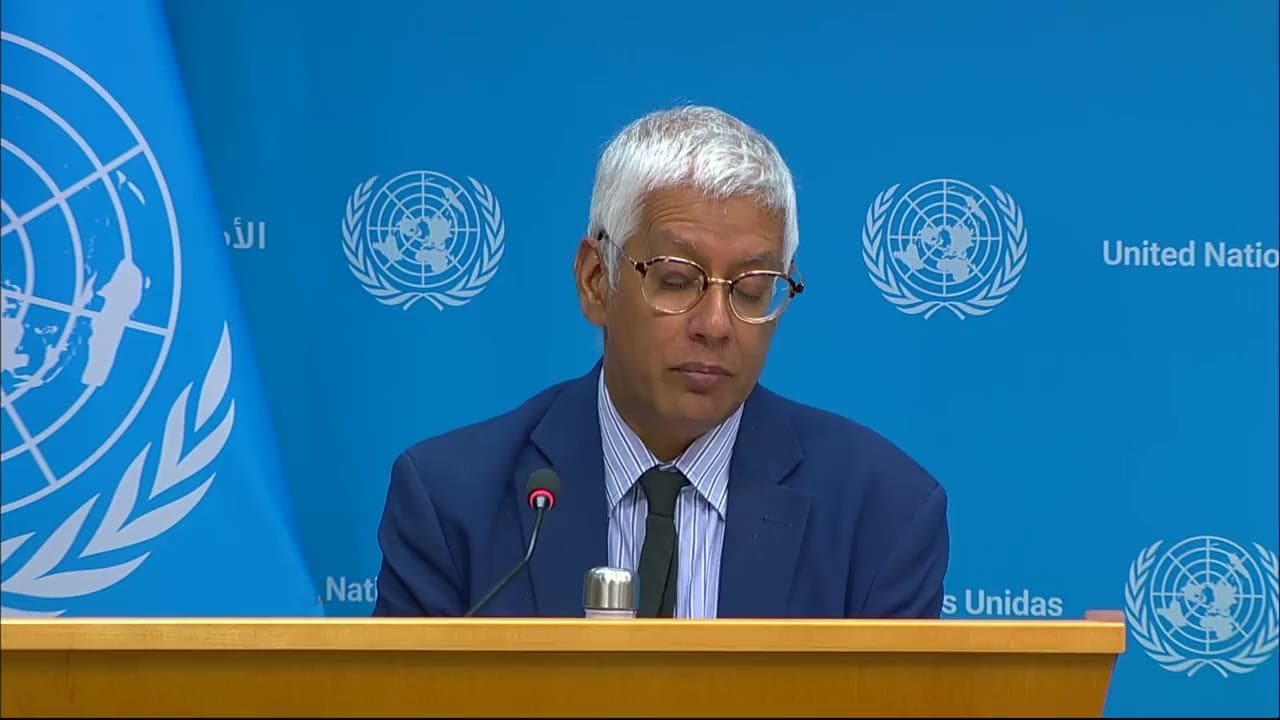
Secretary-General / BRICS Summit, Deputy Secretary-General / Nigeria, Yemen & other topics - Daily Press Briefing
Press Briefings • United NationsSeptember 14, 2026
Locunity is a independent informational service and is not an official government page for this commission.We use AI-assisted analysis and human editorial review to publish information.
SG Pushes for Global Institutional Overhaul as Crises Mount Before UNGA
The United Nations daily briefing painted a picture of a world order under acute strain — from the Secretary-General's demand at the BRICS summit that global institutions be reshaped for a multipolar era, to engine oil blockades choking Gaza's hospitals, explosive jerry cans dropped by drones in Lebanon, and an AI governance vacuum the UN's top human rights official says is already harming democracies. All of it lands days before a high-level General Assembly week that may be further complicated by US visa disputes with Iran.
- Secretary-General calls for Security Council and Bretton Woods overhaul at BRICS summit in New Delhi, holding bilateral meetings with leaders of India, Egypt, Indonesia, and Malaysia
- Over 92,000 liters of engine oil stuck at the border as Israeli approval bottleneck threatens to collapse Gaza's water, health, and sanitation systems
- 125,000 displaced in Yemen in two weeks; humanitarian access suspended along key west coast corridors, with 2,300 refugees now reaching Djibouti
- UNIFIL documents explosive-filled jerry cans, 32 airstrikes, and patrol obstruction in southern Lebanon
- UN Human Rights Chief warns AI is already eroding privacy and democracy; Secretary-General expected to press for global governance framework at upcoming General Assembly
- UN presses Washington on Host Country Agreement after Iranian officials report visa denials ahead of General Assembly high-level week
A Multipolar Demand at the BRICS Table
The basics: The 18th BRICS Summit in New Delhi brought together an expanding bloc of developing and emerging economies. Deputy Spokesperson Farhan Haq used the briefing to relay the Secretary-General's address to the group — and it was pointed.
Why it matters: The Secretary-General chose one of the most politically charged multilateral stages to press his case that the current institutional architecture — the UN Security Council and the Bretton Woods financial system — no longer reflects global reality. The remarks land just days before high-level week at the General Assembly, where reform proposals will face the countries that hold the vetoes.
Where things stand: Haq reported that the Secretary-General told the summit that "the global institutions must be reshaped to reflect today's economic, demographic, and geopolitical realities as the world moves irreversibly towards multipolarity." The message extended to climate, where the SG pressed countries to speed the transition from fossil fuels, scale up financing for developing nations, and stop the extraction of critical minerals without local benefit — adding, in Haq's telling, "enough plundering."
The SG held bilateral meetings with Indian Prime Minister Narendra Modi, Egyptian President Abdel Fattah el-Sisi — where the discussion turned to Gaza, the West Bank, Ukraine, and Palestinian self-determination — as well as Indonesian President Prabowo Subianto, Malaysian Prime Minister Anwar Ibrahim, and the President of the International Solar Alliance, Ashish Khanna.
A journalist from Silkway TV Channel in Kazakhstan, Anor, asked about the SG's view of BRICS' role as a voice for the Global South. Haq affirmed that "BRICS has been a very vital force for multilateral responses to the situations the world has faced."
When a journalist asked whether the SG had sought meetings with the Russian or Chinese presidents at the summit, Haq said only that the SG had held the bilateral meetings described.
What's next: The reform push will carry directly into the General Assembly, where the SG is expected to address AI governance, Security Council expansion, and development financing.
Engine Oil Blockade Threatens Gaza's Last Lifelines
Why it matters: Generators are the backbone of what remains operational in Gaza — water pumps, desalination plants, hospitals, food distribution points, and sewage systems all depend on diesel-powered backup systems. Without engine oil, those systems break down.
Where things stand: Haq laid out stark numbers: "Since March, Israeli authorities have approved the entry into Gaza of some 13,500 liters of engine oil, while more than 92,000 liters are still pending approval." The bottleneck runs through the UN 2720 coordination mechanism, meaning supplies exist but are held at the border.
Military operations continued across all parts of Gaza over the weekend, including airstrikes, shelling, gunfire, and naval fire. UNICEF reported nine children killed in the previous week alone, including two sisters aged 6 and 12. A pregnant mother and her unborn baby were killed by gunfire.
What's next: Without approvals for engine oil and spare parts, the UN warns that safe water access could deteriorate further, sewage systems could fail, and uncollected waste could compound an already dire public health emergency.
Yemen: 125,000 Displaced, Humanitarian Corridors Shut
Why it matters: The scale and speed of displacement in Yemen — 18,000 households uprooted since Sept. 1 — is outpacing an already strained relief operation, and key routes for getting aid in are closed.
Where things stand: Haq reported that "at least 18,000 households, or 125,000 people, have been displaced since the start of the month." The UN Human Rights Office verified 40 civilian casualties — eight killed and 32 injured — with women and children accounting for half of those killed and more than half of those injured. Humanitarian movements into and within several west coast locations remain suspended, and key roads are restricted or impassable.
The crisis is already spilling across borders. Approximately 2,300 people have arrived in the Obok region of Djibouti. UN Resident Coordinator José Barahona visited the area with representatives from UNHCR, IOM, and WFP. Additional resources are urgently needed.
What's next: With access routes blocked and supplies low, the UN is calling for protection of civilians and immediate restoration of humanitarian corridors.
Explosive Jerry Cans and 32 Airstrikes in South Lebanon
Why it matters: UNIFIL's observations describe a pattern of activity that goes well beyond routine military operations — the use of drone-dropped explosive jerry cans near civilian areas, sustained airspace violations, and direct interference with UN patrols.
Where things stand: Haq reported that "of particular concern is the continued use of explosive-filled jerry cans. Between Thursday and Sunday, peacekeepers observed IDF drones dropping jerry cans in the vicinity of Al-Mansouri." At least nine explosions were recorded on Saturday alone. Between Thursday and Sunday, UNIFIL counted at least 32 airstrikes in its area of operations, along with numerous drone and fighter aircraft flights violating Lebanese airspace.
IDF personnel stopped a UNIFIL patrol near Kfar Shuba for two hours on Sunday. UNIFIL also observed IDF patrol boats operating inside Lebanese territorial waters off Nakoura. Despite these conditions, UNIFIL facilitated 16 humanitarian missions through its Liaison Branch in Sector West.
AI Already Harming Rights, UN Warns Ahead of UNGA
The basics: UN High Commissioner for Human Rights Volker Türk issued an open letter warning that AI-related harms — to privacy, essential services, public debate, and democratic institutions — are not hypothetical. They are happening now.
Why it matters: The letter arrives as tech industry leaders have called for a pause on AI development, and as the Secretary-General is expected to make AI governance a centerpiece of the upcoming General Assembly session. The convergence of pressure from both civil society and industry is unusual — and gives the SG a political opening.
Where things stand: A journalist asked whether the SG would support a pause on AI development. Haq did not endorse a pause directly but restated the SG's core position: "The technology that will shape the future of humanity must be shaped by all humanity." He added a sharper warning: "The Secretary-General warns that unchecked, the AI divide will widen every other divide, including in income, opportunity, security, and sovereignty."
The other side: Nathan Guma, a DAG Fellow from Zimbabwe, raised concerns about African governments signing non-tendered deals with international companies on biometrics and electoral processes — specifically citing a company called GVG — and the privacy implications. Haq acknowledged the concern and said the SG wants an equitable system for AI sharing: "We want to bring evidence-based expertise into this discussion so that all member states can be part of the conversation about how the AI technology, which is transformative, can be governed for the benefit of all."
The UN is advancing governance discussions through the Independent International Scientific Panel on AI and the Global Dialogue on AI Governance.
What's next: AI governance is expected to be a focal point at next week's General Assembly session.
UN Presses US on Visa Denials Before General Assembly
Why it matters: The Host Country Agreement requires the United States to grant access to diplomats and heads of state attending the General Assembly. Reported denials test that obligation at a politically sensitive moment.
Where things stand: A journalist reported that Iranian officials said they had not received visas for President Masoudi Pezeshkian and his delegation, and that they had been "denied by Americans." Haq said he had not heard about the situation one way or the other, but was unequivocal on principle: "We want to make sure that the host country fulfills its obligations to allow all those expecting to attend the General Assembly to be able to do so."
Sinan, a journalist, asked whether the SG's office had received visa complaints from other member countries. Haq confirmed that different countries are raising concerns, that the UN receives such requests every year, and that it takes them up with the host country.
What's next: Unresolved visa disputes could prevent heads of state from participating in the General Assembly, testing diplomatic norms ahead of an already high-stakes session.
Minor Items
- Sudan displacement surges: Drone strikes hit fuel stations and critical infrastructure in Blue Nile State, North and West Darfur, and South and North Kordofan. IOM estimated nearly 100,000 people displaced across Blue Nile between January and August — a 66% increase since late May. Thousands have fled to Chad.
- Ukraine weekend strikes: Attacks across Donetsk, Kherson, Mykolaiv, and Odesa damaged hospitals, warehouses, farms, pipelines, and ambulances. Two health workers were injured today in Kherson when their ambulance was hit. Humanitarian organizations provided emergency shelter, meals, and cash registration.
- Deputy Secretary-General in Nigeria: Amina Mohammed visited Ogun and Imo States, meeting World Bank-supported women's program beneficiaries and young innovators developing AI applications, drones, e-commerce platforms, and e-governance tools. She also met former President Olusegun Obasanjo and traveled to Lagos for an Africa Diaspora Leadership Program before heading to South Africa for the Africa Expert Panel.
- IAEA General Conference: The SG delivered a message through Monica Juma, Director-General of the UN Office at Vienna, warning the conference comes at a moment of "profound global turbulence" and highlighting Syria safeguards developments.
- Cluster Munitions Review Conference: The SG addressed the Third Review Conference in Vientiane, Lao PDR, deeply regretting reports that some countries have re-adopted cluster munitions and urging all states to implement their obligations.
- Chad pays UN budget in full, bringing the total of fully paid-up member states to 138.