
India and Liberia Rally 25 Nations to Protect Shipping Lanes From Armed Attacks
Press Briefings • United NationsSeptember 25, 2026
Locunity is an independent informational service and is not an official government page for this commission. All information is sourced from public footage and an analysis of official agendas with the aid of responsible, fact-checked AI. to report an error or omission.
India and Liberia used the United Nations General Assembly stage to launch a new 25-nation coalition aimed at shielding commercial shipping and seafarers from escalating armed attacks in the Red Sea, the Strait of Hormuz, and the Black Sea. The press briefing ended with a sharp, unscripted confrontation over India-Pakistan security allegations.
- India and Liberia co-launch 25-nation Group of Friends to combat attacks on commercial vessels and protect nearly 2 million seafarers worldwide
- Coalition targets armed threats across the Red Sea, Gulf, and Black Sea that endanger $35 trillion in annual global trade
- Liberia's foreign minister declares seafarers "must never be treated as expendable cargo"
- Post-briefing shouting match erupts over allegations of an Indian plot against a Sikh leader in New York
A New Maritime Coalition Takes Shape at the UN
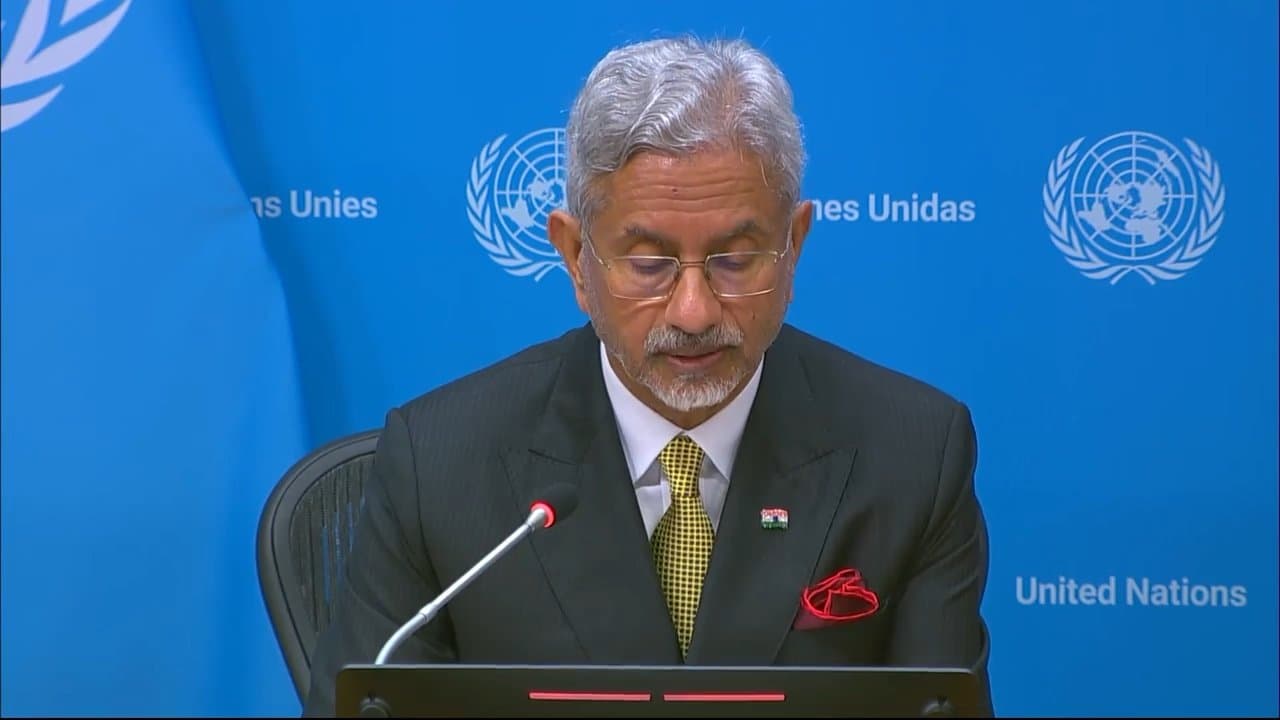
The basics: External Affairs Minister Subrahmanyam Jaishankar of India and Foreign Minister Sara Beysolow Nyanti of Liberia announced the formal launch of the Group of Friends on the Safety and Security of Shipping and Seafarers during a joint press stakeout at the United Nations on Sept. 25. The coalition brings together 25 member states in what both ministers described as an inclusive, voluntary, and action-oriented platform designed to complement existing international frameworks — principally the International Maritime Organization and the International Labor Organization.
Why it matters: Maritime shipping carries roughly 80% of global trade. Minister Jaishankar put a number on the stakes: "Maritime shipping accounts for 4/5 of the global trade, and that trade, I remind you, was $35 trillion last year." Armed attacks on commercial vessels in the Strait of Hormuz, the Red Sea, and the Black Sea have disrupted supply chains for food, fuel, and fertilizer — commodities that affect prices and availability in every country. Nearly 2 million seafarers face the direct consequences.
Where things stand: The pairing of India and Liberia as co-chairs is strategic, not symbolic. India is one of the world's largest source countries for merchant mariners; Liberia hosts the largest shipping registry by tonnage. Minister Jaishankar framed the threat in stark moral terms: "You would all be aware that in recent months the world has seen unacceptable attacks on commercial shipping and merchant mariners. They are legally and morally indefensible."
He detailed the human toll, noting that "recent global developments underline the threats posed to the safety and security of seafarers, including prolonged confinement on board, delayed crew changes and repatriation, separation from families, psychological distress, quite apart from the physical attacks that many of them have been subjected to."
The group's stated objectives center on promoting the exchange of views among member states, sharing experiences, and fostering practical cooperation — without duplicating existing institutional mandates.
Three "Non-Negotiable Imperatives"
Minister Nyanti laid out the coalition's operational pillars in forceful terms. "The Group of Friends unites our nations around 3 non-negotiable imperatives," she said. "First and foremost is safety, demanding uncompromising technical standards, stringent vessel compliance, and coordinating environmental stewardship to prevent loss of life and marine degradation."
The second pillar — security — focuses on defending sea lanes against piracy, armed attacks, and what Nyanti called asymmetric threats. The third addresses seafarer welfare: crew abandonment, fair labor standards, rapid medical assistance, and protection in conflict corridors.
Minister Nyanti delivered the briefing's most pointed line on the human dimension: "Seafarers must never be treated as expendable cargo that can just be dumped over the docks, over the sea, and thrown into unforgetfulness."
She pushed back against any suggestion the coalition is performative. "The Group of Friends is not a symbolic gesture. It's an action-driven multilateral coalition within the framework of the International Maritime Organization and the International Labor Organization," she said. She invoked the backing of Liberian President Joseph Boakai and Commissioner General Neto Lai of the Liberia Maritime Authority.
Minister Nyanti underscored the sheer scale of the economic system at risk: "Over 80% of the goods that power, feed, and heal our world moves by sea. The global economy does not run on abstract figures. It moves on water."
What's next: The 25-nation inaugural meeting signals the coalition's formation, but concrete policy outputs — whether new safety protocols, seafarer welfare standards, or coordinated naval arrangements — remain to be defined. Future work will operate within IMO and ILO frameworks, and the group's ability to translate diplomatic alignment into operational changes in some of the world's most contested waterways will be the real test.
Confrontation Erupts Over India-Pakistan Allegations
As the formal briefing concluded and ministers moved to leave, an unidentified individual shouted accusations that India was involved in an attempt on Sikh leader Gurbaksh Singh Panu's life in New York and demanded to know when the Indian government would stop sponsoring such actions.
Minister Jaishankar responded sharply: "A terrorist country is asking me that question?"
A journalist then alleged that Pakistan had presented documents to the United Nations claiming Indian government sponsorship of the Taliban in Afghanistan and Indian involvement in killing civilians in Pakistan. The moderator attempted to intervene as other unidentified voices interjected.
The exchange — lasting under 30 seconds — underscored the persistent India-Pakistan tensions that surface at multilateral gatherings, particularly during UN General Assembly week. No substantive response to the specific allegations was offered by either side during the confrontation.