
---
Press Briefings • United NationsSeptember 22, 2026
Locunity is an independent informational service and is not an official government page for this commission. All information is sourced from public footage and an analysis of official agendas with the aid of responsible, fact-checked AI. to report an error or omission.
World Leaders Arrive at UN General Assembly for High-Level Week Opening
The United Nations General Assembly's annual high-level week kicked off Sept. 22 with heads of state and government streaming into the General Assembly Hall in New York, exchanging greetings and pausing for stakeout interviews with reporters stationed along the arrival route. While no formal decisions were taken during the ceremonial procession, press exchanges outside the hall previewed several diplomatic flashpoints likely to dominate the week's bilateral meetings and side events.
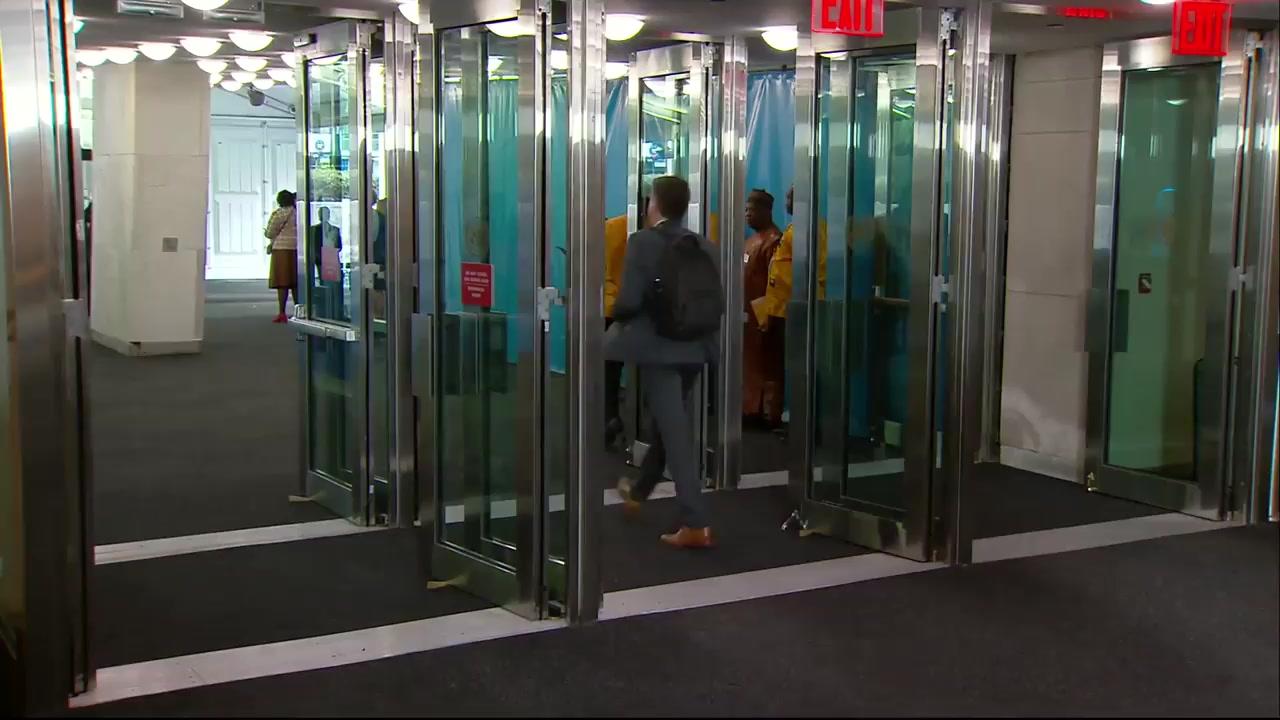
World leaders arrived at the General Assembly Hall in a procession spanning several hours, with delegations greeted by officials and observed by press
Stakeout interviews touched on Iran, antisemitism, Ukraine, Cuba, UN Security Council reform, and narco-terrorism as delegation representatives fielded reporter questions
Defense spending and bilateral cooperation featured in at least one extended press exchange with a delegation leader
⚠️ Transcript Quality Advisory: The source transcript for this broadcast is severely compromised. An automatic speech recognition system configured for Lithuanian was applied to multilingual audio — English, Arabic, Spanish, French, and other languages — producing largely garbled output. As a result, speaker identities could not be confirmed, and direct quotations cannot be reliably rendered. The thematic summaries below are drawn from fragmentary intelligible passages and contextual analysis, but should be treated as provisional. Locunity will update this coverage if corrected transcripts or official UN records become available.
Diplomatic Signals at the Stakeout Mic
Iran, Antisemitism, and the Israeli Delegation
Why it matters: Israel-Iran tensions and debates over antisemitism are central to multiple General Assembly agenda items this week, and stakeout remarks often telegraph negotiating positions before formal sessions begin.
Where things stand: A delegation spokesperson — whose remarks thematically align with the Israeli delegation based on references to Prime Minister Netanyahu, Hamas, and Iran — criticized those who promote antisemitism and expressed deep skepticism toward Iran. The spokesperson called on the international community to be vocal about the Iranian people's desire for a better future and referenced engagement with President Trump on the issue. Due to transcript quality, precise quotes cannot be reliably reproduced.
The spokesperson characterized the General Assembly week as potentially significant, expressing hope for international recognition of their delegation's position.
UN Reform, Venezuela, and Cuba
A second delegation representative — who referenced Secretary of State Marco Rubio and described 18 years of General Assembly attendance — defended their president's speech and called for reform of the UN Security Council, including all five permanent members. The spokesperson also addressed developments in Venezuela and Cuba policy, though the garbled transcript makes precise characterization of those positions unreliable.
Defense Spending and Bilateral Cooperation
A third spokesperson gave an extended interview discussing bilateral defense cooperation, citing a commitment to spend 4% of GDP on defense, alongside energy partnerships and solidarity measures. A reporter's question about potash purchases also drew a response, though details could not be reliably extracted from the transcript.
Democracy and Narco-Terrorism
A fourth spokesperson — who referenced cooperation with the United States and Brazil — discussed democracy, narco-terrorism, and what was described as a 53-day political blockage. The speaker referenced $50 million in campaign spending. Contextual clues suggest a Latin American leader, but identity could not be confirmed.
The Arrival Scene
The hours-long broadcast captured the pageantry of arrival day: security directions, warm greetings between officials, and the visual diplomacy of who walks in with whom. Among the intelligible English-language exchanges, one official told a visiting leader, "Mr. President, it was wonderful to see you again and we love you very much." References to Saudi Arabia's delegation, Romania's president, and Colombia's president were also noted in the broadcast.
What's next: The General Assembly's general debate — where heads of state deliver formal addresses — follows the arrival ceremony. The stakeout themes previewed here — Iran, UN reform, defense commitments, and Latin American governance — are likely to surface in those speeches and in bilateral meetings throughout high-level week.