
Lavrov Blames West for Sabotaging Every Ukraine Peace Deal Since 2014
Press Briefings • United NationsSeptember 26, 2026
Locunity is an independent informational service and is not an official government page for this commission. All information is sourced from public footage and an analysis of official agendas with the aid of responsible, fact-checked AI. to report an error or omission.
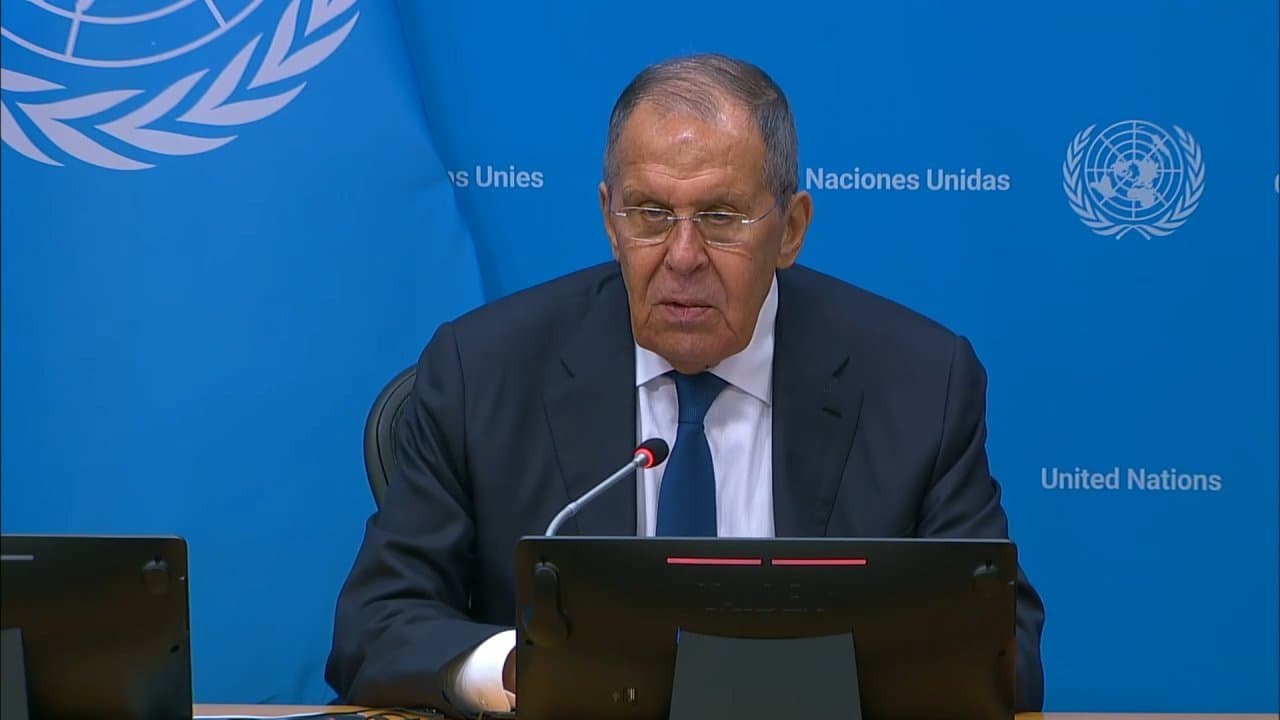
Russian Foreign Minister Sergey Lavrov used a sweeping press conference at the UN General Assembly to present Moscow's case that Western governments and Ukrainian President Zelensky have torpedoed every peace agreement since 2014 — from the Minsk Accords to the Anchorage framework reached with the Trump administration. Fielding roughly 13 questions from an international press corps, Lavrov laid out positions on Palestine, the next UN secretary-general, S-400 missile transfers, Kurdish rights and what he described as contradictory signals from Washington.
- Lavrov traces four failed Ukraine peace deals, blaming Western guarantors and Zelensky for collapse of each
- New West Bank settlements could permanently sever Gaza from the West Bank, Lavrov warns, making a Palestinian state "impossible"
- Russia signals openness to Latin American women candidates for next UN secretary-general but declines to endorse
- New U.S. sanctions on Lukoil and Rosneft undercut Trump diplomacy, Lavrov says
- S-400 transfers from Turkey blocked without Russian consent; Moscow open to approved third-party sales
- Germany's diplomatic outreach dismissed as "utter replica" of daily public statements
- Russia and Belarus launch Eurasian Charter initiative, with expert group meetings planned through 2027
Ukraine: A Catalog of Broken Agreements
The basics: Foreign Minister Sergey Lavrov devoted the largest portion of his press conference — both in his opening statement and across multiple rounds of Q&A — to constructing a detailed historical narrative of the Ukraine conflict, tracing what he described as a pattern of Western betrayal stretching back more than a decade.
Why it matters: With U.S.-brokered negotiations ongoing and European leaders jockeying for a seat at the table, Lavrov's account functions as Russia's pre-negotiation framing: any future deal, Moscow is signaling, must include enforcement mechanisms that prior agreements lacked.
Where things stand: Lavrov walked through four agreements he said were signed or drafted and then abandoned. He started with the February 2014 deal — guaranteed by France, Germany and Poland — that collapsed within hours of its signing. He moved through the Minsk Agreements endorsed by the UN Security Council, the 2019 Paris summit under French President Macron and the March 2022 Istanbul draft terms.
"That's not something that is likely to strengthen trust when you sign something one day and it's completely disregarded the next," said Foreign Minister Lavrov.
On Istanbul, he was more pointed, accusing former British Prime Minister Boris Johnson of personally persuading Zelensky to walk away from a deal. Lavrov said Johnson and other European leaders pushed Ukraine to "fight Russia rather than signing that documents."
The most current friction point: the Anchorage framework negotiated with the Trump administration. Lavrov said Russia accepted the terms Ukraine rejected, and that French President Macron subsequently declared the agreement dead at a European summit. He described ongoing bilateral and trilateral contacts — including in Abu Dhabi — but characterized Western overtures as recycling the same condemnations without offering new substance.
The other side: Valeria Robecco, correspondent for ANSA Newswire, pressed Lavrov on what concrete confidence-building measures Russia would take to move beyond diplomatic positions. "What concrete confidence-building measure Russia is prepared to take now to move from diplomatic positions to actual negotiation?" she asked.
Lavrov responded that Russia had demonstrated trust repeatedly by accepting proposed terms and that the burden now lies with Western partners to honor agreements rather than undermining them.
What's next: Lavrov indicated Russia remains ready to engage but signaled no new concessions are forthcoming. The diplomatic track continues through bilateral contacts with U.S. officials, including Secretary of State Marco Rubio, Special Envoy Keith Kellogg's replacement Stephen Witkoff and Jared Kushner.
Palestine: Settlements Threaten to Kill Two-State Solution
Why it matters: Lavrov used some of his sharpest language of the press conference to warn that Israeli settlement expansion in the West Bank could permanently foreclose the possibility of a Palestinian state — a position that aligns Russia with much of the Global South but puts it at odds with the Trump administration's approach.
Where things stand: Lavrov explained Russia's abstention on Security Council Resolution 2803, which endorsed elements of Trump's peace plan. He said Russia abstained rather than vetoed because Arab states and Palestinians specifically asked Moscow not to block it — but that the resolution was flawed because it contained no mention of the United Nations' role.
"If those settlements were to be established there, then the link between Gaza and the West Bank will be severed, and essentially the Palestinian state would be — there would be nowhere to establish a Palestinian state," Foreign Minister Lavrov said.
He estimated that settlement expansion could reduce Palestinian-controlled territory to roughly 20% of the land envisioned for a future state, severing geographic continuity between Gaza and the West Bank.
The other side: Lavrov acknowledged that Palestinians themselves bear some responsibility for the impasse. He described Moscow-hosted meetings with 11 to 12 Palestinian factions — parallel to Chinese-hosted efforts — that failed to produce unity between Fatah and Hamas. He said Russia stands ready to assist but does not impose initiatives, contrasting this with Western approaches he characterized as producing "loud events" with no follow-through. He referenced the defunct Quartet (U.S., Russia, EU, UN) and its earlier roadmap that called for a Palestinian state within one year — a timeline long since abandoned.
U.S.-Russia Relations: Engagement and Escalation Simultaneously
Why it matters: Lavrov's characterization of the Trump administration as sending contradictory signals — pursuing diplomacy while imposing new economic penalties — offers a window into why the Ukraine talks have stalled despite regular high-level contact.
Where things stand: Lavrov recalled Secretary of State Rubio's February 2025 statement in Riyadh articulating a national-interest-based foreign policy that would recognize other powers' interests. He quoted Rubio as saying "the United States wants their Russian colleagues to understand that under Donald Trump, we are pursuing a policy that is based on our national interests without any ideology whatsoever. And at the same time, we recognize that other states, particularly other superpowers, also have their own national interests."
But Lavrov said the actions have not matched the words: "It is now Trump, not Biden, that is adopting sanctions against Russia, in addition to automatically extending all the sanctions against Russia that were introduced under Biden." He specifically cited new sanctions targeting Lukoil and Rosneft, which he said are designed to push Russia out of global energy markets.
Pamela Falk, journalist for US News and World Report, asked about the G20 Miami summit invitation and travel restrictions on Russian diplomats. Lavrov objected to framing the G20 invitation as a bilateral gesture rather than standard chairmanship protocol and criticized the exclusion of South Africa and the unauthorized invitation of Poland.
Lavrov noted five or six meetings with Rubio plus contacts with Witkoff and Kushner, but said the Ukraine issue remains the primary obstacle. He expressed confidence that "life will teach our U.S. partners to start thinking in terms of multipolarity."
Germany's Outreach Falls Flat
Why it matters: Germany has been anxious about being sidelined in Ukraine negotiations, and its new foreign minister's attempt at re-engagement was publicly and thoroughly rebuffed.
Where things stand: Anna Pömer, correspondent for the German Press Agency, asked about the meeting between Lavrov and Germany's Foreign Minister Wadephul. Lavrov said the meeting was requested at the last minute and offered nothing new.
"He sent a note and read out a text which was a complete replica, utter replica of what Germany, through its leaders officially and publicly, has been stating on a day-to-day basis," Foreign Minister Lavrov said.
He said the subtext was that Germany considered the meeting itself a goodwill gesture and expected Russian concessions on Ukraine and Black Sea navigation in return. Lavrov challenged anyone to name a single case where Russia targeted a commercial vessel in the Black Sea, attributing all such damage to Ukrainian attacks — including strikes on Caspian Pipeline Consortium infrastructure and a Chevron tanker.
Lavrov also took aim at Chancellor Merz's stated ambition to make Germany a "leading military power in Europe again," questioning whether Merz understood the historical weight of the phrase "once again." He noted Germany signed and failed to honor both the 2014 agreement and the Minsk Accords, and questioned Germany's bid for a permanent Security Council seat given that record.
UN Secretary-General Race: Russia Open to Latin American Candidates
Why it matters: As a veto-holding Security Council member, Russia's preferences will determine whether any candidate advances in the final selection rounds expected in coming months.
Where things stand: Lavrov leveled sharp criticism at the current UN Secretariat under António Guterres, arguing it has tilted decisively toward Western interests. He noted that the seven or eight most significant administrative positions are held by nationals of NATO member states.
"If you look at who is occupying the top ranks of the Secretariat, you will see that these 7 or 8 most significant positions when it comes to the functioning of the UN are occupied by citizens or nationals of NATO member states," he said.
Gabriel Elizondo, journalist for Al Jazeera English, asked specifically about the two front-runners — Rebecca Greenspan and Carolyn Rodriguez-Burkett — who have received the most encouraging votes in three Security Council straw polls. Lavrov said there are "worthy candidates" from Latin America who meet Russia's criteria but stopped short of a full endorsement. He outlined what he considers essential qualifications: the next secretary-general must serve as chief administrative officer rather than making unilateral political decisions, maintain impartiality, and represent all of humanity.
When the Interfax journalist asked whether Russia might exercise its veto, Lavrov said no candidate is "completely acceptable" but noted this is normal — full agreement, he quipped, exists only "in the graveyard."
S-400 Systems: No Transfer Without Moscow's Consent
Why it matters: The S-400 question has been a persistent friction point in NATO-Turkey relations and between Moscow and Ankara. Lavrov's comments clarify that Russia retains effective veto over any third-party transfer.
Where things stand: Two journalists — one from a Turkish outlet, one from CNBC Turkey — pressed Lavrov on whether the S-400 systems sold to Turkey could be transferred to a third party, with the UAE mentioned as a potential recipient.
Lavrov confirmed that the original contract includes end-use certificates preventing Turkey from transferring the systems without Russian consent. He said no such request has been received. He said Russia would consider any proposal but only with explicit consent and guarantees that the systems would not leave the destination country, citing instances where Western nations have diverted purchased weapons to Ukraine.
Eurasian Charter: A Continental Alternative Takes Shape
Why it matters: The initiative represents Russia's most concrete institutional step toward building a continental alternative to Western-dominated security architectures.
Where things stand: Lavrov described the launch of work on a Eurasian Charter of Diversity and Multipolarity, jointly initiated with Belarus. Nearly a dozen delegations have expressed willingness to join an open-ended expert working group. The first meeting will be held in Minsk by the end of 2026, with a second planned in Moscow in the first half of 2027.
Lavrov framed Eurasia as the only major continent lacking a pan-continental organization — unlike Africa (African Union) and Latin America (CELAC) — and argued this "omission needs to be addressed." The charter aims to create an architecture of equal, indivisible security and cooperation open to all countries and organizations on the continent.
Kurdish Rights in Syria's New Order
Namo Abdullah, journalist for Rudaw Media Network, asked whether Russia presses for Kurdish rights in the new Syrian constitution now that the Kurdish-led autonomous administration has been dissolved. Lavrov said Russia has "excellent relations with nearly all Kurdish movements," including the Syrian Democratic Forces.
He recounted how the SDF turned to Russia for help when the U.S. withdrew under Trump's first term, then lost interest when American forces returned. He said the SDF "willingly agreed to sign the relevant document" with Damascus's central authorities and denied reports of the Kurdish language being suppressed.
Sinan Tunçdemir, journalist for Amargi, followed up on the 2018 Afrin operation and current SDF-Damascus integration. Lavrov said agreements with Turkey on the northern border and Idlib were not fully implemented but that Turkey remains a generally trustworthy partner. He affirmed that Russia "never severed relations with the Kurds" in Syria, Iraq or Iran.
Minor Items
- European war preparations: Lavrov reiterated President Putin's warning that any war with Europe "would be completely different and it would be short," adding that Russia has "no intention to fight with Europe" but that European nations are preparing for conflict daily.
- Romania's Deveselu missile base: Ana-Maria Pacuraru, journalist for Radlitata TV, asked whether the U.S. missile defense installation at Deveselu remains a Russian military target. Lavrov responded only with "Is that a secret?" — declining to confirm or deny explicitly.
- Bucha investigation: Lavrov challenged the international press corps to conduct independent investigations into the Bucha incident, questioning why no journalistic team has identified the victims by name from official records.