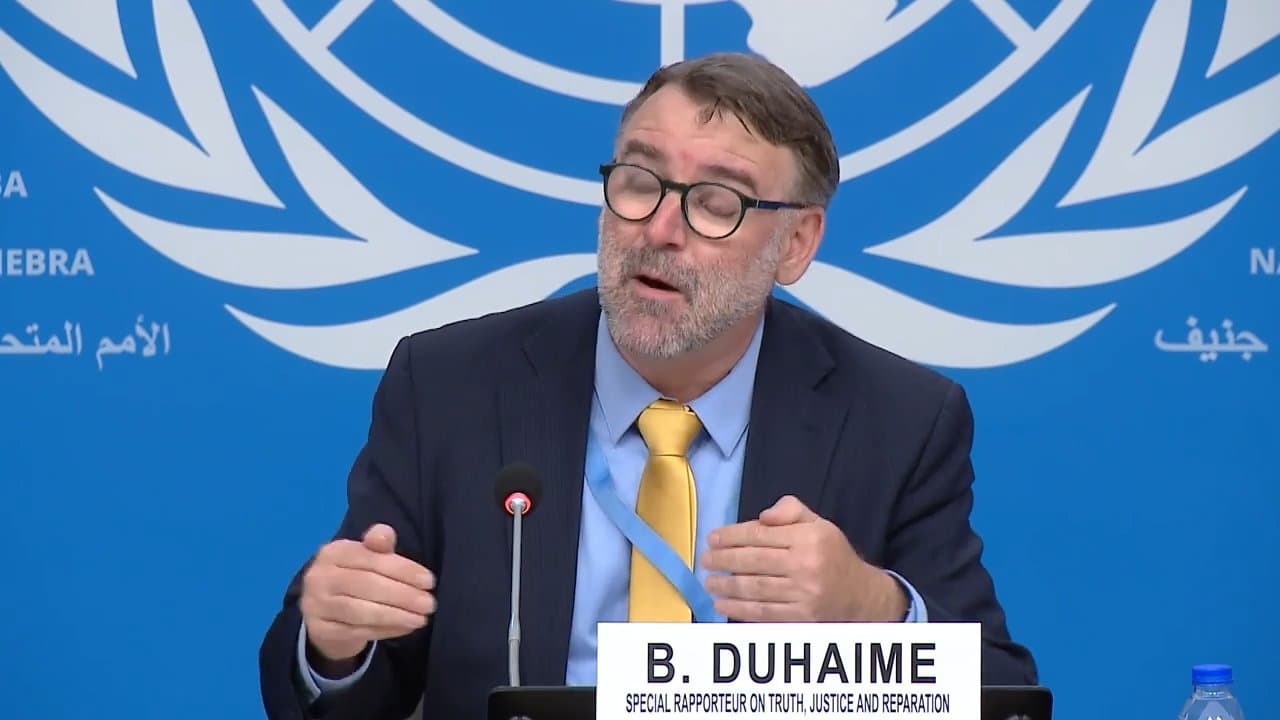
OHCHR - Press conference: A Global Briefing on Transitional Justice Around the World
Press Briefings • United NationsSeptember 17, 2026
Locunity is an independent informational service and is not an official government page for this commission. All information is sourced from public footage and an analysis of official agendas with the aid of responsible, fact-checked AI. to report an error or omission.
UN Expert Sounds Alarm on Global Denialism Wave and Marshall Islands Nuclear Crisis
Special Rapporteur Bernard Duhaime told journalists at the United Nations that a "dangerous wave of denialism" is eroding accountability for past atrocities worldwide — and then delivered a searing account of the unresolved nuclear devastation in the Marshall Islands, where a leaking dome of radioactive waste sits centimeters above rising seas. The briefing, held during the 63rd Session of the Human Rights Council, connected two sprawling crises: politicians rewriting history to serve narrow interests, and a Pacific community still bearing the genetic and environmental costs of Cold War–era nuclear tests the United States has yet to fully reckon with.
- UN rapporteur warns denialism is creating "apathy" toward truth as politicians replace evidence with emotionally charged narratives
- Runit Dome called an "environmental time bomb" — a concrete cap over nuclear waste from 67 US tests is already leaking into the Pacific
- US government has not responded to an October 2025 formal inquiry on nuclear testing reparations and archives
- Serbia condemned for glorifying convicted genocidaire Ratko Mladić with official repatriation ceremonies
- Oct. 1 special session announced at the Human Rights Council on the Marshall Islands nuclear legacy, with affected islanders participating
Denialism Is Winning — and Apathy Is the Price
Why it matters: The Special Rapporteur on the promotion of truth, justice, reparation and guarantees of non-recurrence, Bernard Duhaime, presented findings from his formal report to the Human Rights Council arguing that state-sponsored denial of past atrocities is no longer a fringe phenomenon — it is a political strategy gaining ground worldwide, amplified by social media algorithms and artificial intelligence.
Where things stand: Duhaime told reporters that political discourse has fundamentally shifted away from evidence-based accountability. "I reflected yesterday on a shift from evidence-based accountability in political discourse, which is now replaced with emotionally charged narratives, identity affirmation, and polarization that serve narrow political or ideological interests," said Special Rapporteur Bernard Duhaime.
He described a pattern in which state actors deny documented violations, glorify perpetrators, stigmatize victims and erase collective memory — often under the cover of restrictive memory or national security laws that function as censorship tools imposing a single state-sanctioned narrative.
Rather than legislation that criminalizes speech, Duhaime argued that open societies offer better defenses. "Freedom of expression, cultural rights, education, and access to knowledge are the most effective tools to counter denialism," he said, recommending that states invest in inclusive education, critical thinking, digital literacy and robust memorialization.
The tech dimension: Duhaime singled out technology companies, warning that AI and social media platforms amplify and monetize denialist content. "Technology companies must act with heightened diligence to avoid fueling denialism, disinformation, and hate speech," he said, calling for human rights due diligence across platforms whose business models incentivize engagement with divisive content.
The deeper danger: In his closing remarks, Duhaime warned that denialism's ultimate weapon is not any single false claim but the corrosion of a society's capacity to care about what is true at all. "One of the most vicious effects that this has on the public is that it creates a form of apathy where people don't know what's true and what's false, and in the end care less and less about the truth," he said. His mandate, he emphasized, is to ensure victims' rights to truth resist that trend.
What's next: Duhaime announced that his next report to the UN General Assembly will address new technologies and transitional justice — a natural extension of the denialism findings. He noted that states were "quasi-unanimous" in calling the current report extremely important, a signal that implementation of its recommendations could reshape how governments address historical atrocities and regulate platform content.
A Leaking Nuclear Tomb in the Pacific
The basics: Between 1946 and 1958, the United States conducted 67 nuclear weapons tests on the Bikini and Enewetak atolls in the Marshall Islands, displacing entire populations and causing extensive human and environmental damage that persists nearly eight decades later.
Why it matters: Special Rapporteur Bernard Duhaime traveled to the Marshall Islands for the International Day Against Nuclear Tests and returned with a detailed account of ongoing harm — and of an American government that has not answered his questions about what it intends to do.
Where things stand: Duhaime described how Bikini residents were told by President Lyndon Johnson in 1968 that it was safe to return home. A decade later, in 1978, they were evacuated again after radiation levels proved dangerously high. Today, alarming rates of cancer, thyroid disease and reproductive health problems persist among Marshallese communities, with limited access to early detection.
The most urgent physical threat is the Runit Dome on Enewetak atoll — a concrete cap poured over a bomb crater and filled with nuclear waste from Pacific tests and reportedly also from Nevada. The dome sits just centimeters above sea level and is already leaking contaminated liquid into the surrounding environment. Duhaime did not mince words: he called it an "environmental time bomb," warning that accidents have already struck Europe and Japan, "and soon we will have a catastrophe in the heart of the Pacific Ocean."
Reparations and silence: The 1986 Compact of Free Association between the United States and the Marshall Islands included a financial settlement that effectively barred victims from pursuing future claims. But the compensation fund was grossly insufficient and quickly exhausted — in part because the full scope of harm was impossible to anticipate. Duhaime explained that the genetic damage from radiation exposure is transmitted across generations. "It seems quite clear today that genetic modifications resulting from radiation exposure are transmitted from generation to generation," he said, underscoring why a one-time settlement decades ago cannot constitute adequate reparation.
In October 2025, Duhaime sent formal communications to both the Marshall Islands and US governments asking about measures to ensure truth, justice, reparations, guarantees of non-recurrence and memorialization. "Only the Republic of the Marshall Islands provided a very detailed, very constructive response. I am still awaiting a response from the American government," he said.
He called for the full release of US nuclear testing archives — some of which were transferred to the Marshall Islands in the 1990s but remain partially redacted for security reasons — as essential not only for victims' right to truth but to prevent further psychological harm from uncertainty about what was done and what contamination remains.
What's next: Duhaime announced that on Oct. 1, the Human Rights Council will hold a special session specifically on the Marshall Islands nuclear legacy. Affected islanders will participate directly — a rare opportunity for communities still living with the consequences of Cold War policy to address the international body with authority over human rights norms.
Serbia's Glorification of a Convicted Genocidaire
Why it matters: As a concrete, contemporary illustration of the denialism trends in his report, Duhaime cited Serbia's repatriation of the remains of Ratko Mladić — the Bosnian Serb military commander convicted of genocide, war crimes and crimes against humanity by the International Criminal Tribunal for the former Yugoslavia for his role in the 1995 Srebrenica massacre.
Where things stand: The repatriation was accompanied by official ceremonies presenting Mladić as a national hero. Duhaime described alarming discourse in Serbia and Republika Srpska denying the Srebrenica genocide despite extensive documentation by civil society organizations and binding legal findings by international tribunals. He issued a press release the day before the briefing condemning the glorification.
The episode illustrates the pattern Duhaime outlined in his report: state actors using emotionally charged narratives to rewrite documented history, eroding the accountability frameworks that took decades of international effort to build. For the Western Balkans, the signal is that revisionism is not receding — it is being formalized through state ceremony.
- Duhaime's next General Assembly report will focus on new technologies and transitional justice, complementing the current denialism findings presented to the Human Rights Council.
- Agence France-Presse journalist Agnès Pedrero prompted the extended Marshall Islands discussion by asking for the most striking recent examples of denialism and details on the rapporteur's activities.
- Reuters journalist Emma Fudge was present and had no additional questions.