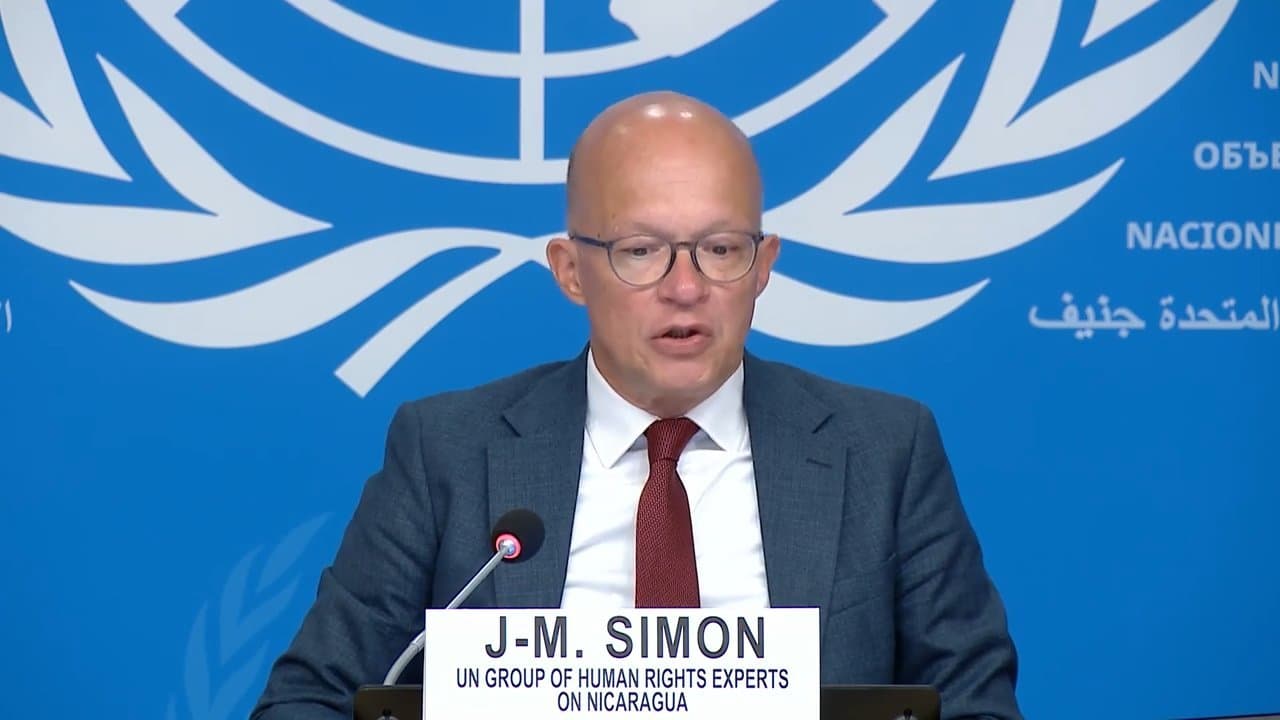
HRC - Press conference: UN Group of Human Rights Experts on Nicaragua
Press Briefings • United NationsSeptember 22, 2026
Locunity is an independent informational service and is not an official government page for this commission. All information is sourced from public footage and an analysis of official agendas with the aid of responsible, fact-checked AI. to report an error or omission.
UN Experts Document 161 Disappearances and 8 Deaths in Nicaraguan Custody
The United Nations Group of Human Rights Experts on Nicaragua presented their latest report to the Human Rights Council on Sept. 22, detailing a state apparatus that has turned enforced disappearance into a deliberate tool of political control — with 29 people still missing and no domestic institution left capable of delivering accountability. The experts challenged the international community directly: the evidence is in; the question is what happens next.
- UN experts verify 161 enforced disappearances since 2018; 29 people remain unaccounted for
- Eight political prisoners died in custody, including Indigenous Miskito leader Brooklyn Rivera and the co-president's own brother
- Experts say democratic governance was already dismantled before Ortega formally ended competitive elections
- Nicaragua has ignored all 22 official letters from the expert group since its mandate began
- Experts call Brooklyn Rivera's death a "wake-up call" for international accountability
Disappearance as a Weapon of State
The report's central finding reframes how the international community should understand Nicaragua's political crisis. Enforced disappearance is no longer a byproduct of crackdowns — it has become the mechanism itself.
The basics: The expert group, mandated by the UN Human Rights Council, has conducted more than 2,000 interviews and produced four reports plus nine additional documents over four years. Their latest findings verified 161 enforced disappearances since 2018, with 29 people still missing. The pattern has evolved: what began as disappearances lasting days or weeks has shifted, particularly since 2023, into vanishings lasting months and even years.
Why it matters: The shift signals a qualitative change in how the Ortega-Murillo government exercises control. People are taken from their homes without warrants. Families are given no information as they search police stations, prisons, and hospitals. The experts found these practices are not the work of rogue officials but reflect centralized coordination among police, the prison system, prosecutors, and courts under the co-presidents' direction.
"The disappearance of people is here no longer merely a consequence of repression, it has become one of its instruments, in particular from 2023 on. And death in custody is its most irreversible consequence," said Chair Jan-Michael Simon, Chair, UN Group of Human Rights Experts on Nicaragua.
Expert Member Reed Brody laid out the mechanics: "Our report today documents 161 cases of enforced disappearances since 2018. 29 of those people remain disappeared today."
Where things stand: Chair Simon noted that the fates of the 29 currently disappeared individuals are entirely unknown. "We cannot say what happened to them, whether they're alive, where they are, or whether they're dead," he said.
The Nicaraguan government has not responded to any of the 22 official letters sent by the expert group since the mandate began, including two sent this year — a posture of complete non-engagement that the experts characterized as reflecting the state's refusal to submit to any form of accountability.
Brooklyn Rivera: A Case That Exposes the System
The report devoted extensive attention to the death of Brooklyn Rivera, the Miskito Indigenous leader who had fought for Indigenous rights on Nicaragua's Caribbean coast for four decades. His case, examined in partnership with Physicians for Human Rights, became the report's most detailed illustration of how the absence of rule of law enables impunity.
The basics: After speaking at the UN Permanent Forum on Indigenous Issues in New York in April 2023, Rivera was banned from returning to Nicaragua. He crossed back anyway and was later seized from his home without a warrant. He vanished for two and a half years. The government eventually released photographs showing him emaciated on a ventilator. He died four days later.
Rivera was buried under police guard in Managua — not among his people, as Miskito tradition requires. Eight relatives who came to claim his body were detained and remain disappeared.
Why it matters: The experts, working with Physicians for Human Rights, examined five government bulletins issued in Rivera's final days and found they contradicted each other on fundamental facts. "Those bulletins contradict each other on the most basic question: how he died," Expert Member Brody said. "In the first most detailed report on his health, there's no mention of COVID. By the time he was dead, it had become the official cause."
The expert group also found the government responsible for the deaths in custody of eight people detained on political grounds, including Rivera and Humberto Ortega — the co-president's own brother.
Expert Member Brody was direct about the structural implications: "What happened to Brooklyn Rivera was possible because there is no one left in Nicaragua who can be asked to account for it. No court, no prosecutor, no independent doctor."
He called Rivera's death a turning point for global attention: "Until Nicaragua has institutions capable of answering for that, accountability will have to come from outside the country. Brooklyn Rivera's death should be a wake-up call for the international community to act."
Democracy Was Already Gone
Two months before this press conference, Daniel Ortega announced the end of competitive elections in Nicaragua — a move that made headlines worldwide. The experts argued the announcement obscured a deeper truth.
Why it matters: Chair Simon framed the real story as one the world had been slow to recognize. "Daniel Ortega announced the end of competitive elections in Nicaragua. That announcement made headlines around the world. But the announcement was not the story. The story was that the foundations of democratic governance had already been dismantled."
Without human rights and fundamental freedoms, the experts argued, elections are meaningless. The group has spent four years building the evidentiary record — more than 2,000 interviews, four major reports, nine additional documents — and Chair Simon said the issue is no longer one of diagnosis.
"The question now is not what we know. The question is what the international community chooses to do with what it knows," he said.
What's next: With Nicaragua having exited the Human Rights Council and refusing all engagement, the burden now falls squarely on international mechanisms — other UN bodies, regional organizations, and individual member states — to determine whether and how to pursue accountability for systematic state repression. The experts' findings are on the record. The response is not.