
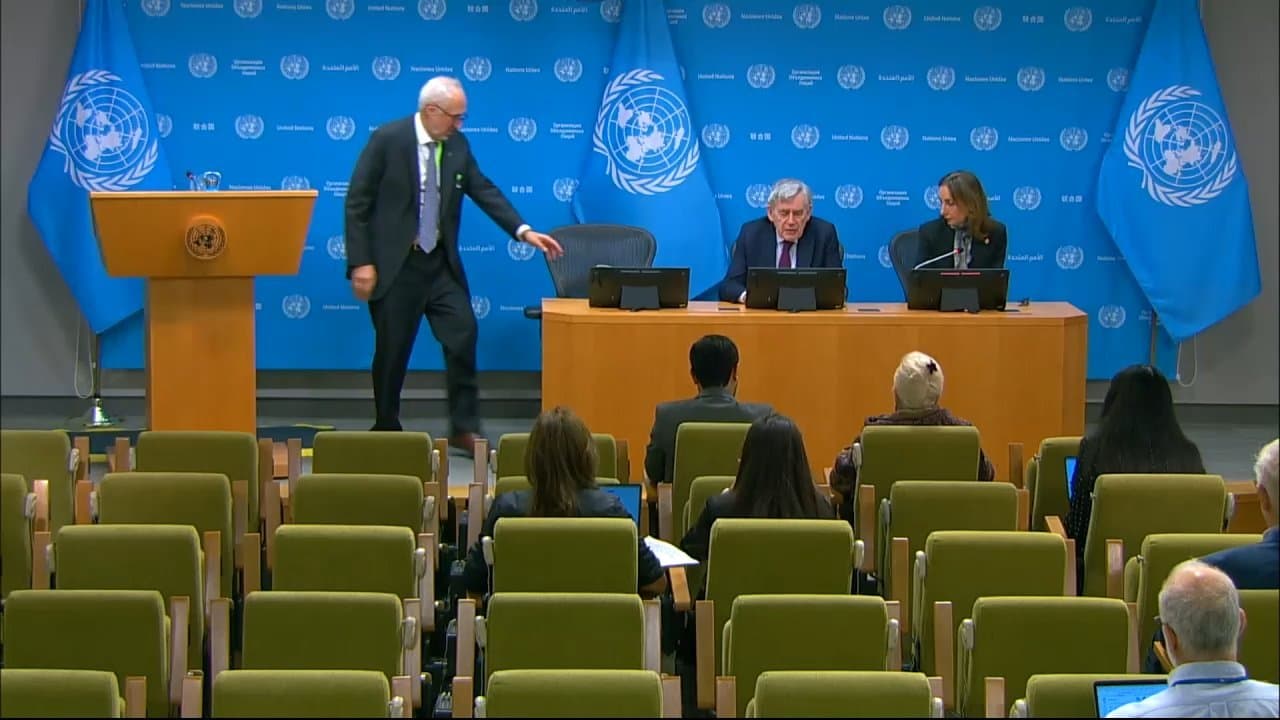
Brown and Jalbout Sound Alarm on 500 Million Children Denied Education
Press Briefings • United NationsSeptember 24, 2026
Locunity is an independent informational service and is not an official government page for this commission. All information is sourced from public footage and an analysis of official agendas with the aid of responsible, fact-checked AI. to report an error or omission.
UN Special Envoy Gordon Brown and Education Cannot Wait Director Maysa Jalbout used a press conference on the sidelines of the UN General Assembly to unveil sweeping new polling data, announce emergency funding for Gaza and Sudan, and issue urgent appeals ahead of two major international pledging conferences — painting a picture of a global education crisis that dwarfs the resources available to address it.
- New global survey finds 5-to-1 majority backs shared responsibility for children's education across borders
- Education Cannot Wait targets $600 million at its Nov. 5 Geneva replenishment conference to reach 10 million crisis-affected children
- ECW commits $3 million in emergency funding for children with conflict-related injuries in Gaza — less than 3% of the estimated $100 million needed
- $22 million deployed for 200,000 children in Sudan, where 8 million remain out of school
- Brown calls Taliban ban on girls' education "the most egregious abuse of girls' rights in any part of the world" and presses Muslim-majority nations to act
- New AI-for-education initiative invites six Global South countries to pilot programs
A Public Mandate, an Empty Checkbook
Why it matters: A massive new global survey provides advocates with what they call a clear public mandate for action — but governments have yet to translate that sentiment into funding, and the gap is widening.
UN Special Envoy for Global Education Gordon Brown presented findings from two surveys commissioned by the Rockefeller Foundation. The primary poll of 35,000 people across 34 countries found that by a 5-to-1 margin, the global public supports shared responsibility for people in other countries.
"By 5 to 1, the global public — that's 64% for and just 12% against — believe we have a shared responsibility to others, even to people in other countries we don't know," said UN Special Envoy Gordon Brown.
By a 3-to-1 margin (57% to 20%), respondents said they want their governments to cooperate internationally on global problems even if it compromises national interests. Sixty-two percent said they trust the United Nations. In the Global South, 88% believe a better future is possible for the next generation — rising to 93% in Africa.
Brown framed the data around a staggering number: 500 million children worldwide denied quality education, comprising 273 million entirely out of school and another 270 million in school but not learning enough.
"This is a lost half billion of children missing out on the basic education we take for granted here," Brown said.
A separate UK-specific poll found 49% of respondents would pay £4 per week to educate a child — a striking willingness to contribute at the household level.
But when Edith Lederer of the Associated Press pressed on whether governments are matching public sentiment with actual spending, the answer was sobering. "You gave these compelling results from the Rockefeller Foundation survey showing how the public feels, but how do governments feel, and are they ponying up money?" Lederer asked, noting broader shortfalls across the entire humanitarian aid system.
The question underscored the central tension of the briefing: overwhelming public support exists for educating the world's children, but the money has not followed.
$600 Million Target, Enormous Gaps
Why it matters: Education Cannot Wait's November replenishment conference is the best near-term vehicle for closing the funding gap for 258 million crisis-affected children worldwide — but the scale of need far exceeds what is on the table.
ECW Director Maysa Jalbout outlined the fund's "Hope Starts Here" campaign, seeking $600 million at a Nov. 5 replenishment conference in Geneva. ECW has reached more than 16 million children since its establishment, but the landscape has only worsened: 258 million school-aged children are affected by crises, and 93 million of those are entirely out of school.
"We released a report in June called the Global Estimates Report that shows that 80% of the out-of-school children in crisis-affected countries live in just 20 countries," Jalbout said.
Where things stand: ECW announced several immediate commitments:
- $3 million in emergency funding for Gaza, targeting children with conflict-related injuries and disabilities, to reach up to 13,000 children
- $22 million for Sudan, deployed through Save the Children and local partners in Gedaref, West Darfur, and South Kordofan, to reach 200,000 children
- $1 million for Nepal after late-August floods and landslides damaged or destroyed 29 schools in a Himalayan valley
Jalbout emphasized that the Gaza funding will be delivered exclusively through local organizations. "They are there now and they will be there for the long term," she said.
Yet the Global Education Cluster estimates Gaza's full education emergency requirement at upward of $100 million — making the $3 million announcement less than 3% of the identified need.
Gaza: 660,000 Children Out of School for a Third Year
Why it matters: Gaza now has the highest per-capita child amputee rate in the world, 97% of schools have been disrupted, and 660,000 children have been out of school for a third consecutive year. The $3 million in new funding is seed money against a crisis that dwarfs available resources.
Brown described visiting pop-up preschool centers created by Their World (supported by the El-Erian Foundation) working with UNICEF, currently serving 1,000 children under 5 in Gaza — roughly 70,000 of the youngest children lack any preschool access.
"I'm haunted by the fact that I was there and there was maybe 30 or 40 children inside the tent, but there was hundreds of children standing outside looking in on something they could not get," Brown said.
The other side: Journalists pushed hard on logistics. Mona of Al-Quds al-Arabi pressed on how prosthetics and wheelchairs will bypass border blockages preventing aid from reaching injured children.
"We know that critical items like wheelchairs and prosthetics are still facing severe blockages at the border. How specifically will these funds bypass those blockages to physically reach the children?" Mona asked.
Jalbout acknowledged the challenge, saying ECW is working with local organizations to find solutions within Gaza. She argued the broader point is that teachers are already at work without waiting for the international community.
"Their teachers in Gaza are teaching on top of rubble, in Sudan inside tents, in Afghanistan in basements. What we need to do is to make sure that the international funding, the little that we do have, meets them where they are," Jalbout said.
Mustafa Abusnene of Arab News also pressed on the funding gap. Brown responded by urging that education must be part of any humanitarian response, not an afterthought.
Sudan: 8 Million Out of School, a Story of Resilience
Why it matters: Sudan accounts for 8 million children out of school — one of the largest single-country education crises in the world — and ECW's $22 million multi-year program represents one of its largest investments in a single country.
Jalbout announced the $22 million commitment, made Aug. 24, for a multi-year program delivered through Save the Children and local partners in Gedaref, West Darfur, and South Kordofan. ECW also supports Sudanese refugees in neighboring countries.
"There are 8 million children out of school in Sudan alone. Education Cannot Wait is fully committed to supporting children in Sudan," Jalbout said. "But the need is far, far greater."
Jalbout shared a personal account from a recent visit to a Sudanese school — a grade-6 classroom of 120 children in 44-degree (Celsius) heat with no electricity or water. There she met an 18-year-old girl who had been displaced for three years, forced into marriage, lost most of her family, and returned to school determined to finish her education.
"She came up to me to tell me that the war had displaced her for the last 3 years. In that time, she had to enter a forced marriage. She has a child. She lost most of her family, but she had come back to school to grade 6 because she was determined to finish her education," Jalbout said.
"In places like Gaza and Sudan, education saves lives," Jalbout added. "Our message to the humanitarian community is that we want to see them step up their efforts in making sure that education is part of the humanitarian response."
Brown Turns Up Pressure on Taliban Over Girls' Education
Why it matters: Despite international condemnation, the Taliban has expanded restrictions on girls, including new laws described as justifying forced marriage, while a growing number of governments are normalizing diplomatic relations — raising the question of whether the international community is accepting the status quo.
John Metzler of worldtribune.com challenged the panel directly: "What about the tyranny of bad government, namely Taliban in Afghanistan, where there's a state policy of keeping women and girls out of school? What can one do about that?"
Brown responded with some of his most forceful language of the briefing.
"This is the most egregious abuse of girls' rights in any part of the world, and it's continuing and in fact getting worse unless we can step up the pressure against the regime," Brown said.
He noted that underground, internet, and "secret" schools exist inside Afghanistan but need support. He expressed disappointment that governments that once condemned the Taliban are now accepting the situation.
"My disappointment is that countries who originally would want to condemn the Taliban regime may now be accepting a fait accompli rather than acting against it," Brown said.
Brown called specifically on Muslim-majority countries to use their religious and cultural influence with the Kandahari clerics driving the ban, noting that the policy is "completely against the tenets of Islam as expressed in the Koran."
Efraim Kousaifi of Arab News Daily pressed further, noting that every Muslim country has already distanced itself from the Taliban. Brown replied that more can be done — through delegations to Kandahar and Kabul, and by countries coming together as a group.
"I also want any government — and there are a number of governments talking to the Taliban — to put this on the agenda rather than allowing it to be forgotten," Brown said.
AI for Education: Six Countries Invited to Pilot
Brown announced a new initiative inviting the first six countries in the Global South to participate in a program applying artificial intelligence to education. The initiative, developed through collaboration among educational organizations during UN General Assembly week, would use AI to enable personalized learning, monitor student progress, and provide access to curricula and library materials even in remote areas.
Brown warned that without deliberate intervention, the digital divide will widen. "Inequality will only grow if we cannot make advantages that are now available to some available to all," he said.
- Nepal emergency funding: ECW committed $1 million after late-August floods and landslides in a Himalayan valley damaged or destroyed 29 schools.
- Early learning summit: Brown called for $1 billion to be pledged at a June 2 high-level international summit in London, noting that only 1% of education aid and 2% of education budgets go to children under 5.
- Pop-up preschool centers: Their World, supported by the El-Erian Foundation and working with UNICEF, is operating centers in Gaza currently serving 1,000 children under 5.