
Pleasanton Asset Study Shifts Infrastructure Debate to Risk-Based Spending
City Council • PleasantonOctober 6, 2026
Locunity is an independent informational service and is not an official government page for this commission. All information is sourced from public footage and an analysis of official agendas with the aid of responsible, fact-checked AI. to report an error or omission.
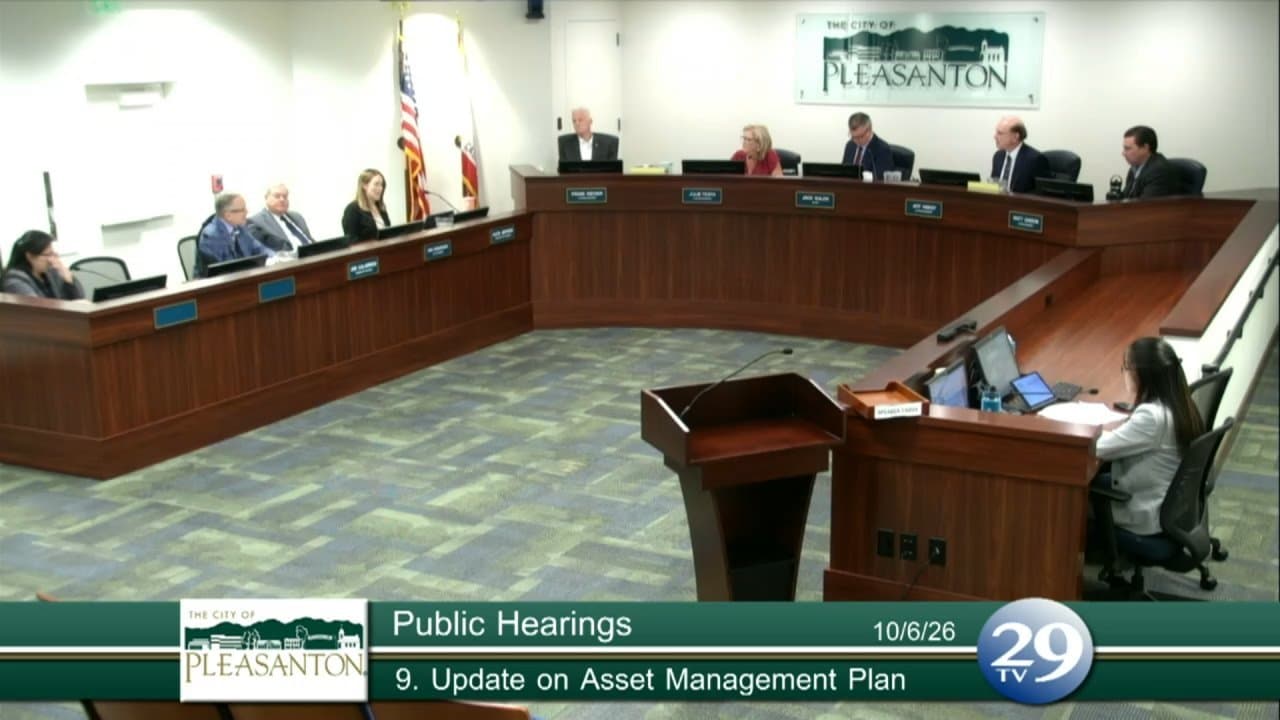
Pleasanton's infrastructure is in better shape than many feared. A new inventory of 206,000 city assets found only $28M in poor or failing condition. At its Oct. 6, 2026 meeting, the City Council heard that the data could move the conversation away from a $900M funding gap and toward targeted, risk-ranked spending. Staff will bring back a recommended capital program in March. Council also heard an early warning on wet-season readiness, with forecasters giving a historic El Niño a 69% chance.
- Asset inventory values city holdings at $4.8B, with $124M rated high risk and a recommended CIP due in March
- Emergency readiness ramps up with a new preparedness committee, 80% of staff trained and sandbags ready ahead of a possible El Niño
- Public Works carries about 19 vacancies of 132 positions, and the city says contractors are standing by
- Council backs a staff-led workshop on downtown commercial vacancies instead of a stand-alone policy push
Asset Data Reframes the Infrastructure Gap
Why it matters: Pleasanton's next capital budget will decide which pipes, facilities and fields get fixed first. The new data gives the city a way to rank those needs by risk rather than by a single headline gap. The Capital Improvement Program, or CIP, is the multiyear list of construction and repair projects. The FY27-32 version must be adopted before the July 1, 2027 budget deadline.
Where things stand: Public Works Director Sue Chin Young presented an update on the asset management plan (CIP 24460) and a streamlined CIP strategy.
- The city tracks 206,000 assets worth an estimated $4.8B.
- Of that total, $3.4B is non-enterprise, meaning outside self-funded utility operations.
- $124M is classified as high risk.
- $28M is in poor or failing condition, roughly 1% of assets.
- Another $80M is rated fair.
- Near-term needs total $14.3M, and midterm needs total $60M.
Funding is still the constraint: The findings do not close the gap. Funding still falls short of needs, so the risk ranking will drive which projects are built first and which wait. Staff's strategy pairs the condition data with a leaner project list. The presentation also referenced Measure BB, the DBAC pool and the Bernal field as part of the capital picture.
The dais reaction: Council members praised the approach and welcomed the finding that the city's infrastructure is generally in good condition. They also noted that funding gaps remain.
Public input: Public commenter Jamie Yee supported the plan. Yee urged the city to build a public project dashboard so residents can track what gets funded and when.
Decisions and stakeholder impacts: This was an informational item, and no vote was taken. The effects show up in March.
- Residents and park users: Neighborhoods near high-risk assets have the most riding on the ranking.
- Departments: Departments competing for capital dollars will now be measured against a common risk yardstick.
- Residents seeking transparency: A dashboard, if adopted, would give residents a way to follow the process.
- Council: Members get firmer footing to explain why some long-requested projects may slip.
What's next: Staff will return in March with a recommended CIP. Adoption is expected before the July 1, 2027 budget deadline.
City Readies for a Possible Historic El Niño
Why it matters: Forecasts show a 69% chance of a historic El Niño event. Flood response falls heavily on Public Works, a department carrying significant vacancies.
Where things stand: Emergency Services Manager Leo Lopez laid out the city's preparedness work:
- A new Pleasanton Emergency Preparedness Committee, known as PEP-C.
- A Ready Pleasanton public outreach campaign.
- Emergency exercises, with about 80% of city staff now trained.
- Rising sign-ups for AC Alert and Nixle, the county and local emergency notification systems.
- Wet-season steps, including sandbag availability.
The presentation also touched on coordination with Zone 7, the regional water agency, along with Genesis Protect and lessons from the Little Fire.
Who gets left out: Councilmember Julie Testa asked how unhoused residents would be reached in an emergency. Staff pointed to police outreach and the city's Alternative Response Unit.
The other side: Public commenter John Bauer pressed on staffing. He asked whether Public Works still has 20 vacancies and what the contingency plan is. Interim City Manager Joe Calabrigo confirmed about 19 vacancies out of 132 positions.
"We have contractors at the ready and available to be able to come in and support our operations," said Calabrigo.
Decisions and stakeholder impacts: No vote was taken.
- Residents in flood-prone areas: Sandbags and alert sign-ups are available now.
- Unhoused residents: Their safety depends on outreach teams reaching them before storms arrive.
- Public Works: Roughly one in seven positions is unfilled. That makes contractor capacity a key backstop if storms hit hard.
What's next: Residents can sign up for AC Alert and Nixle and follow the Ready Pleasanton campaign. The staffing gap is worth watching heading into the rainy season.
Downtown Vacancies Headed to a Workshop
Where things stand: Councilmember Julie Testa asked the council to take up strategies for reducing commercial vacancies, proposing phased incentives. Mayor Jack Balch and Interim City Manager Joe Calabrigo suggested a staff-led workshop instead, including updates from the Economic Vitality Committee. Other members supported that approach.
Why it matters: The workshop could lead to incentives or changes to the Downtown Specific Plan for empty storefronts. Routing the issue to a workshop keeps it in staff's hands rather than producing an immediate policy direction.
What's next: No date was set. Downtown property owners, merchants and the business community should watch for the workshop announcement.
Minor Items
- Consent calendar approved 5-0: Items 1 through 4 passed by roll call, moved by Councilmember Julie Testa and seconded by Councilmember Jeff Nibert. Item 2 makes Workday a city vendor after a competitive evaluation, and Workday's Tom Nolan said the city becomes a customer this week. Items 3 and 4 cover generator and water engineering work, which Mayor Balch said is consistent with city master plans. (For: Balch, Gaidos, Eicher, Nibert, Testa; Against: 0; Absent: 0.)
- Domestic Violence Awareness Month: Councilmember Jeff Nibert read proclamations declaring October 2026 Domestic Violence Awareness Month. They honored Narika, which serves roughly 1,000 survivors a year, and Tri-Valley Haven.
- JustServe commended: Council recognized JustServe for connecting residents, including youth earning service hours, with volunteer opportunities.
- Public comment: Jamie Yee praised Porsches on Main and the city's partnership with the Pleasanton Downtown Association. John Bauer challenged the mayor's campaign claims on the Alternative Response Unit, Measure PP and water rates. The exchange ended with a council apology over how speaking time limits were enforced.
- City manager report: Calabrigo flagged that the water meter replacement project may raise some residents' bills. He also noted that election ballots arrive soon. Council members reported on a Cal Cities vote.
Looking Ahead
The recommended FY27-32 CIP returns in March. The downtown vacancy workshop is pending scheduling. Wet-season preparedness continues as the El Niño forecast develops.