City Council - Mar 02, 2026 - Meeting
City Council • Pleasant HillMarch 2, 2026
Locunity is a independent informational service and is not an official government page for this commission.We use AI-assisted analysis and human editorial review to publish information.
Council Launches Prop 218 Rescue for Cash-Strapped Landscaping Districts
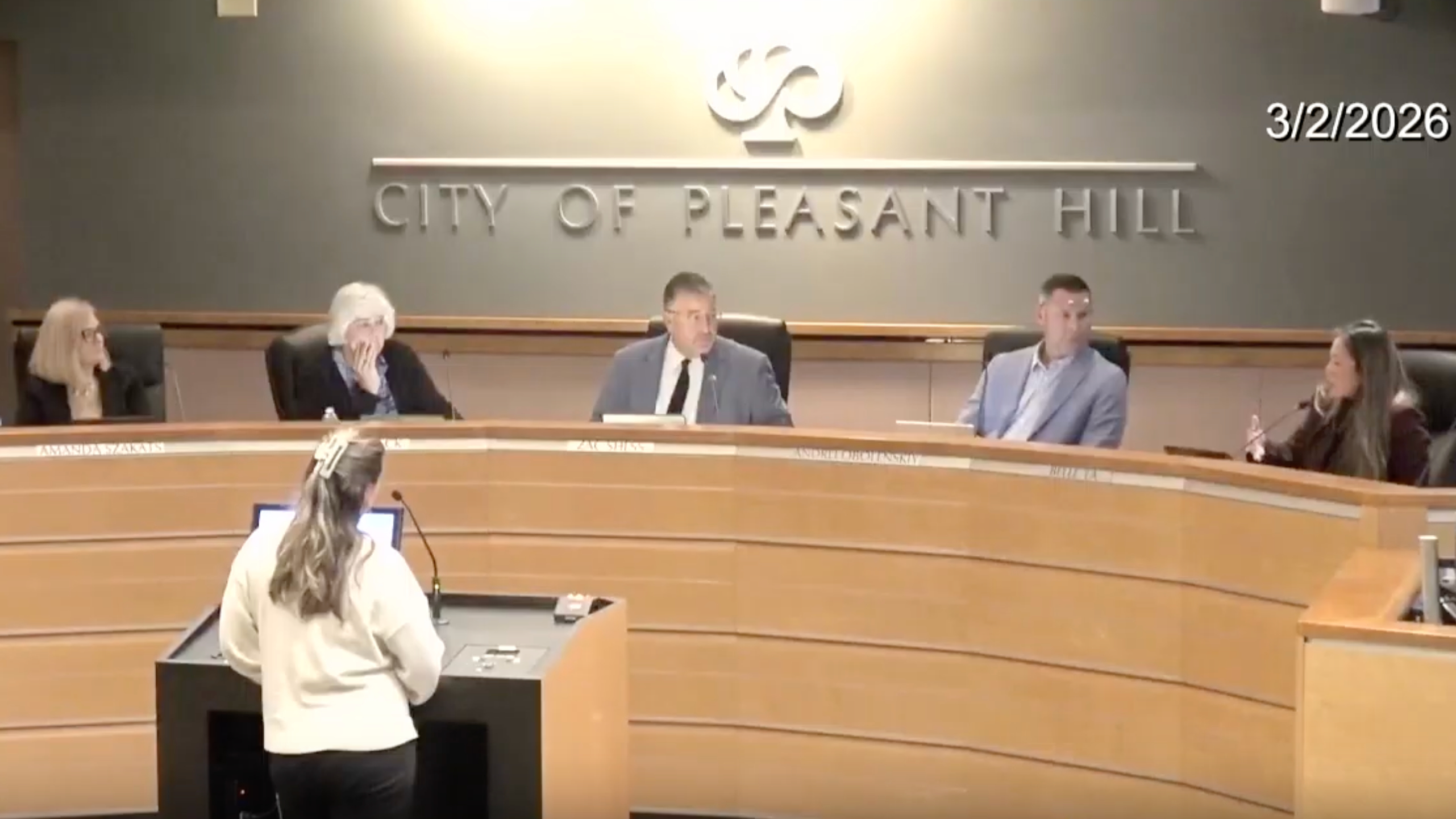
On March 2 the Pleasant Hill City Council unanimously advanced a slate of infrastructure decisions — from rescuing financially underwater assessment districts to closing the books on a years-long boulevard safety overhaul — while signaling growing concern about the city's pace of housing production and an approaching state deadline on stormwater compliance.
Council hires consultant to launch Prop 218 ballots in two assessment districts where most zones are running negative balances and can only fund basic safety maintenance
New ordinance would require commercial property owners to install trash capture devices as the city sits at 87.3% compliance against a 100% state mandate, facing potential $10,000/day fines
$7.98M Contra Costa Blvd safety project accepted as complete, finishing $269K under budget after an eight-year journey from grant application to ribbon-cutting
Housing progress report shows just 307 of 1,496 state-mandated units permitted in two years, with no large development in the pipeline behind the 85 Cleveland project
Metropolitan Transportation Commission (MTC) approves Transit-Oriented Communities policy after two years of negotiation, unlocking $45M in incentive funds for nine Bay Area counties
Underwater Districts, Last-Chance Ballots
The council unanimously approved hiring SCI Consulting Group to prepare engineer's reports and run community outreach for Prop 218 property owner ballots in Assessment Districts (AD) 20 and 22 — two pre-Proposition 218 landscaping and lighting districts that have hit their maximum assessment rates and, in most zones, gone broke.
The basics: Assessment Districts 20 and 22 were formed under the Landscape and Lighting Act of 1972, before Prop 218 required voter approval for assessment increases. Both have reached their rate ceilings. Under Prop 218, each parcel owner gets one ballot, weighted by the assessment amount, with passage requiring more than half of weighted ballots returned during a minimum 45-day noticing period.
Both the AD 20 contract ($81,892) and AD 22 contract ($45,788) will be funded by their respective assessment districts.
Why it matters: In AD 20, zones 1, 2, 3, 5A, and 6 are financially underwater — all but Zone 2 carry negative fund balances. In AD 22, Grayson Woods (maxed at $359) and Gallery Walk (maxed at $234.36) have no room left. Without a rate increase approved by property owners, the city cannot fund routine landscaping and lighting in these neighborhoods.
Where things stand: Ann James, from the city's Public Works department, described it a struggle:
"Right now we are doing just basic safety services in those assessment districts," she said. "Very little new flowers, bark, things like that. It's basic maintenance, light repair, maintenance repair and any tree trimming we have to do if limbs fall and that sort of thing."
A previous Prop 218 vote in 2024-25 succeeded in only two of seven AD 20 zones — Zones 4 and 5B — which now have a three-year escalation schedule. Melanie Lee, Senior Consultant at SCI Consulting Group, outlined the outreach plan: stakeholder interviews, a local input website with FAQs and zone-specific information, and identification of community leaders for non-advocacy outreach. SCI targets a 20-25% voter participation rate.
Vice Mayor Andrei Obolenskiy pressed staff on how SCI identifies stakeholders to interview, particularly in larger zones. Councilmember Belle La asked about impacts to HOA residents and rate proportionality, and whether multilingual materials would be available. Councilmember Amanda Szakats raised a timing concern, wondering if SCI is trying to target the November election.
Staff confirmed balloting would likely begin in January or February 2027 — after the November 2026 election — targeting the July 2027 tax roll. James said the team wants to "nail the public outreach and get as much input as we can to get it right this time."
Decisions: The Council authorized the city manager to execute a professional services agreement with SCI Consulting Group. Two separate votes — one for each AD — passed 5-0 (For: 5, Against: 0, Absent: 0).
What's next: SCI will begin stakeholder interviews and launch its local input website, with the Prop 218 ballot process expected to conclude before the July 2027 tax roll deadline.
One Parking Lot, 10% of the City's Trash Problem
The council introduced an ordinance that would give the city authority to require commercial property owners to install and maintain trash capture devices on their private storm drains — a power it currently lacks.
The basics: The Municipal Regional Permit (MRP 3.0) Provision C10 required 100% trash load reduction by June 30, 2025. The city is currently at 87.3%. Because the city can only condition installation through building or planning permits, property owners who don't apply for those permits have no obligation to act.
Why it matters: A single large commercial area at Contra Costa Boulevard and Chilpancingo, which discharges directly into a flood control channel, accounts for roughly 10% of the city's total trash load. Without the ability to compel action on private parcels, the city cannot close the compliance gap and faces potential $10,000/day cease-and-desist fines from the Regional Water Quality Control Board.
Where things stand: A civil engineer from the city's Engineering Division told the council:
"We can't really wait for any of these parcel owners, especially that one [accounting for about 10% of our total trash load], to apply for a building permit, because our deadline was June of last year."
The most cost-effective solution is an inlet filter — described as working like "a pasta strainer" — costing about $500 per device. The city explored retrofitting public right-of-way infrastructure, but the problem parcel flows exclusively into a flood control channel outside city jurisdiction.
Councilmember Amanda Szakats asked whether grants exist for businesses to cover the cost. Staff said they were not aware of any for private parcels. Enforcement would follow an escalating administrative citation model: $100, then $200, then $500 per day, along with nuisance abatement authority. Szakats also asked about source-control measures to reduce waste before it reaches drains. Councilmember Belle La asked if the city would educate parcel owners about the three devices they could install. Mayor Zac Shess suggested enlisting the Water Board itself for outreach support.
Decisions: The ordinance was introduced on first reading, 5-0 (For: 5, Against: 0, Absent: 0). It will return for adoption at a future meeting.
What's next: A second reading and adoption vote is expected at an upcoming council meeting, after which commercial property owners in noncompliant areas would be subject to the new requirements.
Eight Years Later: Contra Costa Blvd Project Wraps Up Under Budget
The council accepted the Contra Costa Boulevard Improvement Project — spanning Viking Drive to Harriet — as complete, closing the book on an effort that began with a 2017 Contra Costa Transportation Authority (CCTA) grant application.
Why it matters: The $4.8M grant from the CCTA anchored a project that ultimately delivered traffic signal upgrades at CCB/Taylor, a new signal at CCB/Allen Drive, bike and pedestrian safety improvements, ADA upgrades, new median street lighting replacing PG&E poles, landscape enhancements, a recycled water irrigation line down Taylor Boulevard, and stormwater infrastructure.
Where things stand: The construction contract was $7.021M at award with a $745K contingency. Change orders totaled $1.4M, but Ann James, from the city's Public Works department, was quick to put that number in context:
"We had $1.4 million in change orders. And before that number scares you, the 1.2 was for paving because that had not been part of the project."
The project finished at $7.985M against an $8.25M approved budget, leaving $269K — a portion of which staff asked be reallocated to cover $77,954.44 in additional construction management costs from Park Engineering, caused largely by PG&E scheduling delays.
Councilmember Amanda Szakats asked about recovering $34,724 from PG&E for a scheduling error in which PG&E reportedly sent a crew to Pleasanton instead of Pleasant Hill.
Councilmember Belle La commended staff and noted the project was only possible because of the CCTA grant's bike and pedestrian requirements.
Decisions: Passed 5-0 (For: 5, Against: 0, Absent: 0). The council authorized the public works director to issue a notice of completion and approved the $77,954.44 Park Engineering contract increase.
Housing Numbers Raise Questions About Production Pace
Councilmember Amanda Szakats pulled the Housing Element Annual Progress Report from the consent calendar to question whether Pleasant Hill is building fast enough to meet state requirements.
Why it matters: The city has permitted 307 of 1,496 state-mandated housing units through two years of its Housing Element cycle — about 17% of the target. The bulk came from the 85 Cleveland development, with no comparable project in the pipeline.
Where things stand: Staff confirmed the pipeline includes two Cleveland townhome developments (9 and 8 units) likely to receive building permits this year, two Habitat for Humanity projects (7 and 4 units) in planning entitlements, and an 81-unit Choice in Aging project that is entitled but has not broken ground. ADU production has been steady at 18-20 units per year.
Councilmember Belle La requested a separate future discussion on housing policy beyond the annual report, noting $5.8M in housing funds with $700K designated for administrative costs. Councilmember Sue Noack and City Manager Ethan Bindernagel clarified the administrative cost allocation, and staff confirmed a $100K set-aside for slope sites on Paso Nogal and Morello is a Housing Element commitment awaiting a developer application.
Decisions: Approved 5-0 (For: 5, Against: 0, Absent: 0). Any general plan amendments made in 2026 will appear in next year's report.
Minor Items
Pleasant Hill Baseball Association Day proclaimed for March 7, honoring the organization's service to the community since 1958, now engaging 1,900+ youth.
National Red Cross Month proclaimed for March 2026. Matt Smith of the American Red Cross reported 101 disaster responses in Contra Costa County last year and asked the community to help identify a new shelter site in Pleasant Hill, as the current partner church has a scheduling conflict.
Ramadan 2026 recognized with the Diversity Commission; Lloyd Sheen of the commission participated in the presentation.
George West, a Sherman Acres resident, urged the council during public comment to protect individual property owners' right to develop under mixed-use zoning without minimum lot size requirements.
City Manager Ethan Bindernagel highlighted an upcoming Safe Streets Action Plan virtual workshop and a screening of the Counted Out documentary.
Councilmember Noack reported that MTC approved the Transit-Oriented Communities policy after two years of negotiation, with $45M in incentive funds at stake for nine Bay Area counties beginning in 2027.
Councilmember La highlighted Cal Cities bills AB 1708, which would create a pathway for cities under 300,000 population to access state homelessness funding, and AB 2296, aimed at improving the Housing Element review process.
Vice Mayor Obolenskiy reported on a Community Health Foundation grant of $100,000 to Beat the Streets, an Antioch organization serving homeless and foster youth.