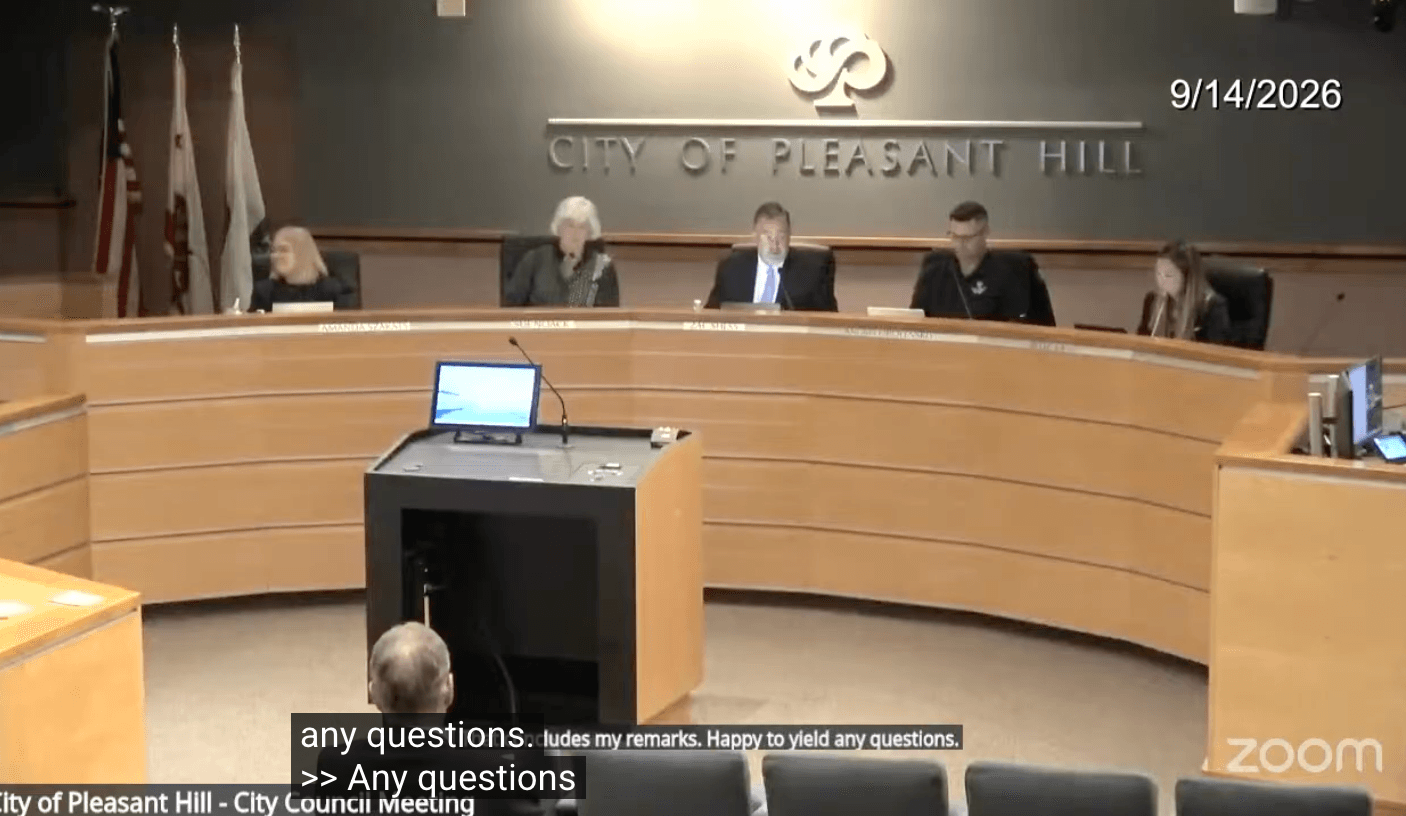
City Council - Sep 14, 2026 - Meeting
City Council • Pleasant HillSeptember 14, 2026
Locunity is a independent informational service and is not an official government page for this commission.We use AI-assisted analysis and human editorial review to publish information.
Council Leans Toward Sales Tax to Close Growing $5M Budget Gap
Pleasant Hill's City Council got its clearest look yet at a fiscal reality years in the making: pension and insurance costs are eating the budget alive, a dozen staff positions have been frozen or eliminated, and without new revenue, the math only gets worse. In a wide-ranging workshop, most council members signaled support for putting a half-cent sales tax on a future ballot — a move that would be the city's first new tax since Measure K passed in 2016.
- Council workshops five revenue options to close a deficit projected to exceed $5 million by FY2930
- Half-cent sales tax emerges as the front-runner, potentially generating $5.5M annually
- Pension costs up 26% over the past decade; city down to 113 active employees from 141 in 2013
- Public commenters push back on rezoning and warn the council against raising taxes
- Measure K library debt payoff in 2032 could free $2.5M per year — but only for infrastructure
The Revenue Crossroads
Pleasant Hill is deficit-spending $1.5 million this fiscal year. By FY2930, that gap is projected to widen past $5 million — driven almost entirely by two line items the council cannot easily control.
The basics: CalPERS unfunded actuarial liability payments have climbed roughly 26% over the past decade to more than $5.5 million, and insurance costs have jumped about 27% to $1.5 million. Meanwhile, the city has shrunk from 141 full-time employees in 2013 to approximately 113 active positions today, with seven frozen slots worth $1.1 million sitting empty.
Why it matters: The city has already cut to the bone. Restoring those frozen positions — many of them in departments residents rely on — would cost another $1.1 million the budget doesn't have. Without new revenue, further service reductions are on the table.
Where things stand: Chief Financial Officer Eric Chung laid out five options in a detailed workshop presentation. A half-cent sales tax would generate roughly $5.5 million per year and require either a simple majority (general tax) or two-thirds vote (special tax). A parcel tax at $100 to $500 per parcel would bring in $1.1 million to $5.4 million but faces a steeper two-thirds threshold. A property transfer tax would first require voters to convert Pleasant Hill into a charter city — a heavier political lift. Two hotel-related options rounded out the menu: raising the existing transient occupancy tax on hotels, or extending it to short-term vacation rentals like Airbnb and VRBO, which could be done by council action alone without a ballot measure.
"Fiscal 2526 that just ended, the projected was about 1.9 million. As of today that number is about negative 1.5," said CFO Chung. "We're still in the red for fiscal year 2526 as of today."
He also flagged a significant wildcard: AB 1383, a pension reform bill currently on the governor's desk, which CalPERS estimates would cost $4.8 billion statewide. "4.2 of that is due to that increase in the pension cap," Chung said — a figure that could push Pleasant Hill's pension obligations even higher.
Exiting CalPERS entirely is not a realistic option. Chung noted the buyout cost would be "somewhere between 85 to $150 million, assuming we had the money to write the check."
Sales Tax Takes the Lead
Council members landed in rough alignment: a half-cent sales tax appears to be the most viable path.
"We have to make some decisions on either revenue generation or cutting expenses. That's pretty much where we're at at this point," said Vice Mayor Andrei Obolenskiy, who noted neighboring cities carry comparable sales tax rates.
Councilmember Amanda Szakats said she was "leaning towards asking staff to look at the possibility of a sales tax," adding that while a property-based tax might be more equitable, "two-thirds seems like a big hump to reach."
Mayor Zac Shess praised staff for keeping revenue and expenditure growth in lockstep at roughly 4.3–4.4% annually for a decade despite losing headcount. "I think that speaks to the competence of our city staff," he said. On the tax question, he favored the sales tax as the most practical choice and was skeptical of the charter city route, saying "I think people would rather spend a smidge more money than having a bunch of Airbnbs in their backyard."
Measure K: A Future Lifeline — With Strings
Councilmember Sue Noack zeroed in on a timeline most residents may not be tracking: the city's Measure K library bond debt gets paid off in 2032, five years before the tax itself sunsets in 2037. That could free up $2.5 million per year.
"The loan of the library gets paid off in 2032, which gives us five years to the end of Measure K — five years of $2.5 million a year freed up of Measure K dollars that could be used," Noack said. But she stressed the council made a promise to voters that those funds would go to infrastructure, and redirecting them would require public approval. She also emphasized the importance of "minimizing the impact to the public as best as possible."
Noack showed command of pension mechanics, explaining why a CalPERS buyout costs far more than balance-sheet numbers suggest: "They use like a 0% discount or very, very low discount to discount future payments on pensions back to today, when normally they're at 6.75 or 6.8% discount rate."
Parking, Airbnb, and Untapped Revenue
Councilmember Belle La pushed the council to think beyond the five headline options. "For example, parking. We're probably like the only city that doesn't charge for parking at all," she said, also suggesting the city explore venue rental fees at the library.
La pressed on vacation rentals, noting the city may already be losing revenue from unregistered Airbnbs: "If there was that switch, just based on what you've presented here, we could be actually losing out on revenue that we should be receiving."
Szakats asked whether newly opening businesses — Osaka Market, Burlington, Dunkin' Donuts — would improve the revenue picture. Chung indicated the sales tax data is well modeled and new retail would help, but not enough to close the structural gap.
Charter City? Not So Fast
The City Attorney poured cold water on the charter city path, explaining that the legislature has steadily eroded the local-control advantages that once made the designation attractive. "It used to be that there was more local control from being a charter city. Anymore, the legislature has been moving to eliminate that," the attorney said, noting that housing and other laws increasingly apply equally to charter and general-law cities.
Decisions: No vote was taken. This was an informational workshop, and the council directed staff to continue analysis and begin public outreach on revenue options.
What's next: Staff will refine the revenue scenarios and begin community engagement. The council's emerging consensus around a sales tax measure signals likely ballot action in a future election cycle.
Residents Sound Off on Taxes and Rezoning
Two public commenters used the general comment period to preview what could become a contentious ballot fight.
Why it matters: The comments signal organized skepticism about new taxes — and a willingness to link land-use decisions to revenue votes.
Albert Franco was the most pointed. He opposed mixed-use rezoning on East Vivian, warned that he and others would vote no on any new tax if residential properties are replaced with retail, and invoked his support for Proposition 13. He returned during the revenue workshop to reiterate his concerns, recalling past efforts to demolish Gregory Gardens that were stopped by previous council members.
A second commenter, Laurel, questioned the scope and pace of the city's general plan land-use consulting study, particularly regarding East Vivian, and pressed the council on whether the city is moving fast enough given its budget shortfall.
The comments suggest the council's revenue conversation will not happen in a vacuum — land-use politics and tax politics are already merging in residents' minds.
Minor Items
- Consent calendar approved unanimously, 5-0 (For: La, Noack, Obolenskiy, Szakats, Shess; Against: none; Absent: none).
- New commissioners introduced: Renee Croto, a VP at the Alzheimer's Association and parent of two school-age children, joins the Education Commission. Ted Welch, with 40 years in magazine publishing including two decades at AAA/Via Magazine and a volunteer with Mobility Matters, joins the Civic Action Commission.
- Community Service Day announced, with a creek cleanup spanning Chilpancingo and Shadow Wood Park involving multiple agencies. City Manager Ethan Bendernickel also highlighted a Fill the Bus food drive with the Food Bank of Contra Costa and Solano and the Contra Costa County Block Party on Sept. 29.
- Bike Family Fest has grown enough to relocate to Diablo Valley College's overflow lot and is expanding to include Martinez riders. Councilmember Noack praised organizer Kara DeYoung.
- Vice Mayor Obolenskiy announced a town hall with Connect Bay Area to discuss a regional sales tax measure.
- Councilmember La reported formation of a new Kiwanis chapter and intern Bella Fusco's presentation on youth civic engagement at the Civic Action Commission.
- The meeting adjourned in memory of former Council Member Jack Weird, who passed away at 86. Mayor Shess noted that Weird "was a lifelong advocate of fiscal oversight" who "founded the Pleasant Hill Taxpayers Association" and served six years as president of the Contra Costa Taxpayers Association.