
City Council - Jun 01, 2026 - Special Meeting

City Council - Jun 01, 2026 - Special Meeting

City CouncilPittsburgJune 1, 2026

Sources:

Locunity is a independent informational service and is not an official government page for this commission.We use AI-assisted analysis and human editorial review to publish information.

Pittsburg Advances $2M in Cuts, Defers Deeper Deficit Reckoning to Mid-Year

Pittsburg's City Council confronted a $5 million structural deficit that will grow to $7 million next fiscal year, advancing roughly $2 million in spending reductions while giving the city manager six months to propose the harder cuts — including potential layoffs — that would close the rest of the gap. Separately, three residents delivered impassioned public testimony demanding the council reconsider a previously approved data center they say threatens their health, property values, and utility bills.

  • Council advances ~$2M in budget cuts — mostly vacant police positions, part-time hours, and professional services — as the first phase of closing a $5M structural deficit, deferring deeper decisions to mid-year
  • Three residents demand council revisit a data center on Golf Course Road, citing energy costs, noise, health effects, and property value declines
  • 25-year water plan shows adequate supply through 2050; public hearing open through June 15 for adoption to meet state grant deadline
  • Police cadet program relaunched after a decade, introducing seven young recruits to the council
  • Clerk and treasurer pay review delayed to August as council prioritizes budget crisis

The Deficit Math: $5 Million Now, $7 Million Next Year

The basics: Pittsburg's general fund faces a roughly $5 million structural deficit that will balloon to $7 million in FY 2027-28 when a $1 million annual payment from energy company Calpine expires after 30 years and contractual union pay raises kick in.

Why it matters: The gap is not a one-year problem. Without structural changes to how the city operates, Pittsburg will be drawing down reserves and deferring maintenance indefinitely — a path that ends in service cuts residents can feel.

Where things stand: After an initial budget workshop on May 4, the Finance Management Subcommittee — Mayor Dionne Adams and Councilmember Juan Banales — met on May 21 and developed what they called a "hybrid" option: moderate cuts now paired with reserve drawdowns to buy time for strategic restructuring.

The package totals approximately $2 million in reductions across five categories:

  • ~$800,000 in salary and benefit savings — eliminating or defunding vacant police positions, reducing part-time hours in HR, finance, and public works, and trimming overtime budgets
  • ~$665,000 in professional services cuts — including $200,000 earmarked for senior center flooring replacement, elimination of extra library hours, and reductions in economic development consulting (including Restaurant Week marketing contracts)
  • ~$280,000 in operating expense reductions, mostly from community and economic development
  • ~$150,000 reduction in the general fund subsidy to the landscape and lighting district — scaled back from an originally proposed $450,000 cut by deferring a wood chipper purchase, reducing winter graffiti part-time hours, and delaying backfill of a planned retirement
  • ~$1.4 million in reserve adjustments — $1.2 million from the budget stabilization fund (drawn over two years) and $200,000 from Measure M reserves

That still leaves a roughly $1.5 million annual shortfall baked into the budget.

The other side: Councilmember Jelani Killings questioned whether the cuts matched the council's own stated priorities. "We said that economic development, infrastructure are like the high priorities for us, but everything that I see listed here is economic development and public works," he said. He acknowledged the difficult position but was candid about his discomfort: "It doesn't sit comfortably with me. But I understand in terms of the work that's being done and trying to allow this next six months and get into mid year to really address it from a structural standpoint."

Councilmember Banales defended the phased approach, drawing on institutional memory. "I think to start inching towards the 2.5 million, we'd be talking about layoffs from full-time staff," he said, adding that the subcommittee wanted to give the city manager runway for strategic restructuring rather than forcing hasty decisions. He also warned against repeating past mistakes: "So many years ago, when we had to make significant cuts, we ended up cutting a lot in terms of part-time workers from public works and some additional dollars which ended up causing a lot of our parks and medians to kind of come into a state where they were overgrown and there was a lack of service levels."

Vice Mayor Angelica Lopez urged colleagues to consider the ripple effects. "Eliminating North Point overnight park security, would that lead to our crime rates going up? I don't know. So in assessing each and every cut, I want us to assess the impact that it will have in our city," she said. She also pushed back on cutting economic development, arguing it should be used to generate revenue: "Let's not forget economic development is really here to help us increase revenue."

Mayor Adams described the overall strategy as a deliberate "haircut approach versus just shutting things off," noting the subcommittee reviewed crime data before recommending security reductions. She added that staff is auditing finances and rethinking how the city delivers services.

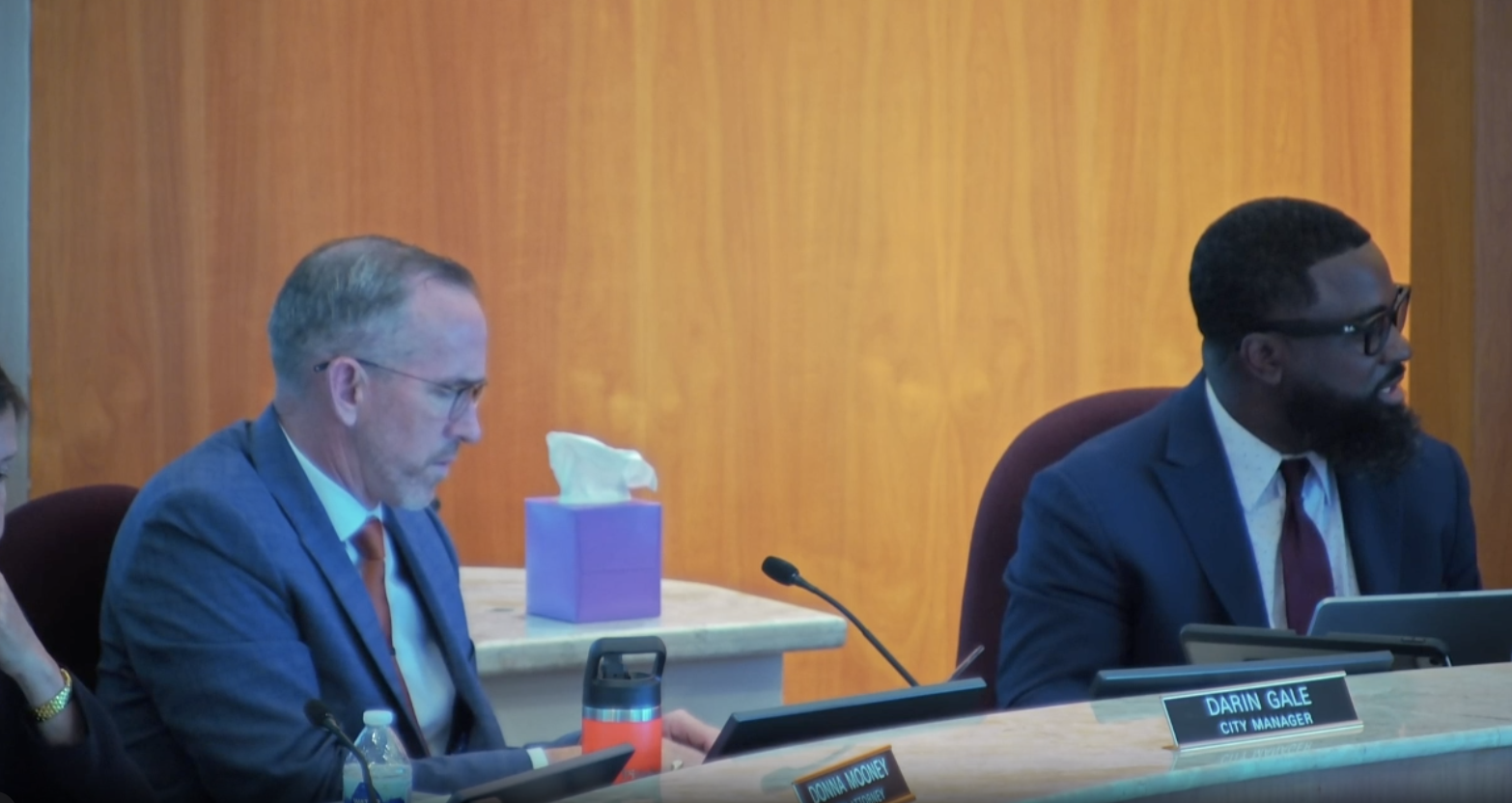
City Manager Darren was direct about what lies ahead. "If we go beyond this, it literally means eliminating positions that are currently filled by employees, and we might have to get there, but I think give us another six months and we'll be able to give you better information," he said. He flagged two potential revenue sources — a Community Facilities District bond sale and refinancing of redevelopment agency bonds — that could narrow the gap at mid-year but are too uncertain to budget now. He also noted the city's landscape and lighting district is subsidized by $1.8 million from the general fund because "residents pay about $100 annually. It's been that number for over 20 years. There's no escalator on it."

After discussion, council directed that the senior center flooring project ($160,000–$200,000, a one-time cost) remain in the budget, with staff tasked to find recurring reductions to offset it. Councilmember Banales specifically requested that swap: "I would like us to try to replace that with recurring cost reductions."

What's next: Staff will finalize the budget for formal adoption on June 15. The remaining $1.5 million gap will be addressed at a mid-year review, when the city manager is expected to present structural recommendations that could include full-time position eliminations. The CFD bond and redevelopment refinancing — if they materialize — could provide some relief.


Residents Sound Alarm on Data Center

Three Pittsburg residents used non-agenda public comment to demand the council formally reconsider a previously approved data center on Golf Course Road — a project they say has already begun causing harm and will only get worse if phases two and three proceed.

Why it matters: Data center opposition is growing nationally as communities confront the energy, water, noise, and land-use impacts of facilities designed to power artificial intelligence and cloud computing. Pittsburg's residents are joining that wave, arguing the evidence of harm has grown substantially since the project was originally approved.

Where things stand: Kristen Ko laid out a multi-pronged case: the facility's energy demand would be equivalent to all homes in Pittsburg, recycled water supplies are finite, noise including infrasound can cause health effects, and utility costs could rise for all residents. She requested a public dashboard, an environmental assessment before phases two and three, and a future council agenda item.

Mark Davey argued the body of evidence about data center harms — property value declines, energy cost increases, fire risk from heat output, and neurological and cardiovascular health effects — has grown since the original approval. He asked the council to reconsider phase one and halt further phases.

Judy Duac, a 45-year resident, made an emotional plea, citing the facility's proximity to homes, schools, parks, and churches. She described constant noise and vibration, generator emissions, and plummeting property values. All three asked the council to place the data center on a future agenda for formal reconsideration.

What's next: The council took no action — public comment on non-agenda items does not allow formal council response under the Brown Act. Whether the data center returns as a future agenda item will depend on whether a councilmember places it on one.


Water Plan Shows Supply Through 2050; Adoption Deadline Looms

The basics: State law requires cities to update their Urban Water Management Plan every five years, documenting supply reliability, conservation progress, and drought contingency measures.

Why it matters: If Pittsburg doesn't adopt the plan by July 1, the state will freeze the city's eligibility for water grants — a serious blow during a period of fiscal austerity.

Where things stand: Public Works Director John Samuelson and consultant Tony Akel of AEL Engineering presented the draft 2025 plan, which shows Pittsburg uses about 10,000 acre-feet of water annually from three sources: raw water purchased from Contra Costa Water District, two groundwater wells, and recycled water from Delta Diablo for park irrigation. Despite 25 years of steady population growth, total water use has remained flat or declined thanks to successful conservation. The city exceeded the state's "20 by 2020" conservation mandate by 2010.

Supply projections through 2050 show adequate capacity during normal years. A Water Shortage Contingency Plan with levels zero through six is in place for drought scenarios.

Councilmember Killings asked why the state keeps pushing conservation when usage has already dropped substantially. "So where we are in 2025 versus where we were in 2000 we're using less water. So I'm trying to grapple with why do we need to continue further," he said. Tony Akel explained that the state's next frontier is indoor water conservation, with smart-meter-based monitoring of indoor versus outdoor use expected in the next five-year cycle: "The policing is going to go to the level of policing how much water is being used at every house, and eventually there will be a meter that measures how much water goes outdoors versus how much water goes indoors."

Mayor Adams asked about consequences for non-adoption. Akel confirmed: "If we don't adopt it, they will withhold any state grants that the city applies for up until the time when it is adopted and submitted."

What's next: The public hearing will remain open through June 15 for formal adoption.


Minor Items

  • Clerk and treasurer pay review delayed to August. Vice Mayor Lopez, who originally requested the review, recommended postponing it given budget pressures, calling it a disservice to pursue when positions might be eliminated. Mayor Adams motioned to authorize staff to research the issue and route it through the finance subcommittee, returning to council only if recommended. Passed 5-0 (For: Adams, Killings, Kobata, Banales, Lopez; Against: none).

  • Consent calendar adopted. Mayor Adams and Councilmember Banales recused themselves from Item 12 due to real property conflicts. The remaining members approved the calendar.

  • Police cadet program relaunched. Sergeant Javon Sanders introduced seven new cadets — the first class in a decade. Cadet Cross spoke about the program's impact on personal growth and community connection. Mayor Adams noted one cadet also serves on the city's youth commission.

  • Alda's Kitchen and Bakery honored. The Filipino- and Hawaiian-inspired restaurant, known for its ube desserts, received the Think Pittsburg proclamation. The LGBTQ-owned business was also recognized during a Pride Month proclamation. The mayor highlighted Alda's participation in Pittsburg's inaugural Restaurant Week.

  • Hybrid council meetings starting in July. City Clerk Alice Evenson announced that under Senate Bill 707 amendments to the Brown Act, council meetings will allow remote public participation via Zoom beginning next month. In-person speakers will be called first, followed by remote participants.

Pittsburg Advances $2M in Cuts, Defers Deeper Deficit Reckoning to Mid-Year | City Council | Locunity