
City Council - Jun 15, 2026 - Meeting
City Council • PittsburgJune 15, 2026
Locunity is a independent informational service and is not an official government page for this commission.We use AI-assisted analysis and human editorial review to publish information.
Packed Chambers Demand Data Center Moratorium as Pittsburg Adopts Budget on Razor's Edge
More than 50 speakers and 107 written cards flooded Pittsburg's council chambers June 15 to oppose the AVO data center already approved on the city's former golf course — a wave of organized resistance that eclipsed every other item on a packed agenda. Against that backdrop, the council adopted a $268M city budget running a $3M structural deficit, a $330M five-year capital plan, and a bond refunding expected to save over $10M.
Over 50 speakers and 107 cards blast AVO data center, demanding a moratorium, citizen oversight and voter approval before any expansion beyond 99 megawatts
City budget adopted with nearly zero cushion — general fund ends the year with roughly $4,000 in available balance after tapping half the budget stabilization reserve
$330M capital plan approved, adding crosswalk safety beacons near six schools and relocating a marina fitness area
Bond refunding set to save $10M by shortening former redevelopment debt from 2036 to 2030
Housing Authority approves $27M budget supporting nearly 1,100 voucher holders including 137 veterans
Death threats disclosed — Vice Mayor Angelica Lopez revealed council members received threats tied to the data center fight
A City Turns Out: Data Center Opposition Dominates
The longest segment of the meeting — stretching well past 11 p.m. and forcing a roll-call vote to extend the session — belonged to residents who packed the chambers to oppose the AVO data center being built on the former golf course site on West Leland Road.
The basics: The project, described by the city as a "technology park," was approved unanimously by all five council members in November 2024 after roughly six to eight years of planning and environmental review. Phase One is approved at 99 megawatts; the full buildout could reach 500 megawatts across three phases. Because the data center was not on the night's agenda, the Brown Act prevented the council from engaging in substantive dialogue — leaving elected officials largely limited to listening.
Why it matters: A petition opposing the project has gathered 12,700 signatures — roughly 15% of Pittsburg's population. Residents said they learned of the project only in recent weeks through social media, and a broad coalition of organizations including Monument Impact, the East County NAACP, the Pittsburg Education Association (representing 600 educators), La Clinica, and Indivisible Resistors lined up against it. Multiple speakers warned of citizen ballot initiatives and electoral consequences if the council does not act.
Where things stand: Speaker after speaker raised a consistent set of concerns: water consumption estimated at 58,000 gallons per day, air pollution from 37 diesel backup generators, noise impacts, fire risk, depressed property values, electricity cost increases, and proximity to Rancho Medanos Junior High and residential neighborhoods. Several questioned whether the $16.7M land sale was adequate compensation for a project estimated to create only 20 to 50 permanent jobs.
"I want to acknowledge that these questions are reasonable," said Mayor Dionne Adams. "Whenever a project comes to our city, residents should ask questions about its impact on our community, our environment, our infrastructure and our quality of life."
Celia Medina Owens, president of the Pittsburg Education Association, representing 600 public school educators, urged the council to oppose the project, citing concerns about student surveillance and what she described as a failure of the democratic process. Maria Reyes, Community Health Education Manager at La Clinica de La Raza, noted that Pittsburg's asthma rates are significantly higher than state averages and asked the council to prioritize community health. Dr. Kimberly Payton, president of the East County NAACP, expressed disappointment in the lack of transparency and cited data center-related mortality figures. Jennifer Morales, Community Organizing Manager at Monument Impact, called for a temporary moratorium, a community advisory council, and urged the city to prioritize rent control, just cause eviction protections, and a second high school over the data center.
Resident Pauline Johnson, a software engineer, presented a detailed project timeline and questioned the land sale price:
"In 2022 the city gave away that land for 16.7 million to Avaya, brand new Wall Street backed company that has never completed an operating data center to this day."
She demanded council review of every future phase with a public vote, a published fiscal impact analysis, and conflict of interest disclosures.
Alvin Nelson called for a moratorium on approvals beyond 99 megawatts:
"I believe the city has an opportunity to rebuild public confidence by increasing transparency and enacting a moratorium on any new data center approvals or expansions beyond 99 megawatts."
Resident Wolfgang Croskey offered two concrete process reforms: posting physical signs on land when major applications are filed, and requiring future phases to go through planning commission and council rather than zoning administrator approval.
"Put a sign on the land four by eight," he said. "If we can do it for a house, we can do it for a data center or other large projects. This will prevent meetings like tonight."
Other speakers opposing the project included Mark Lindy, who formally requested a two-year moratorium on phases two and three and formation of a citizens oversight committee; Bill Forrest, who noted that nearby Oakley rejected a similar project after engaging residents early; Enrique Macias, a chemical engineering graduate who argued biodiesel backup generators produce nitrogen oxides damaging to lungs; and Dorothy Miller, a 40-year resident who called the project a waste of space too close to homes.
The other side: The project's developer and one trade union spoke in support. John DeLacio of AVO said the project represents six years of planning and community input:
"We've been able to get less than significant impact on every element of CEQA. The project we're building uses 100% recycled water, 100% carbon free electricity."
He noted that 50% of the former golf course would go to premier athletic fields.
Tim Sbranti, the Executive Director of the Contra Costa Building & Construction Trades Council backed the project, citing extensive multi-agency review by BAAQMD, Contra Costa Water District, Fish & Wildlife, the Army Corps of Engineers, and the California Energy Commission.
Decisions: No formal action could be taken. Adams committed that staff would follow up: "
We will have staff follow up with the residents. We heard many of the concerns here. We were all taking notes."
Vice Mayor Angelica Lopez proposed creating a data center compliance subcommittee comprised of community members, planning committee members, and council members.
Lopez also acknowledged the political context, noting the project had been six years in development:
"When this item came before us, we don't have the panic that is going on right now, which is AI. And I believe that's part of the bigger conversation that we need to have either today or in the near future."
The meeting ended on a sobering note. Lopez disclosed that she and her team have received death threats "because of this." The chambers were cleared after disruptive behavior.
What's next: Staff is expected to follow up with residents. The proposed compliance subcommittee structure will need formal council consideration at a future meeting. Residents have signaled they may pursue citizen ballot initiatives if the council does not enact a moratorium.
Budget on a Knife's Edge: $4,000 Left After Reserve Drawdown
Why it matters: Pittsburg's general fund — the city's only discretionary fund — projects $60.7M in revenue against roughly $70M in expenditures for FY 2026-27, creating a structural deficit that can only be papered over by draining half the budget stabilization reserve. The result: approximately $4,000 in available balance at year's end. The city's own 20-year forecast shows the general fund going negative by FY 2028-29 without structural changes.
Where things stand: Finance Director Elena Adair presented citywide revenues of $263M against $268.5M in expenditures. Staff cut $2M to $3M in expenses per prior council direction. Key cost drivers include 4% annual salary growth, 5.5% health insurance increases, and a landscape and lighting assessment district that has not been increased since the late 1990s to early 2000s. The city has 312 authorized positions, with 109 in police and 122 in public works.
Councilmember Jelani Killings flagged the long-term trajectory:
"I'm looking at the 20 year general fund forecast and it's showing us by 2829 not being in compliance with our fiscal sustainability ordinance."
City Manager Darin Gale committed to a focused review:
"Over the next six months, we'll sit down with staff, sit down our department heads and surgically look at what are some changes that we need to make to kind of right the ship and make some additional recommended changes for the council's consideration."
Public commenter Judy Duac asked whether the data center was embedded in the budget — staff confirmed it was not — and expressed concern about potential cuts to Small World Park and Buchanan Pool.
Decisions: The budget passed 4-0. Councilmember Arlene Kobata recused herself due to the proximity of personal property to a project included in the budget.
What's next: The city manager will spend the next six months identifying structural changes to bring back to council. The landscape and lighting assessment district fee, unchanged for roughly two decades, is a likely candidate for review.
$330M Capital Plan Adds School-Area Safety Upgrades
The five-year Capital Improvement Program covering FY 2026-27 through 2030-31 encompasses 60 active and new projects totaling over $330M, with $10.3M in new allocations for the coming fiscal year.
Why it matters: The most notable addition is the Walk Smart Crosswalk Improvement Project, which will install rectangular rapid flashing beacons at six unprotected crosswalk locations within 1,000 feet of schools — a direct pedestrian safety investment for children.
Where things stand: Assistant Director of Public Works Gina Haynes presented changes since the April workshop, including renaming the City Entrance Features project to City Gateway Monument (now on hold), reducing the Bella Vista Riverview Water Consolidation Project estimate from $1.5M to under $1M after hydraulic modeling showed Sunny Hill Way capacity upgrades were unnecessary, expanding the Buchanan Park Storm Drain scope and funding, relocating the marina outdoor fitness area to Central Harbor Park per council feedback, and allocating $2M for Dream Courts completion. Councilmember Jelani Killings asked about parking impacts from the marina relocation; staff noted a Delta Conservancy grant application for a walking path in the area.
Decisions: Approved unanimously, 5-0.
Bond Refunding to Save $10M, Shorten Debt by Six Years
Finance Director Elena Adair and municipal advisor Eric Scriven of NHA Advisors presented the preliminary official statement for issuance of 2026 subordinate tax allocation refunding bonds.
Why it matters: The transaction refinances four existing successor agency bonds — inherited from the former redevelopment agency — shortening maturity from 2036 to 2030 using available cash reserves. Current market conditions project gross cash flow savings above $10M and net present value savings of over $2M. Savings flow to all taxing entities in the former redevelopment area, including schools, the county, and the city.
The transaction has already been approved by the county Oversight Board (a seven-member cross-county body) and the state Department of Finance. Staff emphasized that approving the POS does not lock the city in — if market conditions deteriorate, the transaction would not proceed.
Decisions: Approved 5-0. Bond sale is expected in early July with closing in late July.
Housing Authority Approves $27M Budget for Voucher Program
The Housing Authority board — which includes additional community members beyond the five council members — unanimously approved its FY 2026-27 budget of $27.1M.
Why it matters: The budget funds the Housing Choice Voucher (Section 8) program, currently serving 949 regular vouchers, 137 VASH vouchers for veterans, 10 homeownership vouchers, and 128 portable-in vouchers. Revenues of $25.3M come primarily from HUD grants. The Housing Successor Agency, which inherited the former redevelopment agency's 20% low-moderate income housing set-aside, projects $223,000 in revenue and $500,000 in expenditures against a healthy $5.8M fund balance.
Decisions: Approved 7-0.
Minor Items
Water management plan adopted 5-0. The 2025 Urban Water Management Plan, prepared by Cal Engineering Group, was adopted after a public hearing with no public comments. The City Manager Gale stated the city has "plenty of water for both our existing customers and for the future plan of the build out of the city," noting that per-home water usage has decreased over approximately the past decade. Contra Costa Water District supplies about 90% of the city's water, supplemented by two city wells.
Consent calendar approved 5-0. Included an amended Alco Shredding letter of credit; Councilmember Kobata recused from an item related to the water treatment plant.
Tobacco retailer license fees advancing. Councilmember Juan Banales reported the Finance Management Subcommittee directed staff to develop a fee structure supporting strong enforcement of the Healthy Communities ordinance. Options to return at a future meeting.
Think Pittsburgh proclamation honored Concord Ironworks, a 50-year-old steel contractor operating in Pittsburg for over 30 years. A Juneteenth proclamation was also issued celebrating African American freedom and culture.
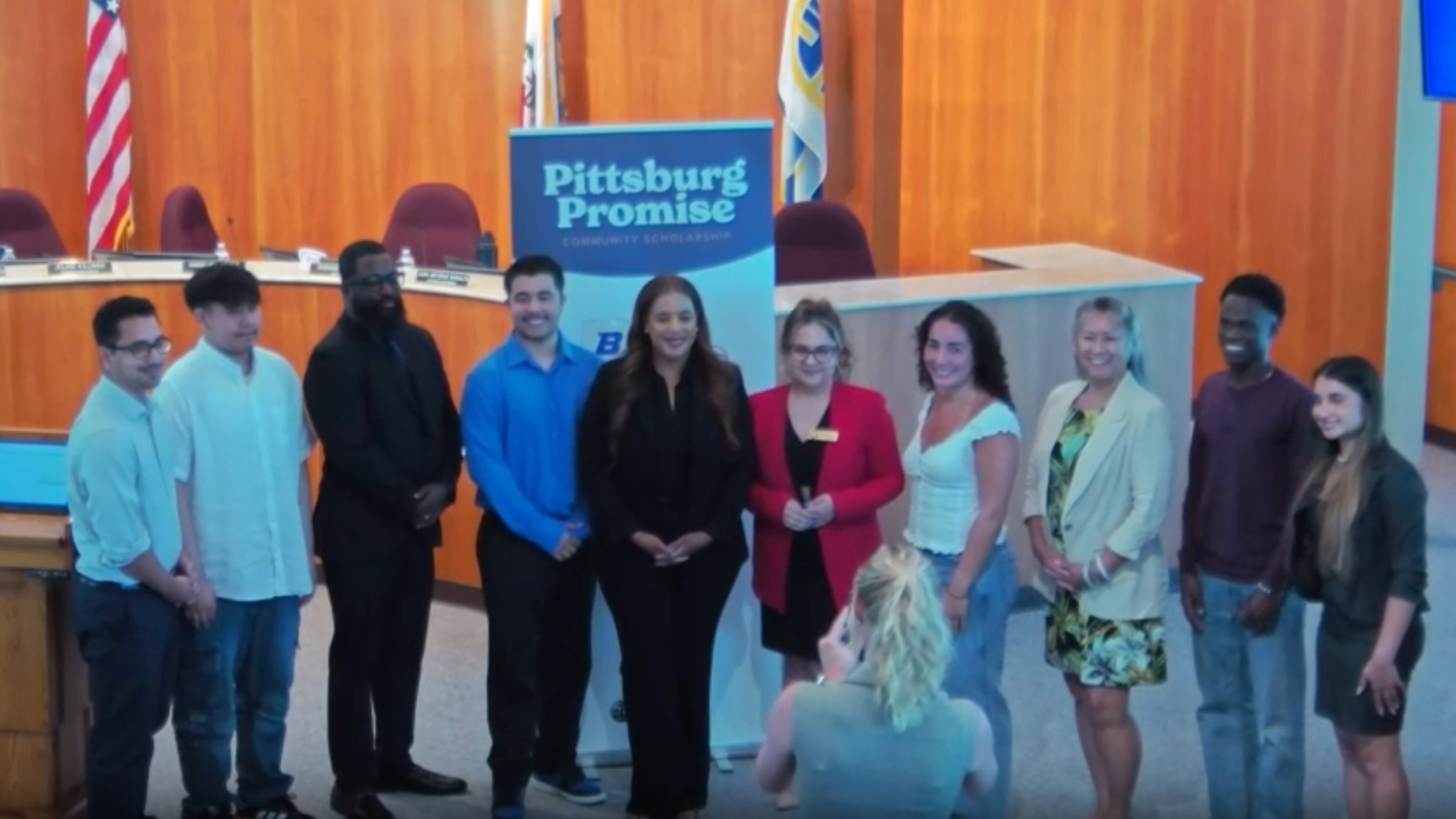
Five Pittsburgh Promise STEAM scholarships awarded to Ethan Chira (UCLA, neuroscience), Eric Gonzalez (UC Davis, biotechnology), Jose Rodriguez (UC Davis, mechanical engineering), Liana Pimenteau (Boise State, pre-nursing), and Terrain Jimenez (Stanislaus State, nursing). The 2027 application cycle opens Jan. 1, 2027.