
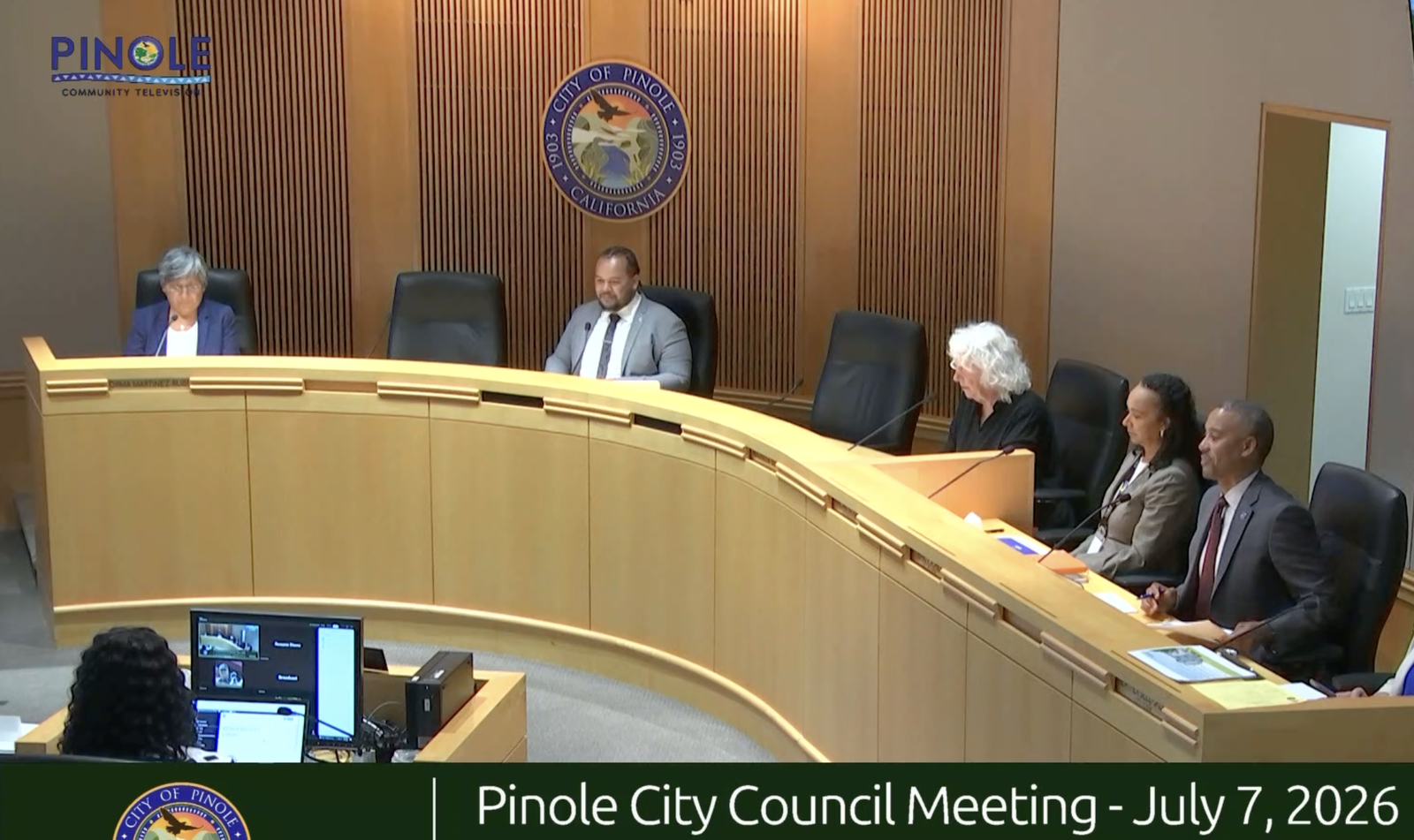
City Council - Jul 07, 2026 - Meeting
City Council • PinoleJuly 7, 2026
Locunity is a independent informational service and is not an official government page for this commission.We use AI-assisted analysis and human editorial review to publish information.
Grand Jury Warns Pinole Faces Bankruptcy as Council Charts Course on Housing and Fiscal Reform
Pinole's new city manager received a bracing welcome this week: a civil grand jury report that gave the city an F on fiscal health, warning of bankruptcy without structural budget changes. The same evening, the council heard its most comprehensive housing strategy in years — a $3.5 million plan to stabilize renters, repair senior homes and explore a community land trust — all while adjourning in memory of a former mayor who shaped the city for two decades.
Grand jury gives Pinole an F on fiscal health, citing $45M unfunded pension liability, $35M retiree health obligation and $120M infrastructure gap; city must formally respond by Aug. 14
Council explores tenant protections, rental assistance and community land trust model for $3.5M in restricted housing funds, with 53% of Pinole households rent-burdened
Staff recommends against in-lieu affordable housing fee for large developments, finding maximum feasible fees would not cover the cost of building replacement units
New City Manager Naomi Kelly pledges 30-day listening period, announces labor coalition to cut retiree health costs and highlights 222 potholes filled in three months
Council Member Maureen Toms pushes for formal policy to deposit post office sale proceeds into pension trust
Residents challenge city employee salaries as 44% above median household income, demanding top-down cuts and COLA freezes
Meeting adjourned in honor of former Mayor Mary Horton, who served five terms and helped bring Target to Pinole
Pinole Gets an F: Grand Jury Warns of Bankruptcy Without Structural Reforms
The basics: The Contra Costa County Civil Grand Jury released Report 2604, titled "Pinole's Future: It's a Rough Road Ahead," containing 25 findings and six recommendations. The independent assessment, prepared with analysis from Baker Tilly Consultants, rated Pinole's fiscal health among the lowest in the county. City Manager Naomi Kelly presented the city's draft response at what amounted to a first reading, with formal action scheduled for July 21 and a mandatory grand jury response deadline of Aug. 14.
Why it matters: The numbers are stark. Pinole carries a $45 million unfunded CalPERS pension liability — up 150% since 2014 — a $35 million retiree health (OPEB) obligation, roads rated at a Pavement Condition Index of 55, and a combined infrastructure funding gap of $120 million. The grand jury gave the city high marks for general fund reserves, debt burden, liquidity, revenue trends and pension funding discipline, but the OPEB costs alone dragged the overall grade to an F.
Where things stand: The city agreed fully with 17 of the 25 findings and partially disagreed with five, primarily arguing that the newly implemented "Yellow Brick Road" budget framework projects structurally balanced budgets beginning in fiscal year 2026-27. The areas of partial disagreement centered on deficit projections the city contends are now mitigated by expenditure cuts.
"Baker Tilly concluded that Pinole faces ongoing severe operation budget issues including the threat of bankruptcy if it does not balance annual expenditures and revenues. Pinole agrees with this finding," said Kelly.
Kelly announced the city has formed a coalition with labor groups to evaluate options for reducing OPEB costs.
"We will be coming back to you within this year with our findings and actions that we may be able to do to reduce those costs," she said.
Councilmember Maureen Toms seized on one recommendation, requesting that staff bring back a formal policy to deposit proceeds from the sale of the city's post office property into the Section 115 pension trust — an investment vehicle that allows cities to pre-fund pension obligations at potentially higher returns than paying down the liability directly.
Residents Push Back
Three public commenters challenged the adequacy of the city's response. Debbie Long questioned whether recurring expenses were being improperly classified as one-time "council directed special projects" and called for staffing reductions "from the top, not the people that have the boots on the ground." Rafael Menis pressed on whether the operating budget was truly structurally balanced if the Section 115 Trust principal was being drawn down. Sheila Grist asked whether there would be a future meeting allowing extended public input on proposed cuts.
Kelly indicated the city would return with more detailed responses at the July 21 meeting.
What's next: The council will take formal action on the grand jury response at its July 21 meeting. The mandatory response to the grand jury is due Aug. 14.
$3.5M Housing Fund Strategy Takes Shape With Tenant Protections, Land Trust Model
The basics: Housing Fellow Jared Murti of the Partnership for the Bay's Future and Asn Ndiaye, Executive Director of the Northern California Land Trust, presented draft recommendations for how Pinole should deploy its $3.5 million Housing Successor Fund — restricted dollars left over from the dissolved redevelopment agency that can only be used for affordable housing purposes. Community Development Director Lilly Whelan introduced the presentation.
Why it matters: With 53% of Pinole households rent-burdened and eviction rates exceeding the county average, the guidebook represents the city's first systematic attempt to steer these restricted funds toward programs that could prevent displacement — without tapping the general fund.
Where things stand: The recommendations were organized in three tiers. Active programs already underway include the CORE homelessness outreach contract, an RSG consultant contract, the Home Match program and fair housing trainings. Prepared initiatives ready for near-term launch include emergency rental assistance modeled on El Cerrito's program at roughly $25,000 per year and a modified in-lieu fee for developments under 10 units.
Emerging initiatives for further exploration include expanded staffing, senior homeowner repair through Rebuilding Together, community land trust partnerships, down payment assistance, rent stabilization and a just-cause eviction policy with right to counsel.
In-Lieu Fee: Yes for Small Projects, No for Large Ones
A feasibility study by RSG Consultants found that even at maximum levels — $25 per square foot for ownership and $49 per square foot for rental housing — an in-lieu fee would not generate enough revenue to replace on-site affordable units in larger developments.
"Even at the highest fee levels, the revenues generated by this in-lieu fee model would not adequately fund the cost of developing separate affordable housing units," said Murti.
Staff recommended against the fee for larger developments but proposed applying it to projects under 10 units.
Homelessness Data Offers a "Hopeful" Picture
Murti shared data from the CORE outreach team that reframed Pinole's homelessness challenge.
"84% of the individuals that they connected with had roots in Pinole, which is a pretty high number, but also a very hopeful number when you also add it with 68% having reported being first-time homeless," he said, suggesting that locally rooted, first-time homeless individuals may be more responsive to intervention.
On evictions, Murti acknowledged the rate exceeds the county average but said the raw numbers — 7 to 15 per year — make the problem addressable.
"We're not talking about 300 evictions. We're talking about 7 to 15 this year kind of thing. Those numbers show that there's a path forward," he said.
Land Trust Model Could Cut Home Costs by Half
Ndiaye explained how the community land trust model separates ownership of land from improvements.
"You really do offer a shared equity model that provides a lot more access to home ownership. You're ending up at home sales costs in some cases 50, 60% of what market rate homes are," Ndi said.
He recommended an annual set-aside of about $25,000 for emergency rental assistance, saying it would address the need for preventing evictions in Pinole.
Council Members Weigh In
Councilmember Norma Martinez-Rubin urged a dual approach:
"It's the prevention of getting into that situation and then addressing an acute state of illness."
She expressed particular interest in the community land trust model and asked whether surplus city properties could become sites for affordable housing development.
Councilmember Maureen Toms raised a practical question about just-cause eviction policy, asking whether existing state law already covers the concern.
"I would be curious when this comes back if we can have some discussion about what legislation there is to address that and would the education that we could potentially provide to landlords just address how the landlords need to comply with existing legislation," she said.
Public commenter Rafael Menis noted that when the council last considered just-cause eviction protections in 2023, it said it lacked data — data this report now provides. He highlighted the $2,409 median rent and 53% rent-burden rate and requested updated 2026 data in the final draft.
What's next: Staff will return in fall 2026 with a finalized guidebook for council adoption.
New City Manager Kelly Outlines Her Approach — and a Pothole Blitz
City Manager Naomi Kelly, four days into the job, delivered her first council report with a mix of administrative pragmatism and community programming.
"I'm approaching Pinole's budget through two lenses. First, understanding the disciplines that are already in place and second, identifying opportunities to strengthen long-term stability rather than short-term fixes," Kelly said — a framing that aligns with the grand jury's call for structural reform over one-time patches.
She announced the hiring of Matt Brown, Capital Improvement Project Manager, a Pinole resident and UC Berkeley engineering graduate, and highlighted that Public Works filled 222 potholes in three months — which she described as triple the prior pace. Upcoming events include an Active Transportation Plan workshop on July 23, a live AI policy survey at pinolspeaks.com, and community policing events including "Froyo with the 5-0" on July 16.
Mayor Pro Tem Devin Murphy reported on welcoming Congressman John Garamendi to highlight the 21st Century Road to Housing Act, which has passed both chambers of Congress and awaits a presidential signature. Murphy, who sits on the National League of Cities Federal Policy Committee, said the legislation would provide additional resources to local communities for housing challenges. He also noted an $11.2 million federal grant for the Port of Richmond's berth 7 rehabilitation and MCE CEO Don Weiss's departure.
Councilmember Norma Martinez-Rubin promoted Port Chicago memorial events, and Councilmember Maureen Toms recognized a Special Olympics athlete send-off and the downtown car show.
Council Adjourns in Honor of Former Mayor Mary Horton
The meeting's most personal moment came early, when public commenter William Horton informed the council that his wife, former Mayor Mary Horton, had died of pancreatic cancer on June 25. He requested adjournment in her honor.
Mary Horton was elected to the Pinole City Council five times, serving from 1990 to 2009 and as mayor in 1994, 1998, 2001 and 2009. Her signature achievement was persuading a fellow councilmember to change his vote to approve the Target/Mervyn's development — a project that remains one of Pinole's top three sales tax revenue generators. She also helped prevent the closure of Shannon School and was a strong supporter of public safety and the Pinole Senior Center.
Councilmember Maureen Toms and Councilmember Norma Martinez-Rubin offered extended tributes. Public commenter Sheila Grist noted Horton was the only councilmember in 37 years to knock on her door. The meeting was adjourned in Horton's memory alongside Amber Schwartz.
Minor Items
Closed session on labor negotiations with AFSCME, police employees and management produced no reportable action.
Independence Day proclamation and recognition of centenarian Rosemary Coutinho were read.
Council candidate nomination period runs July 13 through Aug. 7 for three open seats.
Public commenter Richard Castle cited city employee median pay of $108,400 versus a resident median of $75,165, arguing the city cannot raise taxes or issue bonds while maintaining that premium.
Public commenter Anthony Vos Brink called for freezing COLAs and considering 2-3% salary cuts for directors and managers, and asked why new recycling bins remain uninstalled at the corporation yard.
Debbie Long raised concerns about racial commentary during the city manager hiring process and questioned whether the closed-session vote was properly reported under the Brown Act's mandatory disclosure provisions.
Council August recess confirmed; next meeting July 21.