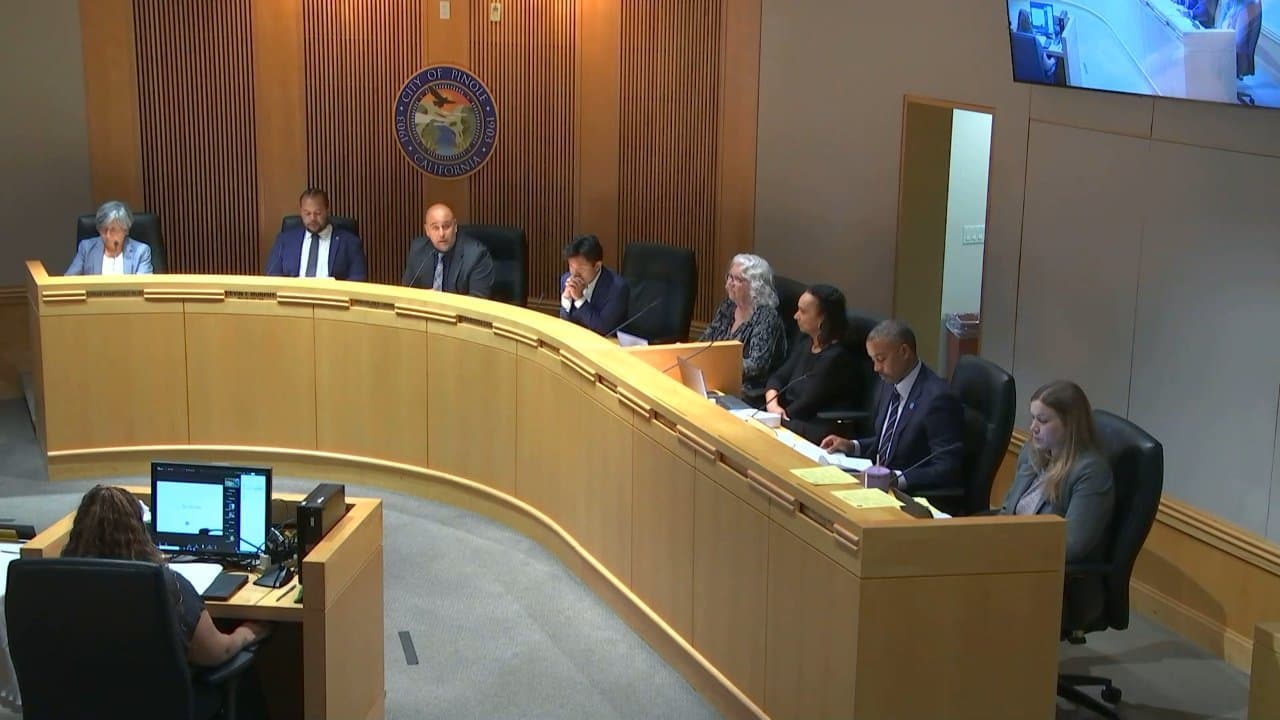
City Council - Sep 15, 2026 - Meeting
City Council • PinoleSeptember 15, 2026
Locunity is a independent informational service and is not an official government page for this commission.We use AI-assisted analysis and human editorial review to publish information.
Council Delays Decision on $30M Industrial Project as Fire Code Dispute Stalls Permit Clock
Pinole's City Council punted the biggest development decision on its plate — whether to grant a one-year entitlement extension for a $30 million light industrial project on contaminated land — after the developer's attorney introduced a legal theory that caught everyone off guard. Meanwhile, the city manager laid bare a structural budget deficit, neighbors pushed the council toward a binding vote on school traffic hazards, and a youth soccer league stepped up with $100,000 to rebuild a crumbling field.
- $30M Pinole Shores 2 industrial project appeal continued to the next meeting after developer's attorney argues 440 days of fire code delays should pause the permit clock
- City Manager warns of structural budget gap after FY 2025-26 closes with $33M in spending against $32.3M in revenue; new spending controls instituted
- Council votes to schedule binding action on school traffic safety near Pinole Middle School after neighbors cite state law that could force the school district to pay
- Youth soccer league pledges $100K to rebuild the Savage field at Pinole Valley Park West, covering nearly all costs without general fund impact
- 14% electric rate cut now in effect for roughly 7,000 Pinole accounts through MCE
- Street paving launches on three corridors, including one road so deteriorated it must be completely torn out and replaced
Pinole Shores 2: A Contaminated Site, a Legal Curveball, and a Decision Deferred
Why it matters: A 120,000-square-foot light industrial building on a former auto wrecking yard at 836–848 San Pablo Ave. would bring union construction jobs, long-term tax revenue, and productive reuse of a lead-contaminated site that state regulators have restricted to commercial and industrial use only. If the entitlement extension dies, the developer starts over from scratch — adding years of delay to a parcel that cannot be used for housing, parks, or community gathering.
Where things stand: The Planning Commission voted 6-1 in a previous meeting to deny GPR Shores' request for a one-year extension of its development entitlements. Staff had recommended approval, finding that the original findings still applied and the applicant had shown diligent pursuit. The commission disagreed, citing limited visible progress, no identified tenant, diesel truck impacts, the city's new environmental justice element, and revenue timing under the disposition and development agreement.
GPR Shores appealed to the council, which held a de novo hearing. Community Development Director Lily Whan presented the staff report reiterating the recommendation for approval.
The hearing's defining moment came when Michael Durkee, attorney for GPR Shores, introduced the concept of "tolling" — arguing that 440 days spent resolving fire code requirements triggered by Contra Costa County Fire should freeze the entitlement clock. "When you put a clock on an applicant and ask them to perform, that's to keep their feet to the fire to make sure they're doing what you've asked them to do," said Durkee. "But there's a concept known as tolling, a pause that's invoked because the applicant's doing everything they can and it's not them that's keeping the things from getting done."
Durkee explained that changes in fire flow calculation methodology — prompted in part by lessons from the Los Angeles fires — forced the developer to redesign the building, removing all wood and engineering a high-output sprinkler system. He also emphasized the site's environmental constraints: "It's lead-laden soil that has been buried under a 12-foot cap of clean soil and been limited by the Regional Water Quality Control Board and the State of California. It can't be residential. It can't be a play center. It can't be a park."
Hector Venus, developer with GPR Shores, detailed weekly calls with city planner David Hanham and extensive fire engineering work. Two union representatives backed the project. Jason Lester, business agent for UA Local 159 (plumbers and steam fitters), emphasized union construction jobs and apprenticeships and argued the delay was caused by fire code compliance, not developer inaction. Jason Lindsay, president of Iron Workers Local 378, said GPR Shores had reached an agreement with local building trades for the project and should not be penalized for cooperating with the fire district on safety requirements.
The other side: Rafael Menes, a public commenter, disputed the developer's argument that federal law preempts local truck emission requirements, citing commercially available Class 8 electric trucks. He argued the city's environmental justice element creates stricter evaluation requirements that should apply as conditions to any extension.
Councilmember Maureen Toms pressed on a key technical question: whether building codes in effect at the time a building permit is filed would apply regardless of the original entitlement date. She confirmed with staff that land use is vested at entitlement approval, but building codes apply at the time of permit submission — meaning the project would need to meet current fire and safety standards regardless.
Decisions: The council voted unanimously (5-0) to continue the hearing to the next council meeting. Councilmember Cameron Sasai moved to direct staff to schedule a closed session with City Attorney Casher to discuss the legal implications of the tolling argument before the council renders a decision.
What's next: The appeal hearing resumes at the next council meeting, where the council will have the benefit of legal advice on tolling — a question that could set precedent for how Pinole handles entitlement timelines when delays are caused by outside agencies.
City Manager Sounds Alarm on Structural Budget Deficit
Why it matters: Pinole ended FY 2025-26 spending roughly $700,000 more than it took in — $33 million in expenditures against $32.3 million in revenues — and the city manager says the practice of covering recurring costs with reserves is unsustainable.
Where things stand: City Manager Kelly presented the fiscal year closeout with a blunt warning: "Unassigned fund balance should be treated primarily as a financial safety net. It should be available for emergencies, cash flow needs, unexpected revenue shortfalls and other one-time expenditures. It should not be used as a source for recurring operating expenses."
The city maintains approximately $5 million in reserves. Kelly identified $376,000 in ongoing costs — $212,000 from the Budget and Planning department and $163,000 from PCTV — that must be structurally addressed. The stormwater fund faces a separate $250,000 annual shortfall currently covered by its own fund balance, and Kelly plans to discuss the current $35-per-equivalent-runoff-unit assessment with the county.
New Spending Controls
Kelly outlined budget controls implemented in the past 75 days: "We are doing monthly budget reviews with each of the departments reviewing each budget line item by line item and to address any variances in those budgets." Additional measures include reduced CAL card (credit card) access, contracting controls routed through budget and legal review, and vacancy review processes.
Public commenter Rafael Menes flagged a 119% budget overrun in utilities (electricity and water) during the consent calendar discussion. Director Guillory, finance director, attributed the overruns to rate increases and noted that revenue shortfalls in the Lighting and Landscape District Fund and Sewer Enterprise Fund were due to late assessment processing and incomplete capital projects with Hercules.
Decisions: The consent calendar, approved 5-0, included a resolution increasing general fund expenditures by more than $770,000 and equipment reserve spending by $150,000 to formally close out the fiscal year.
What's next: The structural deficit and stormwater fund gap will require ongoing attention in the FY 2026-27 budget cycle.
Council Sets Stage for Binding Vote on School Traffic Crisis
Why it matters: Parents and neighbors near Betty Reid Soskin at Pinole Middle School have spent months pushing the city to force the West Contra Costa Unified School District to fund traffic safety infrastructure. The council's 4-0 vote to agendize the TAPS committee recommendations formalizes that path — and the legal codes cited by residents could shift costs from Pinole's strained general fund to the district.
Where things stand: Multiple public commenters delivered pointed testimony during the general comment period. Yassine, a Main Street parent, urged the council to exercise authority under California Government Code 53097 and Vehicle Code 21373 to compel the district to pay for improvements. He cited the city's $80 million unfunded liability crisis, $60 million infrastructure deficit, and the fact that only three police officers are available at any given time.
Tracy Zell Bennett, speaking on behalf of a neighborhood coalition, read a formal statement requesting the council adopt the unanimous TAPS committee recommendation and place the issue on the next formal agenda for a binding vote. She cited Safe Routes to School grants that cover 90–100% of construction costs. Both speakers noted the school district failed to attend the TAPS committee safety meeting.
Councilmember Toms reported spending an hour personally observing the school drop-off and found the problems were largely behavioral: "I saw most of the problems were behavioral" — parents ignoring no-left-turn signs, dropping off in red zones, and stopping in the middle of the street. She recommended enforcement if parent communication fails, while acknowledging that the neighbors' infrastructure recommendations would be beneficial.
Mayor Pro Tem Devin Murphy reported touring the school with the superintendent and a board trustee.
Decisions: Councilmember Toms moved, seconded by Mayor Pro Tem Murphy, to agendize the TAPS recommendations for a future meeting. The motion passed 4-0, with Councilmember Sasai absent (having left the meeting at 7:32 p.m.).
What's next: The TAPS recommendations will appear on a future council agenda for a binding vote, potentially compelling the school district to fund traffic infrastructure improvements.
Soccer League Donates $100K to Rebuild Park Field
Why it matters: The West Contra Costa Youth Soccer League's $100,000 commitment covers nearly all of the $110,000 needed to rehabilitate the Savage field at Pinole Valley Park West — with no general fund impact — in a region starved for quality playing fields.
Where things stand: Community Services Director Andrea Dwyer presented the partnership, which follows a successful 2024 collaboration that rebuilt the east field at Wright Avenue. The parks master plan identified $8.5 million in total renovation needs for Pinole Valley Park. The west field currently has holes and unleveled surfaces, restricting use to recreational practices only.
"They are once again knocking on the city of Pinole's door," said Director Dwyer. "They are committed currently to providing approximately $100,000 to support the rehabilitation of the west soccer field."
Dwyer also flagged an unexpected challenge: unauthorized use by adult groups traveling from as far as Napa and Brentwood. "We did not expect the use that we are getting," she said, noting the city is exploring locked goals and fencing as deterrents.
Tyler Dark, president and executive director of the West Contra Costa Youth Soccer League, said the competitive program grew from seven or eight teams to 40 teams in five years and needs additional field access as school district fields become increasingly booked.
Mayor Pro Tem Murphy asked about restroom plans. Director Dwyer confirmed restroom units have been purchased, with installation targeted to coincide with the Savage field completion in three to four months.
Anthony Vosbrink, a public commenter, raised concerns about the condition of existing restrooms, a broken bridge over the creek, and whether parking can handle increased use.
Work is targeted for the November–February closure period.
Murphy Eyes Federal Housing Dollars, MCE Rate Cut
Preparing for Federal Housing Funds
Mayor Pro Tem Murphy reported on a National League of Cities webinar about the 21st Century Road Act Housing Act, a bipartisan federal law focused on increasing housing supply, reducing regulatory barriers, and providing financing for construction. Pinole's state-certified housing element requires accommodating 500 new units between 2023 and 2030.
Murphy drew a lesson from the American Rescue Plan Act experience: "We did learn from the American Rescue Plan Act, which we got a little over $4 million from the federal government in the last few years." Cities with identified projects and established partnerships, he said, are better positioned to capture limited federal resources. He has discussed with staff about aligning the housing element with potential federal opportunities.
Electric Rates Drop 14%
Murphy also announced from his MCE board service that a 14% reduction in electric rates took effect April 1, along with a temporary bill credit and the MCE Cares bill relief program. Roughly 91% of eligible electricity accounts in Pinole — about 7,000 customers — receive MCE service.
Road Paving Launches on Three Corridors
Interim Public Works Director Matthew Brown reported that construction has begun on the FY 2025-26 road rehabilitation project covering three segments: Shea Drive (grind and overlay from Sarah Drive to Pinole Valley Road), Pinole Valley Road (slurry seal from Seamus to past Wright Avenue), and Marlesta Road (full removal and replacement between Appian Way and the roundabout). Marlesta's pavement condition is so deteriorated that the most expensive repair type — complete removal — is required.
Zone 2 is the current focus of the city's five-zone, five-year maintenance cycle, covering approximately 5.5 miles of crack seal work. Brown also noted the Appian Village development under construction will increase traffic on these corridors.
Minor Items
- Community Services Commission: Four new members — Debbie Ojeda, Laurel Martin, Nicholas Teller, and Kayla Martin — appointed unanimously (5-0) to two-year terms, filling all vacancies.
- Firefighters Memorial proclamation: Council honored fallen firefighters ahead of the Oct. 3 California Firefighters Memorial Ceremony in Sacramento. Pinole has two firefighters on the memorial wall. Chief McAllister of Contra Costa County Fire accepted the proclamation.
- K9 Milo retirement: Council recognized therapy dog K9 Milo and Officer Jennifer Witchie after eight years of service. Milo was among Northern California's first law enforcement therapy dogs.
- Constitution Day: Sept. 17 proclaimed Constitution Day in Pinole.
- Suicide Prevention Week: Councilmember Sasai shared a personal connection to suicide loss and encouraged residents to call the 988 Suicide & Crisis Lifeline.
- Man Drive improvements: New no-left-turn signage, red curb painting, and keep-clear legends installed near Pinole Middle School as part of the road rehabilitation project.
- Code enforcement dispute: Public commenter Debbie Long alleged the city sent a weed abatement notice to elderly property owners (the Zacchae family) whose land the city has maintained for 35 years and who were donating property for a Pinole Creek grant. She questioned whether the action was retaliatory.
- COVID-19 update: Rafael Menes reported California wastewater data showing COVID-19 levels still increasing and encouraged N95 masks and the latest vaccine.
- Flag protocol complaint: Anthony Vosbrink criticized the city for not flying flags at half-staff for 9/11 at the veterans memorial and requested security improvements at Bayfront Park.
- Council candidacy announcement: Retired Pinole Police Commander Matt Avery announced his candidacy for City Council, emphasizing safety, infrastructure, and fiscal responsibility.
- Closed session: No reportable action from closed session items on public employee performance evaluation and real property negotiations.