
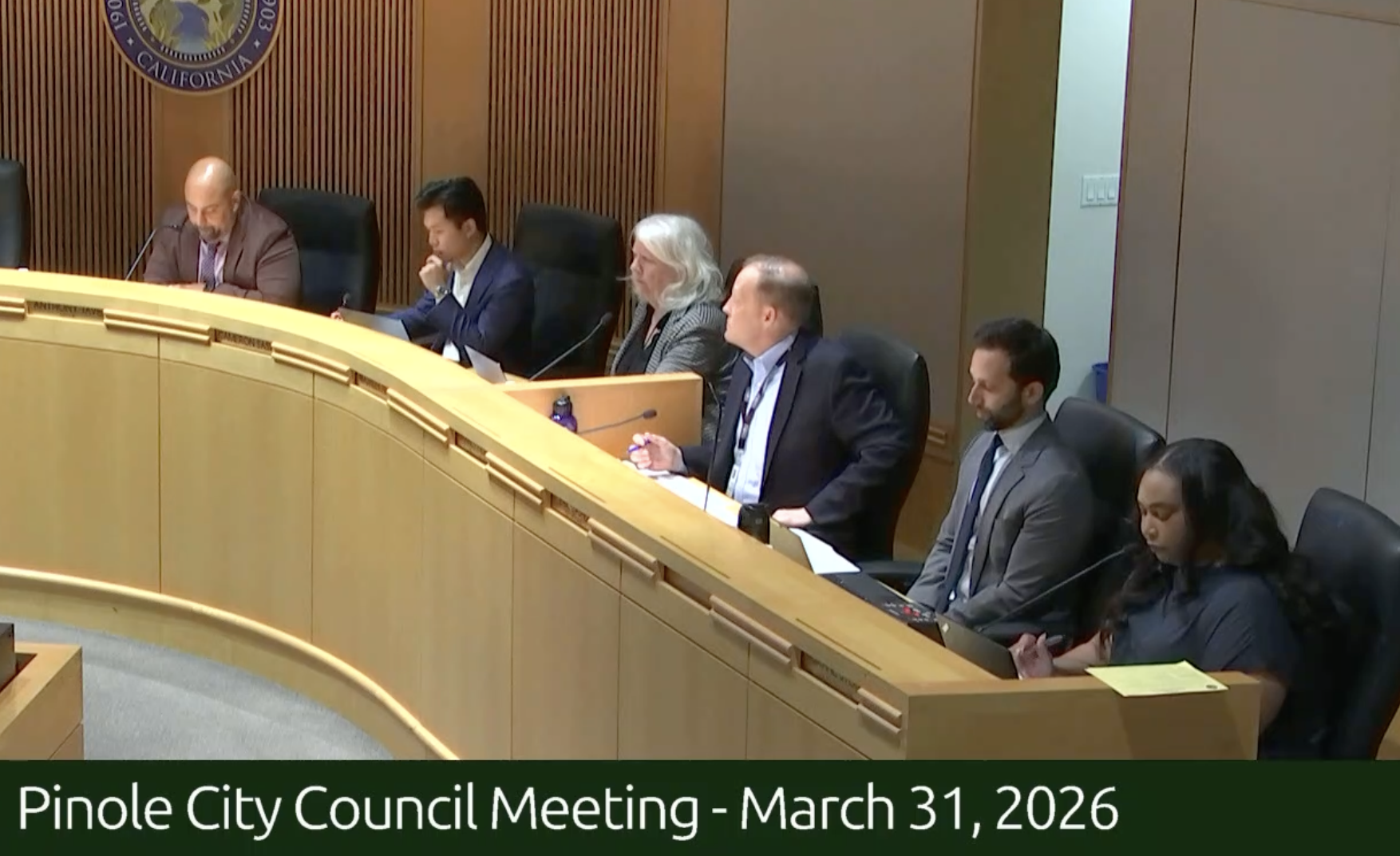
City Council - Mar 31, 2026 - Special Meeting
City Council • PinoleMarch 31, 2026
Locunity is a independent informational service and is not an official government page for this commission.We use AI-assisted analysis and human editorial review to publish information.
Pinole Confronts $4.3M Structural Deficit as Fire Contract Threatens to Swallow Tax Revenue
In a special session, Pinole's city council got its first hard look at a budget season that will demand painful choices: a preliminary FY 2026-27 general fund showing $33 million in spending against $32.1 million in revenue — a gap that balloons to $4.3 million once a rapidly depleting pension trust is stripped away. The single largest long-term threat? A fire services contract growing at 8% a year, on pace to consume every dollar of property tax the city collects within a decade.
$4.3M structural deficit revealed when one-time pension/OPEB trust transfers are excluded from the general fund
ConFire contract growing 8% annually would absorb all property tax and most voter-approved measure revenue in 10 years
Pension and OPEB trust projected to be exhausted by 2031 without budget-balancing action starting this year
$3M pavement rehabilitation project set for posting April 9 after year-long engineering vacancies near end
Police exploring fleet leasing at up to $326K/year and phased radio replacement at $82K/year
Residents rally against Measure D, the directly elected mayor ballot question headed to voters June 2
The Fiscal Reckoning: A $909K Gap That's Really $4.3M
Twelve city departments filed through the council chambers for Pinole's special budget workshop, and the picture they painted was sobering. Finance Director Markisha Guillory laid out the math: total general fund revenues of $32.1 million against $33 million in expenditures, producing a nominal $909,000 shortfall.
But that number relies on $3.4 million in one-time transfers from the city's pension and Other Post-Employment Benefits (OPEB) trust — a cushion that is shrinking fast.
"If we did not account for the $3.4 million that we're transferring in, which ultimately helps to balance the budget, the budget gap of $909,000, we would add that to the $3.4 million. It actually comes out to $4.3 million," said Guillory.
Why it matters: The pension and OPEB trust is projected to be fully exhausted by 2031. Without budget-balancing measures beginning this fiscal year, the deficit is projected to grow to $5.6 million. The general reserve has already been reduced from 50% to 25% of operating expenditures to seed a new $2.4 million OPEB trust — leaving less room for emergencies.
Where things stand: Expenditures are growing at 5% while revenues rise just 2%. Pension and benefits costs are climbing 9%. Property tax delivers only 19 cents of every general fund dollar; sales tax contributes about 2.5 cents. Measure I, approved by voters, is helping maintain staffing and service levels at roughly 117 full-time positions — but it cannot close a gap this large alone.
Interim City Manager Garrett Evans proposed what he called a multi-year deficit reduction roadmap targeting roughly $2 million in cuts or new revenues in the first year.
"To create a balanced budget plan, I would like to work with the council to develop what I will call a yellow brick road plan that identifies cuts or revenues to ensure a balanced budget," he said.
The council's response: Councilmember Norma Martinez-Rubin pressed on whether recurring revenues can cover recurring costs over the next five years, and whether the city is leaning too heavily on one-time funds. Mayor Anthony Tave directed staff to model 3%, 6%, and 10% across-the-board reduction scenarios to identify where service impacts begin.
What's next: Staff will develop reduction scenarios and the deficit elimination plan for the May 5 proposed budget presentation. Final adoption is targeted for June 16.
The ConFire Problem: 8% Growth, 10-Year Collision Course
Buried inside the professional services line item is the single biggest fiscal threat Pinole faces: its contract with the Contra Costa County Fire Protection District (ConFire) for fire and emergency medical services.
Interim City Manager Garrett Evans did not mince words, pointing out that ConFire is a fiscal concern.
"[The contract] is growing right now at 8%. That will double in 10 years. In 10 years that would pretty much consume every single dollar of property tax generated for this city plus almost all of Measure S and Measure I. That's not sustainable for this community," he said.
Finance Director Markisha Guillory clarified that the 8% applies specifically to the fire contract, while overall general fund expenditures are growing at a net 5%.
Councilmember Maureen Toms pushed for immediate action:
"I think it is important that we get the fire contract under control. I know that there's several of our areas... that already have a distribution for ConFire, so it seems like we're paying them twice."
She flagged that unincorporated areas adjacent to Pinole — Montalvin Manor, Tara Hills, and Bayview — are served by ConFire Stations 73 and 74 and generate their own ConFire tax revenue, yet those revenues do not appear to offset Pinole's contract costs. The implication: Pinole may be subsidizing fire service for areas outside its borders without a corresponding discount.
What's next: Evans identified the fire contract as a priority for renegotiation with the county. Council direction suggests a deeper fiscal analysis of the contract structure will follow.
Roads, Bridges, and Empty Desks: Public Works Tries to Catch Up
Public Works Director Heba El-Guindy outlined a department that has been hampered for over a year by two vacant engineering positions — a Capital Improvement Program (CIP) manager and an associate engineer. Interviews are finally scheduled: April 2 for the CIP manager and April 7 for the associate engineer.
Why it matters: Those vacancies have bottlenecked road repairs and capital project delivery across the city. Filling them could accelerate a zone-by-zone infrastructure plan that has divided Pinole into five maintenance areas for systematic attention to potholes, signs, streetlights, and pavement markings.
The big project: A $3 million-plus pavement rehabilitation program, funded largely by accumulated SB1 gas tax revenues, is scheduled for posting on April 9. Major capital projects in the pipeline include the San Pablo Avenue Bridge, the Tennant Avenue Bay Trail gap closure, and railroad crossing safety improvements.
Capital outlay of $1.39 million breaks down to approximately $590,000 for streets and sidewalks, $425,000 for building improvements, $270,000 for storm drains, and $105,000 for parks.
Councilmember Norma Martinez-Rubin questioned whether the city is relying too heavily on one-time grant funds for ongoing infrastructure needs. Interim City Manager Garrett Evans explained the distinction:
"Generally speaking, the ongoing revenues that you utilize are more for the neighborhood streets. The real big expenditures, you go after the grants and try and balance the two."
He also proposed creating an infrastructure and transportation ad hoc subcommittee to meet monthly for project updates — a sign that council wants closer oversight as capital spending ramps up.
Police Fleet and Radios: Aging Equipment Forces Tough Choices
Police Chief Melissa Klavoon presented a department budget of just under $13 million — with nearly $12 million consumed by personnel costs — and identified two urgent capital needs.
Vehicle fleet: The department is evaluating a leasing program that could cost up to $326,000 per year for a full fleet lease, compared to current annual maintenance costs of $72,000 that consistently run over budget. Mayor Anthony Tave noted the potential for buybacks at the three-year mark, which could reduce net costs.
Portable radios: The department's 49 Motorola portable radios can no longer be serviced by the manufacturer. Each replacement unit costs $8,200, and the chief proposed a five-year phase-in replacing 10 units per year at approximately $82,000 annually.
The department also reported $1.9 million in grant revenue from traffic safety (OTS), cannabis, and firearm safety (BURN) programs, and is pursuing an opioid detection canine funded through National Opioid Settlement funds.
Residents Line Up Against Elected-Mayor Ballot Measure
Four residents used the public comment period to raise concerns — and three of them targeted Measure D, the ballot question that would establish a directly elected mayor in Pinole and appears on the June 2 ballot.
Jennifer Horn read an email from resident Janet Wilkes calling the proposal "remarkably tone deaf" given the city's fiscal position, deteriorating roads, the need to hire a permanent city manager, and an unresolved police contract. Wilkes cited over 5,000 social media responses with virtually no support for the measure.
William Horton pointed to structural flaws in the proposal. There's no term limit for the elected mayor — a contrast with existing council term limits — nor a salary cap, meaning compensation could be increased by council vote at any time. He noted the rotating mayor system has been in place for approximately 100 years.
Why it matters: Sustained, organized public opposition signals political risk for council members ahead of the June 2 vote and could shape how the budget debate intersects with governance reform questions — particularly when critics are invoking the $55,000 election cost alongside road repair needs and the $4.3 million deficit.
PCTV Faces Cord-Cutting Revenue Cliff
Director Epps presented a roughly $680,000 PCTV budget confronting a structural revenue decline: external revenue from cable franchise taxes and PEG (public, educational, and government) fees has dropped from $210,000 in FY 2023-24 to a projected $85,000 in FY 2026-27 — a 60% decline driven by nationwide cord-cutting.
The city currently receives $250,000 to $280,000 annually in combined cable franchise and PEG fees, but that figure will continue falling absent legislative intervention. Pinole has joined the Alliance for Community Media's policy committee to pursue legislation expanding cable definitions to include internet streaming services and collect fees from streaming corporations. Communications Director Fiona Epps cited the Santa Barbara vs. Disney case as a recent California example of the legal landscape shifting.
PCTV is also preparing a proposal to provide meeting production services to a neighboring city — a potential new revenue stream to partially offset franchise fee losses. The department supported over 70 public meetings, 21 workshops, and 4 public events this year with just 2.75 FTE staff and about a dozen volunteers.
Minor Items
Community Development secured more than $1.8 million in grants for housing element compliance, sustainability, energy projects, and code enforcement. The department shows a positive net operating result of $747,340, though Guillory clarified this is attributable to one-time grant revenue; the department still requires a $630,000 general fund subsidy for non-grant operations. Upcoming work includes permitting Appian Village Phase 2/3 and Pinole Shores 2, and beginning general plan and zoning ordinance updates estimated for 2029 and beyond.
Community Services decreased special event spending by $50,000 and plans to boost revenue through expanded facility rentals, contract classes in underutilized spaces, and the new master fee schedule. The department's $2.4 million budget requires a $1.8 million general fund transfer. Summer camps hit maximum capacity for the first time in years. The animal services contract is projected at $245,000 and the library contract at $200,000.
IT Department cut $82,000 in software redundancies through a citywide evaluation after transitioning from fully outsourced to in-house operations. Key capital needs include firewall replacements ($50,000-plus with a five-year subscription) and a long-overdue fiber evaluation ($60,000-plus). Sasai raised cybersecurity concerns following the Foster City ransomware attack. The department plans a citywide AI policy training rollout and Windows 11 upgrades.
Toms flagged that the city council's travel budget is four times larger than the community development department's — a department with 10 employees.
Rafael Menes, president of Pinole Pride, posed approximately 30 detailed line-item questions covering every department budget and requested the council recognize March 31 as National Trans Day of Visibility.
The meeting was adjourned to the regular city council meeting of April 7, in remembrance of Amber Schwartz.