
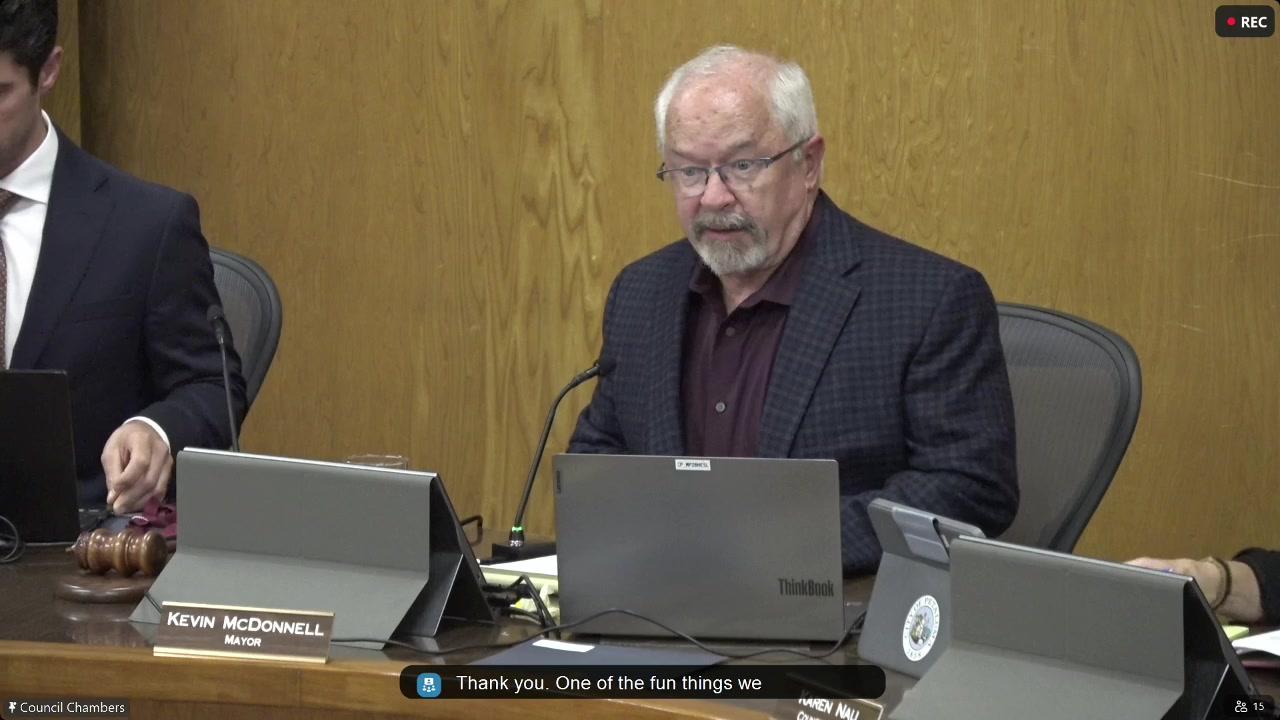
Petaluma Council Passes Citywide Zoning Overhaul 5-2, Defers Tough Calls
City Council • PetalumaNovember 10, 2026
Locunity is an independent informational service and is not an official government page for this commission. All information is sourced from public footage and an analysis of official agendas with the aid of responsible, fact-checked AI. to report an error or omission.
Petaluma's City Council rezoned every parcel in the city late Monday, Nov. 9, 2026, adopting Phase 1 of its zoning reform 5-2 after a nearly four-hour hearing over housing, trees and whether residents had been heard. Before the vote, the council added four amendments, including larger minimum setbacks and a higher inclusionary housing exemption, and sent the thorniest questions back to staff. Earlier, the council adopted a state-driven ban on watering nonfunctional turf, 6-1.
- Phase 1 zoning reform passes 5-2 with four amendments; Vice Mayor DeCarli and Councilmember Shribbs dissent
- Setbacks rise to 5-foot minimums totaling 20 feet front and rear, but private open space stays at 30 square feet
- Inclusionary housing exemption raised to 20 units, while SPAR review bypass stays at 10 or fewer units
- Data centers banned citywide; staff will study size caps on accessory server rooms
- Nonfunctional turf irrigation ban adopted 6-1, affecting about 204 properties
- Mobile home residents allege investor park owners spent about $42,000 on election flyers
A Once-in-Decades Rezoning Clears Its First Hurdle
The basics: Petaluma's 28-chapter Implementing Zoning Ordinance has outlasted two general plans. General Plan 2050, adopted earlier this month, requires the zoning code to match it.
Why it matters: The ordinance rezones every parcel and sets rules for housing density, setbacks and business uses. Phases 1B, 2 and 3 are still to come. City Attorney Eric Danly framed the stakes plainly: "job one, for phase one, is general plan zoning consistency." He also flagged the city's exposure under the Housing Accountability Act, the state law that limits a city's ability to deny code-compliant housing.
Where things stand: Staff and consultants from M Group presented a package that includes:
- A unified citywide zoning map, folding in Central Petaluma Specific Plan and SMART Code zones
- A rewritten Chapter 6 floodplain chapter with stricter finished-floor rules
- A new Chapter 29 Maker Micro zone for small producers
- 100% residential use on six vacant downtown mixed-use parcels
- An explicit citywide data center ban
A proposal for 3100 Lakeville Highway was withdrawn.
On Maker Micro permitting, Heather Gerwitz, senior planner, M Group, said, "Zoning clearance is a documentation of that conversation that holds the business owner accountable to what they're telling the planner."
The process fight: Before the hearing began, Councilmember John Shribbs and Vice Mayor Alex DeCarli asked to convert the item into a workshop. "I looked at 90 pages of commentary from the public about this," Shribbs said. Danly cautioned that the switch would raise 72-hour Brown Act notice issues: "So I would recommend against that change." A show of hands kept the item as a public hearing, and five hands moved it ahead one slot on the agenda.
Public commenters pressed the same theme. "There's no reason to rush through these really important things," said public commenter Tom Bornheimer. Planning Commissioner Christopher Neugebauer countered that the draft had been public for two months, with about 15 hours of hearings. "There is an urgency here to get something passed," he said.
Decisions and stakeholder impacts: Councilmember Brian Barnacle moved adoption with four amendments, and Councilmember Janice Cader Thompson seconded. The amendments:
- Define farm animal keeping to allow temporary grazing in open space, parks and the urban separator
- Set 5-foot minimum front and rear setbacks totaling 20 feet
- Remove mini storage from the Maker Micro zone
- Raise the inclusionary housing exemption to 20 units or fewer
The vote was For: 5 (Mayor Kevin McDonnell, Barnacle, Cader Thompson, Councilmember Karen Nau, Councilmember Frank Quint); Against: 2 (DeCarli, Shribbs); Absent: 0. DeCarli and Shribbs said property owners had not been adequately told about the changes. Shribbs added that the Planning Commission package "just feels like it went a little bit too far" on housing compared with other plan goals.
Setbacks vs. Trees: A Split Decision
Why it matters: Smaller setbacks make infill housing easier to build but leave less room for tree canopy. That trade-off drew the most sustained public pushback of the night.
Where things stand: Staff explained that the objective design standards require trees to cover 30% of open and landscape areas after 15 years, but set no minimum tree count. Reduced setbacks take priority over trees. Mayor McDonnell broke with the proposed 5-foot setbacks: "I think we overstepped. I think 5 feet is, for me, that's the wrong number." DeCarli wanted to keep the existing 15- to 20-foot setbacks: "I would propose that we go back to what it currently is right now."
Commenters Veronica Olson, Rebecca Carpenter, Beverly, Lendry Purcell and Rosemary urged more room for trees and adherence to climate goals. "I'd like to see the zoning require trees and greenery," said public commenter Rebecca Carpenter. Public commenter Lendry Purcell added, "I encourage you to stick to plans you made in the Blueprint for Climate Action."
The other side: Cader Thompson favored flexibility: "These are choices that people make if they want to live there." Public commenter Morgan Bellinger blamed parking rules rather than setbacks. "Why are we requiring off-street parking?" he asked, putting the cost at $30,000 to $80,000 per spot and proposing overnight street parking permits instead. The Fire Prevention Bureau said 3-foot side setbacks are allowed if they meet stricter fire and building requirements.
Decisions and stakeholder impacts: Five members backed the 5-5-20 setback formula in a straw poll, and five backed keeping the 30-square-foot private open space minimum. Builders keep the small open-space floor. Tree advocates won a modest setback increase and a promise of clearer tree language in a Phase 1B or Phase 2 cleanup.
Small Housing Gets a Faster Lane
The basics: Projects of 10 or fewer units will skip the city's SPAR design review and rely instead on objective design standards. Community Development Director Brian Oh described the logic: "if you have good standards in place, then go straight to building permit." Staff said the bypass cuts 12 to 20 weeks, plus holding costs, from the development timeline.
Where things stand: Barnacle proposed exempting projects of up to 40 units from inclusionary housing requirements. Shribbs and DeCarli resisted. "I'll go with 10, but I want less than 10," Shribbs said. A five-member straw poll settled on 20.
The other side: Public commenter Darren Rakazin argued that Section 4.030E waives density maximums in the four lowest-density zones, effectively reclassifying about 10,000 parcels. "So what we're doing is hitting our 4 lowest tiers, what were supposed to be the feathering out of density to the outside of town," he said. Beverly cited sewage, noise and flood evacuation concerns, and Rosemary urged a full update of design standards before lifting SPAR.
Staff and Quint replied that the four-units-by-right policy implements General Plan Action 7.2.1 and state law, and that no such projects have come forward. "To me, it feels like a smokescreen," Quint said of the density argument. He noted projected growth from about 60,000 to 76,000 residents by 2050.
What's next: Staff will return with options for implementing the four-unit policy, including a possible 6,000-square-foot minimum lot size.
Data Center Ban Holds, Size Caps Under Study
The ordinance bans data centers citywide. It exempts server rooms that serve on-site businesses, computing used to make products, and telecommunications facilities, which are protected by federal law. "It was to prohibit data centers," Andrew Triplett, principal planner, M Group, said of the council's midsummer directive.
DeCarli warned of a loophole: "somebody could have a business that's permitted, and the accessory use of a server room or something could suddenly become 10,000, 20,000 square feet." Economic Development Manager Katherine DiPasqua cautioned that a hard size cap could backfire: "we don't want the manufacturers that we want here to be prohibited unintentionally." Shribbs suggested small, localized data centers, such as those serving autonomous vehicles, might be acceptable.
A straw poll accepted the ban as written, and staff will explore size limits for accessory uses.
Turf Irrigation Ban Clears Final Vote
Why it matters: The ordinance amends Chapter 15.17 to ban irrigating nonfunctional turf with drinking water, a step staff described as a state mandate. The ban affects about 204 commercial and institutional properties. Staff estimated a revenue loss of roughly 1.15%, or about $200,000 a year.
Where things stand: Environmental Services Analyst Lauren Lum outlined the city's support for affected properties: postcard mailers, targeted letters, on-site meetings, the Mulch Madness program, and workshops with Daily Acts and the Sonoma Marin Saving Water Partnership. Shribbs praised staff's answers on cutoff consequences and native planting.
The other side: DeCarli held to his first-reading opposition, citing green space, water rates, business reporting and fire risk. "I also wish that we could find a better way to do this than to just do what the state says we have to," he said.
Decisions and stakeholder impacts: Nau moved and Cader Thompson seconded. The second reading passed For: 6, Against: 1 (DeCarli), Absent: 0.
Mobile Home Residents Allege Election Spending
Speaking for mobile home residents, public commenter Chris Parker alleged that investor park owners spent about $42,000 on election flyers attacking candidates. He also described 7-day notices served on seniors at Youngstown and 1,700 pages of legal filings in a fourth arbitration at Littlewoods. Parker said lost parking is worth $93,600 in ground-rent value at Littlewoods and $81,600 at Capri, and that owners are circumventing rent stabilization.
"These 7-day notices to me are very abusive, and I hope that the city attorney is watching that closely," said Councilmember Cader Thompson. Mayor McDonnell noted that the Littlewoods closure application is set for a Dec. 14 hearing.
- Consent calendar approved 7-0 on a motion by Cader Thompson, seconded by Nau.
- Adobe Creek Golf Course: Resident Susan Kirks warned of a possible Nov. 17 county hearing on rezoning and annexation. The mayor said staff are engaged.
- Trestle Promenade: The MIG visioning contract is final, and the first community workshop slips to January.
- Proclamations recognized Native American Heritage Month and Veterans Day.
- East-side pathway naming was carried over to a later meeting.
Looking ahead: Staff will return on tree and design standards, accessory data center limits, the four-units-by-right policy and more downtown residential sites in Phase 1B. It was not stated whether the zoning ordinance requires a further reading. Outgoing Councilmembers Nau and Shribbs were thanked during public comment, and Nau offered to keep serving on the Public Safety Advisory Committee as a member of the public.