
Petaluma Adopts General Plan 2050, Keeps 8 Stories at SMART Site
City Council • PetalumaSeptember 15, 2026
Locunity is an independent informational service and is not an official government page for this commission. All information is sourced from public footage and an analysis of official agendas with the aid of responsible, fact-checked AI. to report an error or omission.
The Petaluma City Council voted 6-1 on Sept. 14, 2026, to certify the environmental review and adopt General Plan 2050, the 25-year blueprint for how and where the city grows. Late in a marathon meeting, the council also kept an 8-story allowance on one parcel by the SMART station, approved a new animal services model at roughly triple the old cost, and split 5-2 over backyard pools at Scott Ranch.
- General Plan 2050 and its Final EIR pass 6-1; Vice Mayor Alex DeCarli's motion to postpone dies without a second
- 8-story height retained on one SMART station parcel after a 5-vote straw poll and split public testimony
- Animal services contracts approved 7-0; annual cost rises toward about $1.5M as critics demand a forensic audit
- Shotwell body shop parcel moved into Maker Microbusiness after owners along Petaluma Boulevard North push back
- Scott Ranch pool ban lifted 5-2 over objections about entitlements and wildland habitat
- Organized coalition presses for an ICE non-cooperation ordinance due back Sept. 28
General Plan 2050 Clears Council After Five Years
Why it matters: The plan sets Petaluma's land use framework for the next 25 years. It caps a process that included "40 GPAC meetings, 16 Planning Commission meetings," according to General Plan consultant project lead Ron Whitmore. GPAC is the General Plan Advisory Committee.
Where things stand: Staff recommended final edits. These include new actions on contaminated fill and remnant historic structures, a downtown mixed-use flexibility overlay, clarified river buffer language, and a Neighborhood Center Mixed Use designation for the River Park Foundation parcel. Staff also previewed upcoming work: a digital general plan and zoning code, plus North Petaluma Station, Central Petaluma and fairgrounds plans.
The environmental impact report (EIR) drew 54 comment letters and did not require recirculation. "There are some instances where impacts remain significant and unavoidable even after mitigation is implemented," said the EIR consultant. Those impacts fall on historic resources, greenhouse gases, noise and traffic. The council accepted them through a statement of overriding considerations, the state environmental law finding that a project's benefits outweigh unavoidable harms.
Small business scare: Owners along Petaluma Boulevard North feared their properties would become "legal nonconforming." That status lets a use continue but can limit sale, expansion and rebuilding. "Leave us C-1 until you can deliver on the ask," said Anthony Bordessa, co-owner of John's Dairy and Pool Supply. Bill Ryder of Jay and Bill's Tire Service urged a pause until owners are included.
Staff said both of those businesses remain permitted under Neighborhood Center Mixed Use. Major collision repair at the Shotwell property on Cinnabar Lane would not be permitted, however. A 6-of-7 straw poll moved that parcel into Maker Microbusiness. Director of Community Development Brian Oh promised affected owners "essentially a zoning conformance letter." Councilmember Frank Quint called this "the most business-friendly council that Petaluma has had."
The other side: Susan Kirks, a public commenter, said consultants did no on-site "ground truthing" and omitted six wildlife corridors. Councilmember John Shribbs asked staff to reach out for her maps. Property owner Ted Cabral questioned the 330-foot river buffer. Staff said the figure comes from a meta-study. Maureen Gottschall, a public commenter, cited what she described as a 12% dry-year water shortfall and said the shortfall plans amount to rate increases. The EIR team said its water analysis drew on Sonoma Water and city plans and relies on drought programs.
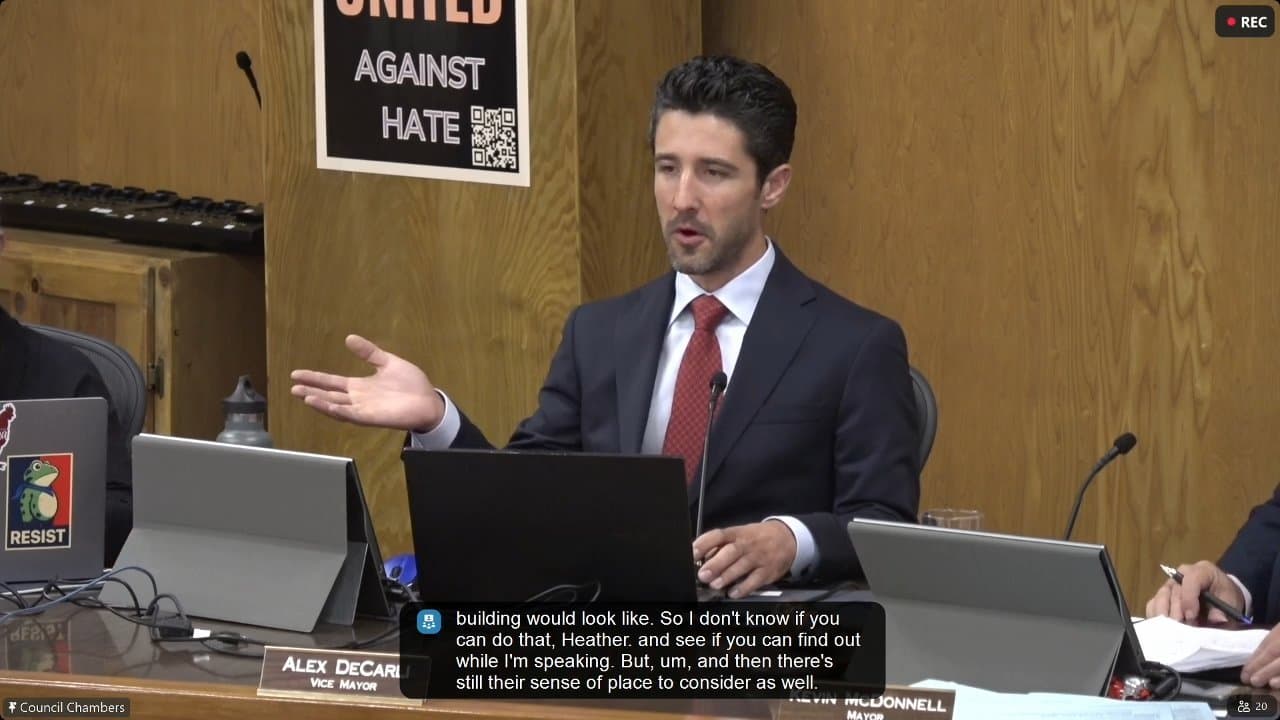
DeCarli moved to postpone adoption to a date uncertain. His motion called for congestion and water studies, an EIR alternative without height and density increases, a return from 8 to 4 stories, resolution of business concerns and completed zoning updates. No one seconded it.
Decisions and stakeholder impacts: Councilmember Brian Barnacle moved both resolutions. "We're preserving our neighborhoods and we're preserving the edges of our city," Barnacle said. Councilmember Karen Nau framed her vote around seniors and family: "I want to age in Petaluma." Matt Francois, attorney for Plaza North owner Sires Properties, said his client does not oppose the plan if 100% commercial use stays allowed. The EIR leaves site-specific biological and traffic review to individual projects.
Votes, EIR certification and General Plan adoption (each): For: 6 (McDonnell, Barnacle, Cader Thompson, Nau, Quint, Shribbs), Against: 1 (DeCarli), Absent: 0.
One Parcel, Eight Stories: The SMART Station Fight
Why it matters: The fight over a single vacant parcel became a proxy for how tall and how dense Petaluma is willing to grow near transit.
Where things stand: Staff said the parcel is owned by SMART. Its 8-story height is paired with a 5.0 floor area ratio and a density range. Staff warned that adding height limits would introduce density caps where none exist today.
DeCarli asked why the EIR studied no alternative that left height and density unchanged, and why there was no traffic study. "The issue is that Petalumans do not want this building," DeCarli said.
The other side: Opponents warned that the state density bonus law could push buildings to 10 to 12 stories without parking. Darren Rackeson, a business owner and former planning commissioner, said, "I think we should move the 8 stories to 6 stories." Christine White cited high-rise approvals in San Rafael and urged 4 stories. Mark Emiley objected to the late-night change in December 2025 that raised the height. Gottschall rejected staff's framing of the height: "There's nothing natural about it." Tom Gaffey asked the council to leave the door open to revisit heights.
Supporters argued the opposite. "We ought to give it a shot at allowing up to eight," said Jessica Moses, Planning Commission member and recent chair. Incoming Planning Commission Chair Brent Newell, public commenter Ben Peters and public commenter Nathan Spindell backed the plan on climate, affordability and fiscal grounds. Peters said density cuts vehicle miles traveled. Spindell said infill helps city finances given Prop 13 limits on property tax.
Decisions and stakeholder impacts: Shribbs floated a compromise: "Let's cap it at 6, but it'll be allowed if it's affordable." Mayor Kevin McDonnell sided with keeping the height: "Trying is better than continuing to have vacant lots all over town." A non-binding straw poll drew 5 votes to keep 8 stories. Members did not name the two non-supporters on the record. The designation carried into the adopted plan.
Animal Services Overhaul Passes; Accountability Fight Doesn't
Why it matters: The contracts complete Petaluma's exit from North Bay Animal Services (NBAS). Annual costs climb from about $500,000 to roughly $1.5 million, and the change follows civil grand jury criticism.
Where things stand: "We're recommending going to a 2-provider model," staff said. Sonoma County Animal Services will handle field services and licensing. The Humane Society of Sonoma County will run the shelter, with a subcontract for Forgotten Felines. Costs are estimated at $1.2 million or more this year and about $1.5 million starting in fiscal year 2027-28. Fees will be updated by CPI over eight years. Quarterly reports will appear on public consent agendas.
McDonnell opened the meeting by noting that an audit is underway. "We are not sweeping this under the rug," he said. Nau asked about restoring an Animal Services Committee. Staff said committees cannot oversee contracts.
The other side: Commenters backed the county switch but not the city's handling of NBAS. "Petaluma residents deserve strong oversight, including an animal services independent oversight committee," said Tyler Terrell, a public commenter. Sierra Morantz sought dangerous-dog abatement rules. Amy Taylor said no one has been held accountable and called for a forensic audit. Jeff Charter and Mark Kimberly accused officials of a cover-up and dishonesty. These are the speakers' allegations. Earlier, Sale White described denied and partial records requests. Tom Chamberlain criticized a July 20 vote rejecting a grand jury recommendation for a pet licensing platform.
Decisions and stakeholder impacts: DeCarli supported the contracts but said "the problem lies on this side of the fence." Cynthia King of the Humane Society of Sonoma County said, "We are ready to move forward with the contract, reopen the shelter, and serve the animals and people of Petaluma."
Vote: For: 7, Against: 0, Absent: 0. Nau moved and Councilmember Janice Cader Thompson seconded.
Scott Ranch Pools Approved on Split Vote
Where things stand: On second reading, the council adopted Ordinance 2932. It amends the Scott Ranch planned unit development (PUD) to allow swimming pools, which the PUD had prohibited. The applicant, Davidon, attended the meeting. Councilmember Janice Cader Thompson moved the ordinance: "The homes are built, there's backyards, there's fences around them." Barnacle seconded. He argued that individual homeowners would otherwise bear entitlement costs.
The other side: Kirks cited about 28 pools and warned of damage to adjacent wildland and the park extension. "This undermines our entitlement process," said Vice Mayor Alex DeCarli, who said the change favors the developer. Shribbs cited fragile hillsides and the city's ecological commitments.
Decisions and stakeholder impacts: For: 5, Against: 2 (DeCarli, Shribbs), Absent: 0.
Organized Push for ICE Ordinance Builds
Where things stand: Speakers in general public comment urged an ordinance codifying the city's non-cooperation with ICE. Ilana Feldman said more than 32 local businesses and faith groups endorse it. Linda Evans delivered an Immigration Legal Resource Center letter. She said an ordinance enables implementation and compliance with SB 580. Gina Garibo, an immigrant resident with Migrant Justice in Action, an initiative of North Bay Organizing Project, asked that staff be trained on responding to ICE. Commenters also cited a Blue Zones Petaluma letter on the health effects of fear.
Why it matters: Supporters say a binding ordinance would be harder to overturn than past resolutions.
What's next: Cader Thompson said she looks forward to the ordinance returning Sept. 28.
- Cal Cities delegates: The city manager and city attorney will vote at the conference, approved 6-1 with DeCarli opposed. Consent items 1-10 passed 7-0.
- Lynch Creek Trail: Four Sonoma Water easements for repaving and accessibility upgrades advanced 7-0 on first reading.
- CUPA update: Fire Marshal Amy Segui said the fix for a 1997-era code inconsistency "does not reduce nor expand regulatory oversight or create any new fees." It passed 7-0.
- Mobile home parks: Residents urged the council to stay firm in park litigation. No closed-session action was reported. Nau told residents, "We're behind you 100%."
- Zoning rewrite: Barnacle said the code update outlines a "belt and suspenders prohibition" on data centers and fewer conditional use permits.
Looking ahead: The county multi-jurisdictional hazard mitigation plan was pulled and moved to the next agenda. The ICE non-cooperation ordinance is expected back Sept. 28.