
Fall Data Puts Math at 20% as Palm Springs Unified Bets on Classtime
Board of Education • Palm Springs Unified School DistrictSeptember 23, 2026
Locunity is an independent informational service and is not an official government page for this commission. All information is sourced from public footage and an analysis of official agendas with the aid of responsible, fact-checked AI. to report an error or omission.
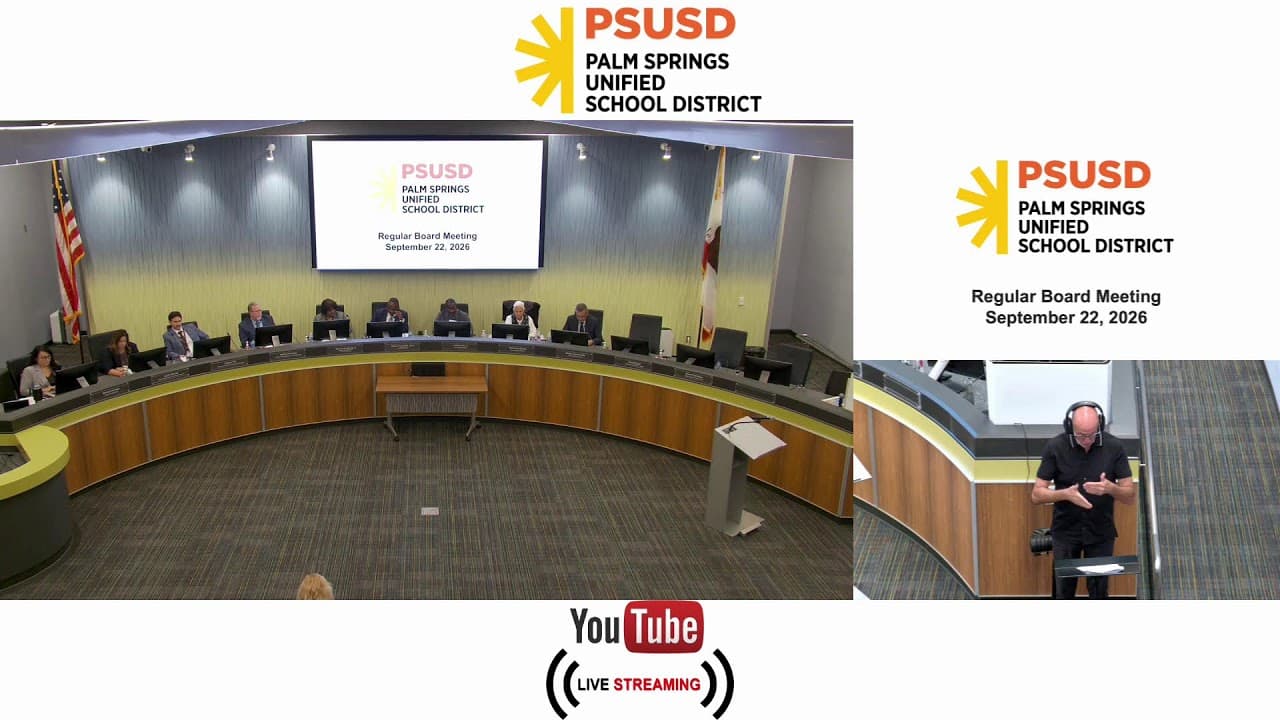
Only 20% of Palm Springs Unified students started the year at grade level in math, according to fall STAR baseline data presented Sept. 22, 2026. Staff answered with a classroom-first strategy built on a new quick-check tool. Trustees pressed on which student groups get named for support. With just three of five trustees present, every vote that night needed all three.
20% of students at benchmark in math, just over a third in reading, in fall STAR data
Trustee asks why African American students weren't named in the district's targeted goals
Superintendent pledges to go beyond Stand Up to Hate week and confront slurs directly
Two-year calendar adopted 3-0; staff to inventory campus shade as ESSER money runs dry
FEMA reimbursement pursued for a storm-damaged basin; staff prepare for El Niño
Math Baseline Sets the Year's Instructional Agenda
The basics: STAR is a fall diagnostic test that gives teachers a baseline early in the year. "STAR is a computer adaptive assessment that is used as diagnostic," said Dr. Deanna Killian, Director of Secondary Curriculum and Instruction.
Why it matters: Math proficiency of 20%, plus declines for English learners and students with disabilities, will shape where training and instructional dollars go this year.
Where things stand: Killian reported that just over a third of K-12 students scored at level 3 or 4 in reading and 20% did so in math. She also broke the results down by grade. She cautioned that the fall-to-fall comparison is not cohort data, meaning it compares different groups of students rather than tracking the same students over time.
The district's response centers on Tier 1 instruction, the core teaching every student receives, within its Multi-Tiered System of Supports, or MTSS. That work includes professional learning communities, priority standards and coaching for teachers of English learners. The newest piece is Classtime, a tool for quick formative checks during lessons. "And so we are so excited to bring in Classtime," Killian said.
Equity flashpoint: Vice President Charlie E. Ervin Jr. questioned which groups the presentation singled out. "But I didn't hear anything about our African American students," Ervin said.
Killian told Ervin he was "exactly right." She said declines in both reading and math for English learners and students with disabilities drove her emphasis. African American students, she said, gained in math. She agreed that all groups need a response.
Trustee Sergio Espericueta urged staff to keep focusing on English learners, a group he put at more than 5,000 students. Trustee Madonna Gerrell asked about intervention time, special education access and tutoring options, including math camps.
The other side: A student board member questioned whether the scores reflect what students actually know. "I believe that the data for some may be accurate, but some I personally feel like it may not be," the student said. The student added that Classtime and STAR are not always taken seriously on campuses. "That's great feedback and great data for me to help support school sites," Killian replied.
Decisions and stakeholder impacts: The presentation was informational, and no vote was taken. Teachers will carry most of the implementation load through coaching and Classtime checks. English learners and students with disabilities are the named priority groups. Ervin's challenge puts African American student outcomes on the record for future updates.
What's next: Superintendent Marcus Funchess said his own priorities include "strengthening Tier 1 instruction, strengthening teacher practice through feedback and coaching."
Leaders Say Anti-Hate Work Is Just Beginning
Why it matters: District leaders signaled that Stand Up to Hate will grow from a one-week campaign into explicit prohibitions and classroom messaging.
Where things stand: Student board members described Stop the Hate and suicide prevention activities on their campuses. During board comments, Gerrell proposed posting a short statement in English and Spanish that "racist hate speech is prohibited here." She cited board governance training as part of her reasoning.
"It's not a week, it's just a start," said Ervin.
Funchess shared his own experience of hate speech. "We are looking to go deeper with that and address some of the more uglier words like the N-word that are prevalent in our society," he said.
Decisions and stakeholder impacts: No formal action was taken. Signage and classroom language could reach every campus, which would affect students, teachers and site leaders. The board also proclaimed October as Bullying Prevention Month on a voice vote with no dissent heard.
What's next: Trustees flagged signage as a follow-up item. No date was set.
Summer Repairs, FEMA Money and El Niño Prep
Why it matters: Contracted repairs and FEMA reimbursement affect district costs. Leaky roofs and flooding could disrupt schools if projected heavy rains arrive.
Where things stand: Greg Shoemaker, Director of Maintenance Operations, walked trustees through summer work across athletic, campus, infrastructure and student-space projects. Highlights included:
A soccer field and basin at Cathedral City Elementary School
Roof restoration at Edward Winslow Education Center
New flooring at Rio Vista Elementary School
Most of the work is contracted out. Asked by Gerrell about heavy-equipment repairs, Shoemaker said, "We don't do that in-house, no. We contract that out." Projects are ranked using work orders, principal site visits and the district's five-year deferred maintenance plan.
Jeff Simmons, district staff, said the basin has been under repair since Tropical Storm Hilary. The district is "working with FEMA and other organizations to make sure we're going to get reimbursed on this particular project," he said.
The El Niño factor: "Governor Newsom declared a state emergency in California just to prepare for the coming El Niño condition," said Espericueta. He also noted a projected bridge project that will affect travel between Cathedral City and Palm Springs.
Simmons said staff have been working on drainage and roofs. He cautioned that some leaks are inevitable.
What's next: The FEMA reimbursement remains pending.
Calendar Locked In, but Shade Funding Runs Thin
Why it matters: Families and employees now have two years of calendar certainty. Early-August starts and rising temperatures, however, raise concerns about student comfort.
Where things stand: Espericueta raised heat at schools, noting that students face part of the summer on campus. Simmons said federal ESSER pandemic-relief money paid for many existing shade structures, but that funding has run out. New requests now go through the district's minor construction projects process. "We can certainly provide the board with an inventory," he said, and offered a plan as well.
Gerrell praised the calendar's semester timing. "It's a win-win that our employees and staff are really content with what we adopt from year to year," she said.
Decisions and stakeholder impacts: The board approved the 2027-28 and 2028-29 calendars without amendment by voice vote (For: 3, Against: 0, Absent: 2: Board President Cornett and Trustee Gerardi). Because only three trustees attended, a staff member asked Ervin to state his vote aloud, and he agreed. Shade remains a budget question with no dedicated funding source.
What's next: Staff will bring the board a shade structure inventory. No date was set.
Minor Items
Teamsters deal: Board ratified 2026-27 contract reopeners with California Teamsters Local 986. Mr. Hill, district staff, cited a "longstanding tradition of partnership, respect."
Pay and contracts: Approved salary increases for administrators, classified managers and confidential employees, plus an Executive Cabinet agreement amendment. No amounts were stated publicly.
Discipline policies: Adopted new Board Policies 4118 and 4218 on employee dismissal, suspension and discipline.
Cathedral City High modernization: Approved a design contract amendment and Increment 2B lease documents with West Coast Air Conditioning.
Other approvals: Approved a special education staffing amendment, two parent settlements, an expulsion and gifts, including Anderson Children's Foundation donations. All passed by voice vote with no dissent heard.
Looking ahead: The board's next regular meeting is Oct. 13, 2026, at 6 p.m. at Desert Hot Springs High School.