
Council Grills Police on Flock Cameras as Grant Cliff Looms
City Council • Palm SpringsOctober 15, 2026
Locunity is an independent informational service and is not an official government page for this commission. All information is sourced from public footage and an analysis of official agendas with the aid of responsible, fact-checked AI. to report an error or omission.
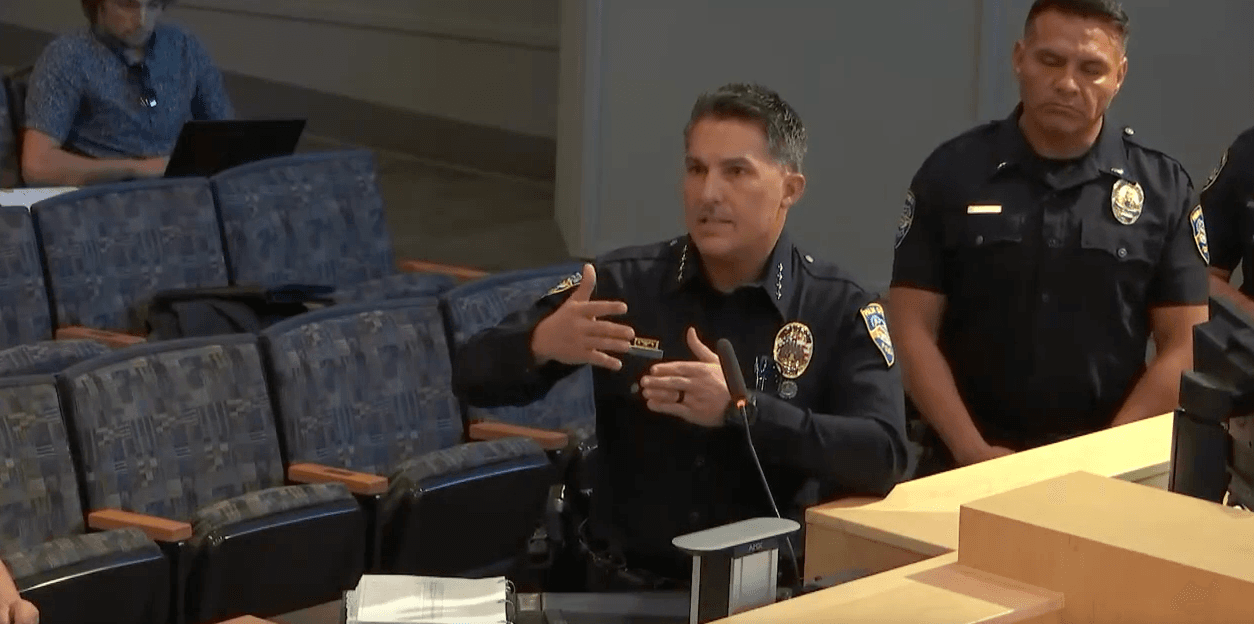
Palm Springs' surveillance network has delivered arrests and recovered property, but its $4.5 million grant runs out in December 2027, and council members want guardrails before the city pays the bill. At its Oct. 14, 2026, meeting, the City Council received a police update on the camera program and gave staff a list of demands: aligned contracts, a misuse ordinance, clearer vendor data rules and updated cost estimates.
The same meeting moved to separate event houses from vacation rental caps and drew a wave of Old Las Palmas homeowners protesting six-figure utility assessments.
- Police camera program faces scrutiny: 55 license plate readers, 169 CCTV cameras, $730,000 projected costs ahead
- Council directs misuse ordinance within 3 to 4 months, plus contract and policy alignment
- Event-house events would no longer count against vacation rental contract caps; vote outcome unclear
- Old Las Palmas owners protest assessments of $111,878 to $140,000 before Oct. 28 hearing
Cameras Deliver Arrests, but Costs and Audits Loom
Why it matters: The program runs mostly on grant money. "The grant ends December of 2027," said Sgt. Frank Guarino of the Palm Springs Police Department. Projected costs reach $201,000 in 2027. "If we're in 2028, 2029, we're looking at approximately $730,000 total," said a police department staff member.
Where things stand: Police Chief Kyle Stern described 55 automated license plate reader (ALPR) cameras, 169 CCTV cameras, four drone docks and a Real-Time Intelligence Center. The city paid $45,000 for its first 15 cameras, which are leased from Flock. Police reported 138 arrests, 36 stolen vehicles recovered and a 70% drop in vehicle thefts. Guarino cited "$365,000 plus in stolen property recovered with the camera assistance."
Stern listed safeguards: human validation of hits, case-number requirements, monthly audits, 26 partner agreements and no facial recognition on the cameras. "The data is automatically purged from the system in 30 days," he said, adding, "We are not allowed by law, SB 54, to assist with immigration enforcement." He also said police plan to propose an ordinance making intentional misuse of the system a misdemeanor.
The other side: Public commenters split. Dahlia Rodriguez said cameras helped police "track down the person responsible and retrieve the tools that belonged to my dad, all in under 12 hours." George Nickel said, "I'm even more in favor of this technology now."
Critics pushed back. Joshua Hanrich said he requested audits on July 29 and was told they "may be available in early November." He urged council "to please not receive and file this report until the audits themselves are attached." Paul Valentino called for a moratorium and a resident vote. Philip Hodges, a data scientist, warned, "If you give me enough observations of plate, place, and time, I can tell where you sleep."
Council pressure points: Councilmember Jeffrey Bernstein, District 2, asked whether Flock can use city data. City Attorney Jeff Ballinger said all the contracts contain language that "allows Flock to use it to enhance their technology." Procurement Contracting Manager Tabitha Richards said one of four contracts "is still being amended to be corrected." Mayor Naomi Soto said the previous council "worked really hard to make sure that the contract reflected Palm Springs values."
Councilmember Ron deHart, District 3, framed the city as "that fierce defender of privacy for our residents." Councilmember Grace Elena Garner, District 1, said major technology items belong on the business and legislative agenda, not consent. Mayor Pro Tem David H. Ready asked "that the city manager has access to the audits, just so it's another check in the system."
Decisions and stakeholder impacts: No formal vote was taken. Soto summarized direction: align contracts and policies, update cost estimates, bring a misuse ordinance, get clarity from Flock on data use, and check the city's legislative platform. "The misuse ordinance, I'd love if we can get that within the next 3 to 4 months," Soto said. Bernstein added that police policies should be reviewed by the city attorney.
What's next: Cost estimates are due before budget season. Stern acknowledged, "Continuing to fund this program will require council support."
Event Houses Move Toward Their Own Lane
The basics: Under Municipal Code 5.25.070(W), "each event house event counts as one of the property's allowable annual vacation rental contracts," said Patrick Clifford, Acting Director, Department of Special Program Compliance. Caps are 32 contracts for existing permittees, 26 for new ones and six for junior rentals.
Where things stand: Staff proposed repealing subsection W while keeping Chapter 5.75 permitting, notification and noise rules. The city has 15 event-house licenses; 13 are also vacation rentals. The most events at one property in 2025 was 21. "I could not find any data that there was a citation issue specific to a related event," Clifford said.
Industry voices backed the change. Brandon McBurney, owner/operator of Shag House, said one application takes "about 2 to 3 hours to complete, so it's a big administrative lift." He and Ron Williamson asked for shorter timelines, from 60 days to 30, plus a 15-day expedited option, reusable property files and clear standards.
Bernstein walked through the working committee's list. Director of Planning Services Christopher Hadwin said of shortened permit times, "I think on the surface it seems like a reasonable request," but flagged staffing, centralizing approvals across three departments, and email notice for one-off events as needing study.
Decisions and stakeholder impacts: deHart said the core ask was "striking that paragraph W." Soto called it "a very straightforward and also common sense separation." deHart moved to accept the staff recommendation, a first reading of the ordinance, and direct staff to study eight streamlining items. The vote result was not clearly announced on the record. If adopted, operators would stop using up rental contracts on events.
What's next: Staff will return with findings on the eight items; an introduced ordinance typically requires a second reading.
Old Las Palmas Homeowners Push Back on Assessments
Why it matters: Owners in Underground Utility Assessment District No. 1 face assessments of $111,878 to $140,000, with liens up to 20 years, ahead of an Oct. 28 hearing.
Where things stand: Eight speakers objected during non-agenda public comment. Don Sherwood, 79, said he opened an envelope and "inside was a ballot and an assessment of $140,000," despite already undergrounded lines. Patricia Barton, a senior on a fixed income, said her assessment is $120,437 and would require a bond if unpaid within 30 days.
Sarah Barton, reading a statement from Barbara Hoover, asked council to "continue the October 28th hearing assessment for at least 45 days." She also cited bond interest up to 12%. Jonathan Barton objected to a 20-year lien before terms and design are known. Matthew Barton said "just 20% of the total residents impacted could move this project forward." Joe Durante said, "I just received the ballot in the mail this morning." Mitch Cogdill called it "a boondoggle" that makes undergrounded owners subsidize others.
Land use consultant Judy Deertrack argued phased review conflicts with Proposition 218, the state law governing property assessments, and CEQA, and raised peninsular bighorn sheep concerns.
Decisions and stakeholder impacts: Garner asked staff for information and legal options, "especially when you're hearing from property owners that have already undergrounded their properties." Ballinger said the hearing was set by resolution of intention. "We have to list it on the agenda whether the council wants to continue it or not," he said.
What's next: Council can continue the hearing, but only on Oct. 28.
Minor Items
- Consent calendar approved by voice vote, including $33.1M in warrants; deHart recused, Bernstein abstained on Item 1E.
- Former Councilmember Mike McCullough joins the Mount San Jacinto Winter Park Authority; consent also included $50,000 traffic safety grant.
- FIND Regional Food Bank reported 14% food insecurity locally and over 154,000 feeding engagements.
- Mayoral position: Ballinger briefed on Palmdale's Measure DE and SB 1174; working group expected next year.
- Public comment: Christina Wallander criticized two-tier rental caps; two speakers urged rescinding the October 2023 Israel resolution.
Looking Ahead
City Manager Scott Stiles previewed Oct. 28: a convention center update, the Coachella Valley LGBTQ Quality of Life Study, the Old Las Palmas hearing, Seven Lakes Historic District, an economic development subsidy report, mayoral discussion and the Gene Autry affordable housing agreement. November brings a first-quarter financial update, an animal shelter agreement and a Dream Hotel update; swearing-in is set for Dec. 9.