
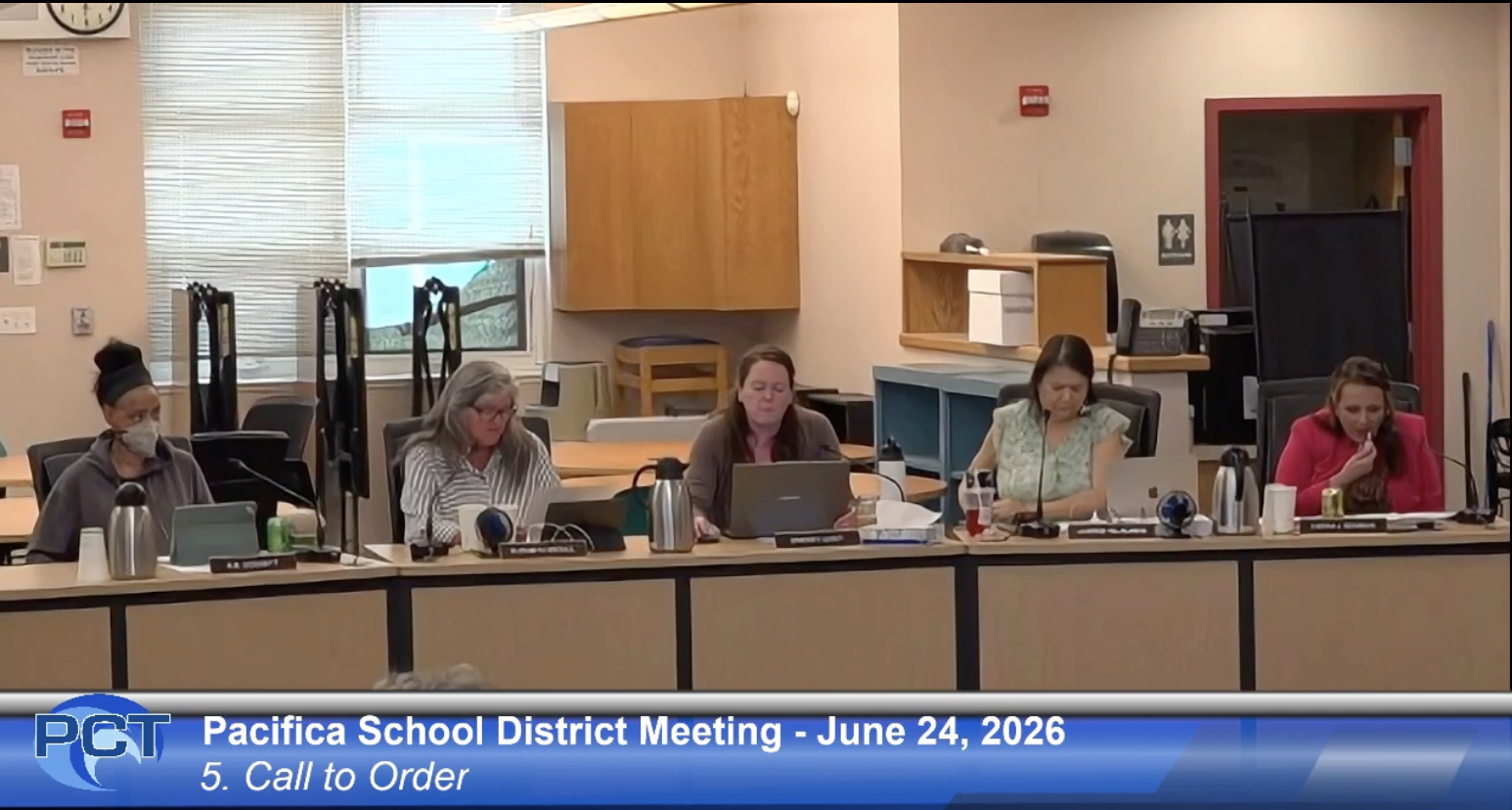
School Board - Jun 24, 2026 - Meeting
School Board • Pacifica School DistrictJune 24, 2026
Locunity is a independent informational service and is not an official government page for this commission.We use AI-assisted analysis and human editorial review to publish information.
Board Adopts Fiscal Stabilization Plan to Stave Off State Takeover
Note: the agenda for this meeting was not publicly available.
The Pacifica School Board on June 24 confronted the district's deepest fiscal crisis in years, unanimously adopting a stabilization plan that eliminates 13 positions and cuts $700,000 in non-staffing expenses — the minimum required to keep California from seizing financial control of the schools. In the same session, the board ratified new labor contracts with both unions, adopted the annual budget, and raised developer fees to their statutory maximum.
Fiscal stabilization plan requires 13 FTE cuts and $700K in savings to prevent state receivership; community Budget Collaborative will decide which positions are eliminated
Teachers and classified staff win 3% raises funded entirely by the new parcel tax, with teachers also securing experience cap removal
Budget adopted showing reserve shortfalls in out-years as enrollment decline erases nearly $2M in revenue
Developer fees jump to $5.38 per square foot on new residential construction
Music teacher reclassification shifts salary costs off the strained general fund and onto state Prop 28 arts funding
Teachers' union warns 2026-27 compensation remains unsettled and criticizes persistent payroll errors
A District on the Brink
Why it matters: Without the cuts approved Tuesday night, the Pacifica School District would lose its cash reserves and fall under state receivership — meaning Sacramento, not the elected board, would control how every dollar is spent.
Where things stand: Resolution 260624A, adopted by roll call vote (For: 4, Against: 0, Absent: 1), commits the district to eliminating 13 full-time equivalent positions — four management, four certificated, five classified — and finding $700,000 in additional non-staffing reductions, for a combined $1.785M in savings.
Superintendent Dr. Carisa J. Bowman framed the crisis bluntly. "We are the lowest or second lowest paid district with $12,000 per child where across the hill they get 23," she said. "And they need the same books, the same standards, the same curriculum and have to pass the same test." She described a "perfect storm" of forces: projected enrollment losses of 76 students — worth roughly $2M in revenue — and a 40% increase in the district's homeless student population.
The superintendent was equally direct about the external oversight headed the district's way. "We will be appointed an external fiscal advisor," she said. "That is a person who will be here, who has stay and rescind orders over anything that the board or myself would put forward and vote on."
Community pushback: Public commenter Tiffany Button criticized the plan's lack of implementation specifics, pointing to last year's consolidation of Valimar and Ocean Shore middle schools into IBL as a cautionary tale. "The lack of a plan was expressed as one of the major concerns with those actions," she said, urging the board to demand more detail.
Dr. Bowman emphasized that the 13 positions to be cut will not be chosen by district administrators alone. "The 13 positions will be decided by the Budget Collaborative. This is a family and community decision," she said. That community body — including teachers, staff, parents, and administrators — is scheduled to hold its first meeting in August.
Trustee Kai Doggett asked about natural attrition as a softer path to reductions, and Board President Lynda Brocchini raised a practical governance concern: how can individual board members stay engaged in the budget process without violating the Brown Act's open meeting requirements? Dr. Bowman agreed to establish paired board member partnerships for ongoing communication.
What's next: The Budget Collaborative convenes in August to determine which specific positions are eliminated. The external fiscal advisor, appointed by the San Mateo County Office of Education, will have authority to block board or superintendent decisions if funds are insufficient.
Budget Adopted, but Numbers Flash Warning Signs
Why it matters: The 2026-27 adopted budget meets the district's required 3% reserve for the coming year, but multi-year projections show the reserve falling short in subsequent years — a trajectory that reinforces why the stabilization plan was necessary.
Where things stand: Dusty Nevatt, presenting the budget remotely, highlighted several improvements from the public hearing version. The board's earlier selection of a social studies curriculum allowed a $650,000 reduction in textbook spending. "I had put in a whole million dollars not knowing where we would land with the social studies," Nubitt said. "With the recommendation and board approval, we were able to reduce that expenditure by $650,000."
Health insurance projections were also revised downward from 8% to 6% for out-years, and both union settlements are now reflected in the numbers — all funded by the new parcel tax.
Trustee Doggett underscored the enrollment math: "The projected loss of 76 students amounts to almost $2 million," she said. Board President Brocchini pointed to another revenue lever — attendance. "We're at 94, 95% attendance rate. And if we could just get that up to 96, 97%, we would have more money to bring in for the kids," she said, framing improved attendance as a community-wide responsibility.
Decisions: The budget was adopted 4-0 (For: 4, Against: 0, Absent: 1). A 45-day budget revision will follow the finalization of the state budget, and unaudited actuals will return to the board in September.
Two Unions, Two Deals: 3% Raises Begin to Close County Pay Gap
Why it matters: Pacifica's teachers and classified staff are the lowest paid in San Mateo County. These contracts, funded entirely by the district's new parcel tax, represent the first steps toward closing that gap — but the teachers' union has already signaled that 2026-27 negotiations will be contentious.
Teachers (LSEA)
The tentative agreement with the Laguna Salada Education Association, approved 4-0, includes a 3% salary increase for 2025-26 retroactive to July 1, 2025; elimination of the prior experience cap effective July 2026; an hourly rate increase from $50 to $55; a teacher-in-charge stipend increase from $750 to $1,000; and new protections around artificial intelligence and cyberbullying. A joint salary schedule restructuring committee will study potential changes for 2027-28.
Rachel Merlo, the district's human resources lead, described the scope of the deal: "Beyond compensation, this agreement represents a massive step forward in operational efficiency. The team spent hours clarifying contract language regarding work hours, safety protocols and class size."
The agreement covers only 2025-26 compensation. During public comment earlier in the meeting, the LSEA representative made clear that the next round will be harder: "It is very important that you understand during the budget presentation and vote tonight that LSEA has not settled compensation for the 2026-27 school year." The representative also criticized persistent payroll problems, saying, "Please hold yourselves and cabinet to it. Communication and processes this year were less than stellar."
Dr. Bowman acknowledged the payroll concerns, saying she has reached out directly to the deputy superintendent and that supports are being put in place.
Classified Staff (CSEA Chapter 128)
The CSEA agreement, also approved 4-0, provides 3% raises in both 2025-26 and 2026-27, reclassification of three IT positions to higher pay ranges, an increase in personal necessity days from seven to eight, and a "me-too" clause allowing CSEA to reopen compensation if another bargaining unit receives more than 3% for 2026-27.
Rachel Merlo explained the me-too provision: "We agreed to a 3% for 2026-27, and they wanted to keep it open to see what the other units were going to get."
The corresponding AB 1200 public disclosure documents for both unions were also approved 4-0.
What's next: LSEA will return to negotiate 2026-27 compensation. The salary schedule restructuring committee will begin its work, with potential implementation targeted for 2027-28.
Developer Fees Jump to State Maximum
Why it matters: Developer fees are one of the few dedicated revenue sources for aging school facilities, and the district raised them to the highest level allowed under state law.
Rob Murray of King Consulting presented the biennial fee study. The State Allocation Board set the 2026 statutory maximum at $5.38 per square foot for residential construction and $0.87 for commercial and industrial. The district retains 60% of fees collected, sharing the remainder with Jefferson Union High School District — bringing Pacifica's effective share to $3.23 residential and $0.52 commercial.
Murray explained the fees are justified by the modernization and reconstruction costs generated by students from new development, calling the process routine maintenance for school districts since 1998.
Decisions: Resolution 260624B was adopted 4-0 after a public hearing that drew no comment.
Music Teacher Reclassification Unlocks State Arts Dollars
The board approved an updated music teacher job description that eliminates the separate band teacher classification, consolidating duties into a single TK-8 music teacher role aligned to California Visual and Performing Arts Standards. The move is specifically designed to satisfy Prop 28 compliance guidelines.
"By moving away from the restrictive band teacher classification, the district establishes a generalized title that perfectly satisfies the compliance guidelines of Prop 28," said Rachel Merlo.
The practical effect: all music teacher positions can now be funded by restricted Prop 28 categorical money rather than the general fund — a meaningful shift during a fiscal crisis. The board also approved the required Prop 28 annual report. Both items passed 4-0.
Minor Items
Closed session settlement: Board approved a $7,000 personal injury settlement in closed session, 4-0.
Consent agenda approved unanimously, 4-0.
LCAP adopted: The 2026-27 Local Control and Accountability Plan was adopted 4-0 after a June 10 public hearing drew zero comments. San Mateo County reviewed the plan and found it compliant with state requirements.
Local indicators met: Staff reported the district meets all five California Local Indicator standards — basic services, academic standards, family engagement, school climate, and broad course access — including new ELA curriculum (Open Court for K-5, Amplify for 6-8) and a new K-5 social studies curriculum, with professional coaching from Core Learning funded by the Give Forward Foundation.
After-school contracts: Two grant-funded after-school partnerships approved 4-0 — one with the Boys and Girls Club of North San Mateo County (at 955 Yosemite Dr.) and one with the City of Pacifica Parks, Beaches and Recreation (at Sunset Ridge, Ocean Shore, Cabrillo, and Valimar). Both are funded through ELOP and ASES grants at no general fund cost. Dr. Bowman noted the district is also expanding partnerships with individual PTOs so they receive grant funding, reducing fees families would otherwise pay.
Board candidate introduction: Grace Sobieski, a Cabrillo School parent, former third grade teacher, and early learning center director, formally announced her candidacy for the November school board election, pledging fiscal responsibility and family-centered decision-making. Valerie Davidson spoke in support of her candidacy.