Revised Budget Brings Short-Term Relief, but $1.8M in Cuts Still Loom for Pacifica Schools
School Board • Pacifica School DistrictSeptember 23, 2026
Locunity is an independent informational service and is not an official government page for this commission. All information is sourced from public footage and an analysis of official agendas with the aid of responsible, fact-checked AI. to report an error or omission.
Pacifica School District's board confronted the tension between modest fiscal progress and deepening structural challenges at its Sept. 23 meeting, hearing a revised budget that shaved $530,000 off projected deficit spending — only to be warned that $700,000 in mid-year cuts and 13 staff positions must still be eliminated next year to keep the district solvent. Both of the district's unions used the meeting to publicly air frustrations over canceled negotiation sessions, exclusion from budget talks, and a special education staffing crisis that one teacher called unsustainable.
Revised budget shows $530K net improvement, but $700K in cuts this year and 13 FTEs next year remain non-negotiable
Both unions blast district for canceling fall negotiation dates and excluding their presidents from the Budget Collaborative
Special education teacher warns of 25-27 student caseloads, lost counselors, and students in mental health crisis
Measure T parcel tax renewal becomes existential: failure would eliminate librarians and counselors on top of planned cuts
Board approves new bond-funded Facilities Specialist position, preserving general fund dollars
A $530K Gain That Can't Paper Over a $1.8M Problem
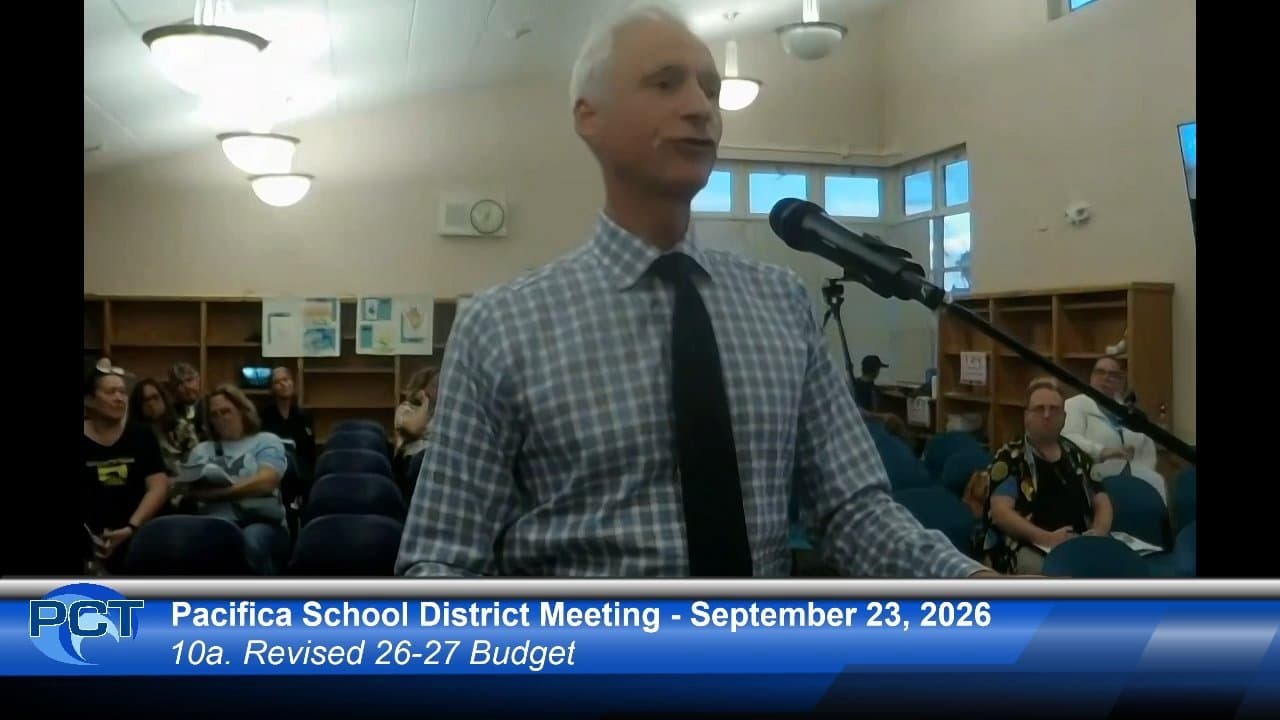
The Assistant Superintendent of Business Services, Chuck Neidhoefer, walked the board through the revised 2026-27 general fund budget — a presentation that arrived, as LSEA President Megan noted during communications, just minutes before the meeting began.
Why it matters: Pacifica School District is operating under state fiscal monitoring with a FICMAT risk score near 50%, squarely in the high-risk category. The revised budget buys time but does not eliminate the deficit. If this year's cuts are delayed, the damage compounds: every dollar not saved now costs two next year.
Where things stand: Revenue rose by $347,000, driven by the district's basic aid status, which ties LCFF funding to property tax receipts rather than per-pupil attendance — a cushion as enrollment dropped more than 80 students, exceeding the projected decline of 50. Expenses fell by $182,000 through corrections in personnel, supplies, and operations, yielding the $530,000 net improvement.
But the structural picture is stark. The fiscal stabilization plan adopted in June calls for $700,000 in cuts to supplies and professional services this fiscal year, plus the elimination of approximately 13 full-time-equivalent positions — roughly $1.8 million — next year. Those year-one cuts are currently budgeted in year two and must be moved forward.
"We need to make changes this year for the protection of our cash flow next year. A dollar saved this year is really $2 next year because it compounds," said Neidhoefer.
The district's spending profile underscores the problem. Approximately 50 contracted positions, mostly in special education, account for 28% of expenditures in services and operations — far above the typical pattern where personnel costs dominate at around 85%. Those contracted roles exist because the district has been unable to fill positions internally.
Two large one-time state block grants expire next year, causing state revenue to plummet from $5.5 million to $3 million. The unrestricted reserve meets the state-mandated 3% minimum but falls short of the board's own 6% target. Neidhoefer told the board that even 6% is low by statewide standards: "An average level for an elementary school district of our size is closer to 10%," citing a study by School Services of California.
The Measure T wildcard: Superintendent Carisa Bowman drove home the stakes of the upcoming Measure T parcel tax renewal. "We have to make $700,000 cut before the end of the year, and we have to make 13 FTEs for next year. If the parcel tax does not pass, then the 13 cannot include the LMTs or the guidance counselors because it's a different fund," she said — meaning those positions would be lost in addition to the already-mandated reductions.
Board President Lynda Brocchini underscored the enrollment trajectory: "Since we're projecting declining enrollment of like 60 to 80 every year, the Budget Collaborative would be extremely important to just continue based on that. That to me, that's like 2 classrooms or 3 classrooms, which is 2 teachers or 3 teachers."
What's next: The Budget Collaborative convenes the day after this meeting to begin stakeholder input on where cuts will fall. Formal budget adoption is scheduled for the next board meeting. Board members requested monthly budget updates in a simplified format and per-pupil spending comparisons under basic aid versus standard LCFF funding.
Unions Sound the Alarm on Canceled Negotiations and Budget Exclusion
The communications section — which was itself missing from the online agenda and had to be restored by a 4-0 corrective vote on a motion from Vice President Laverne Villalobos — became the meeting's most emotionally charged stretch, with both LSEA and CSEA representatives detailing a breakdown in trust with district leadership.
Why it matters: With an unsettled 2026-27 certificated contract and mandatory fiscal cuts on the horizon, labor peace is not optional. Interest-based bargaining, the method both sides have committed to, depends on sustained engagement and mutual trust — both of which union leaders say are eroding.
Where things stand: LSEA President Megan told the board that the district shortened the unions' first scheduled full-day negotiation session to just four hours, then canceled all pre-arranged dates from October through January, forcing the union to reschedule substitutes and CTA staff.
"Members of the district team seem frustrated or surprised that the negotiation process takes so long. We are negotiating a contract that governs the working conditions of the people who educate the district students every day," she said.
She also revealed that neither she nor CSEA President Charlene Higuelo were invited to the Budget Collaborative — a body both had participated in since its inception. CSEA representatives echoed the concern, noting that four key labor leaders who had been part of the Collaborative from the beginning were excluded.
LSEA Bargaining Chair Rachel Merlot, a 13-year veteran of the process, reinforced the warning during public comment, citing ACSA research on trust as the foundation for successful negotiations. "It is becoming more difficult to trust that both parties are committed to this process when dates that have been set and agreed upon since July are canceled," she said, requesting formal notification if the district intends to change bargaining methods.
The other side: Superintendent Bowman responded that the Budget Collaborative used a randomized selection system recommended by FICMAT, and that LSEA and CSEA members were included — just not the specific presidents. "We could see that there was representation from LSEA and CSEA. There's no intentional to leave anybody specific out," she said. She added that the district had sent proposals to 8-12 IBB facilitators to ensure proper implementation this year.
Megan also pushed back against suggestions to moderate her tone at the podium: "Perhaps rather than asking me to demonstrate more positivity, we should ask what can be done to create fewer of these situations in the first place."
Special Ed Teacher Paints a Picture of a System Under Strain
Jane Solano, a special education teacher at IBL, delivered some of the meeting's most vivid testimony during public comment, connecting the district's staffing gaps directly to student safety.
Why it matters: The positions Solano described going unfilled are among the 50 contracted roles driving the district's outsized services spending. Addressing those gaps could simultaneously reduce costs and improve outcomes for the district's most vulnerable students.
Where things stand: Solano described caseloads of 25 to 27 students, with each IEP requiring approximately eight hours of work across preparation, assessment, meetings, and follow-up paperwork.
"Special ed teachers like me are handling 25 to 27 student caseloads. Each IEP meeting takes about 3 hours of paperwork prep, 3 to 5 one-on-one sessions pulling students during our one prep period," she said.
She reported that the district's ERMS counselor — the educationally related mental health provider — was let go and the workload shifted to the school psychologist, who was already struggling with initial and triennial assessments. "To save money, the district let our ERMS counselor was let go and their workload was dumped on the psychologists. That's just crazy to me," Solano said.
The school's behaviorist quit after what Solano described as an impossible year, with no replacement in place, meaning functional behavior assessments now also fall to the psychologist. A student experienced suicidal ideation that week, consuming an entire morning of a counselor's time. The school also lacks a second vice principal.
Decisions: Board President Brocchini directed Superintendent Bowman to follow up on the special education program and report back at the next meeting. Bowman agreed.
Unions Rally for Measure T Door to Door
With the Measure T parcel tax renewal on the ballot, LSEA reported launching a door-hanger campaign. In a soft-launch weekend, 27 Pacifica School District employees hung nearly 2,000 hangers with CTA support. CSEA members also participated, though representatives acknowledged the difficulty of asking members to support a tax when their wages remain below neighboring districts. LSEA recognized library media technicians, particularly Rebecca, for leading the campaign effort. The stakes are unusually direct: if Measure T fails, the counselor and librarian positions it funds disappear on top of the 13 FTE cuts already mandated by the fiscal stabilization plan.
Minor Items
Resolution 2026-0923A designating Oct. 12-18 as Week of the School Administrator was adopted 4-0 (For: Brocchini, Doggett, Villalobos, Bredall).
MOU with CSEA Chapter 128 creating a bond-funded Facilities Specialist position was approved 4-0. HR Director Rachel Romo noted the position supports facility operations while preserving general fund resources. The bond funding is significant given the district's fiscal constraints.
First reading of five personnel board policy updates based on August 2026 CSBA revisions was completed with no objections. Key changes include whistleblower protections, annual LGBTQ+ cultural competency training mandates, K-2 reading assessment preparation requirements, and a target of 100% youth behavioral health certification by July 2029. Policies incorporate AB 715 prohibitions against discriminatory training materials and SB 303 protections for good faith bias disclosures. The policies will return on consent for adoption at the next meeting.
Consent agenda approved 4-0; no items pulled.
Closed session yielded no reportable action.
Trustee Kai Doggett admonished attendees for talking and laughing during presentations, calling on everyone to model behavior expected of students.
Vice President Villalobos reported attending candidate forums, an SMCOE special education meeting, and a Bloomberg interview on workforce housing, and highlighted drone footage of Oddstad workforce housing progress.
Superintendent Bowman provided a salary increase history from 2021-22 through 2026-27 as requested by Trustee Doggett during the closing discussion.
Looking ahead: The next meeting will include formal adoption of the revised budget, introduction of the Student Advisory Committee, and resolutions recognizing LGBTQ+ History Month and Filipino American History Month.