
Pacifica Commission Blocks 1,225-Unit Quarry Housing Project, Upholds Voter Initiative
Planning Commission • PacificaAugust 3, 2026
Locunity is an independent informational service and is not an official government page for this commission. All information is sourced from public footage and an analysis of official agendas with the aid of responsible, fact-checked AI. to report an error or omission.
Pacifica's Planning Commission drew a firm line on the future of the Rockaway Quarry, unanimously denying a developer's appeal and preserving a 40-year-old voter right to decide whether housing can be built on the former industrial site. The decision pits one of California's most aggressive affordable housing tools — the builder's remedy — against local democratic control and newly certified coastal protections.
Planning Commission votes 5-0 to deny appeal on proposed 1,225-unit "Coastal Crest" project at the Rockaway Quarry, upholding both a 1983 voter initiative and the 2025 Local Coastal Land Use Plan
All eight public speakers oppose the developer's appeal, citing voter rights, indigenous heritage, wildlife habitat, and skepticism of the project's affordability claims
City Manager announces special council meeting Wednesday on a 1-cent sales tax measure for the November ballot to fund fire services and road repairs
Short-term rental ordinance heads to the California Coastal Commission on Aug. 12 with staff recommending significant modifications
Quarry Standoff: 1,225 Units, Zero Votes in Favor of the Developer
The basics: The Preserve at Pacifica, represented by land use attorney Alicia Guerra of Buchalter, filed a builder's remedy application under the Housing Accountability Act for 1,225 rental units — 20 apartment buildings and 26 townhomes — on an 86.39-acre former quarry site. The applicant claims the project is 100% affordable housing. Community Development Director Samantha Updegrave made two key determinations the developer contested: that Ordinance 391CS, a 1983 voter-adopted initiative requiring a public vote before any residential development on C3-zoned land, applies to the project; and that the 2025 Local Coastal Land Use Plan, certified by the California Coastal Commission on May 8, governs the site — not the earlier 1980 plan.
Why it matters: The ruling keeps intact Pacifica voters' four-decade-old guardrail on quarry development and could set a precedent for how builder's remedy projects interact with voter initiatives and coastal protections across California. The developer must now either take the project to a citywide vote, redesign to address extensive inconsistencies with the 2025 coastal plan, or challenge the decision in court.
The Legal Battle
Assistant City Attorney Karen Murphy delivered a detailed legal analysis addressing each of the appellant's arguments. On the voter initiative, Murphy argued the Housing Accountability Act does not revoke voter-adopted land use requirements: "Generally state law does not allow development in contravention of existing voter-adopted land use requirements, and this voter requirement was adopted in 1983 and has been in effect since that time."
On the coastal plan question, Murphy cited a recent Court of Appeal ruling to bolster staff's position: "There was just a recent Court of Appeal decision that held that LCLUP standards are required to be complied with even for a builder's remedy project. And that's New Commune versus City of Redondo Beach." The California Coastal Commission also submitted a letter agreeing with staff's interpretation. Staff's position is that preliminary applications filed under SB 330 do not vest California Coastal Act requirements, and the HAA expressly preserves the Coastal Act.
The Developer's Case
Alicia Guerra, the developer's attorney, argued that the builder's remedy should preempt the voter initiative based on trial and appellate court decisions, and that the project should be evaluated under the 1980 coastal plan because both the reclamation and housing components were filed as a single project before the 2025 plan was certified. She emphasized the site has been stuck in a 40-year development cycle.
"My client is proposing 100% affordable units. And think about it. Where do you see affordable housing with a view of the ocean?" Guerra said during rebuttal, adding that state law allows housing to move forward without legislative authorization under the builder's remedy.
Eight Speakers, One Message
Every public commenter urged the commission to deny the appeal. Their arguments ranged from legal to deeply personal.
Catalina Gomes, a Ramitush descendant from the village of Tmictock along Calera Creek — the exact area where the project is proposed — opposed the appeal on cultural and environmental grounds: "My name is Catalina Gomes, Ramitush, descendant from the village of Tmictock along Calera Creek, which is exactly where this project is proposed. I hope that this appeal does not get approved."
Peter Loeb, a former Pacifica City Council member who was serving when the 1983 ordinance was adopted, offered a historical anchor: "I was on the city council here in 1983 when we adopted, not we, the voters adopted that ordinance. And I'm quite relieved to hear the city attorney's argument that more recent legislation, the HAA, does not overturn a voter-adopted ordinance that has been in place for decades."
Kimberly Finelli read comments from her father, former Planning Commissioner William Leo Leon, arguing the applicant must comply with the Hillside Preservation District ordinance, which mandates slope calculations, open space requirements, and citywide voter approval for zoning changes. Lori Goldberg questioned the project's affordability claims, raised concerns about wildlife habitat destruction, sea level rise, and traffic, and referenced the developer's past denied project for 2,500-square-foot bungalows. Sam Casillas, a Pedro Point resident, thanked Gomes for standing firm on indigenous rights and accused the developer of previously attempting to use the coastline as a toxic soil dump. Cliff Lawrence characterized the application as vindictive and designed to circumvent voters' rights.
Commission Deliberation
Commissioner Chris Redfield drew on personal memory, recalling a 1996 quarry development vote that failed at the ballot: "When I was about like 13 in 1996, that was a plan that I recall was a development plan along with, as was referenced, the reclamation and that was required to go to a public vote. It didn't pass the public vote." Redfield also praised the staff report's legal analysis as thorough and understandable.
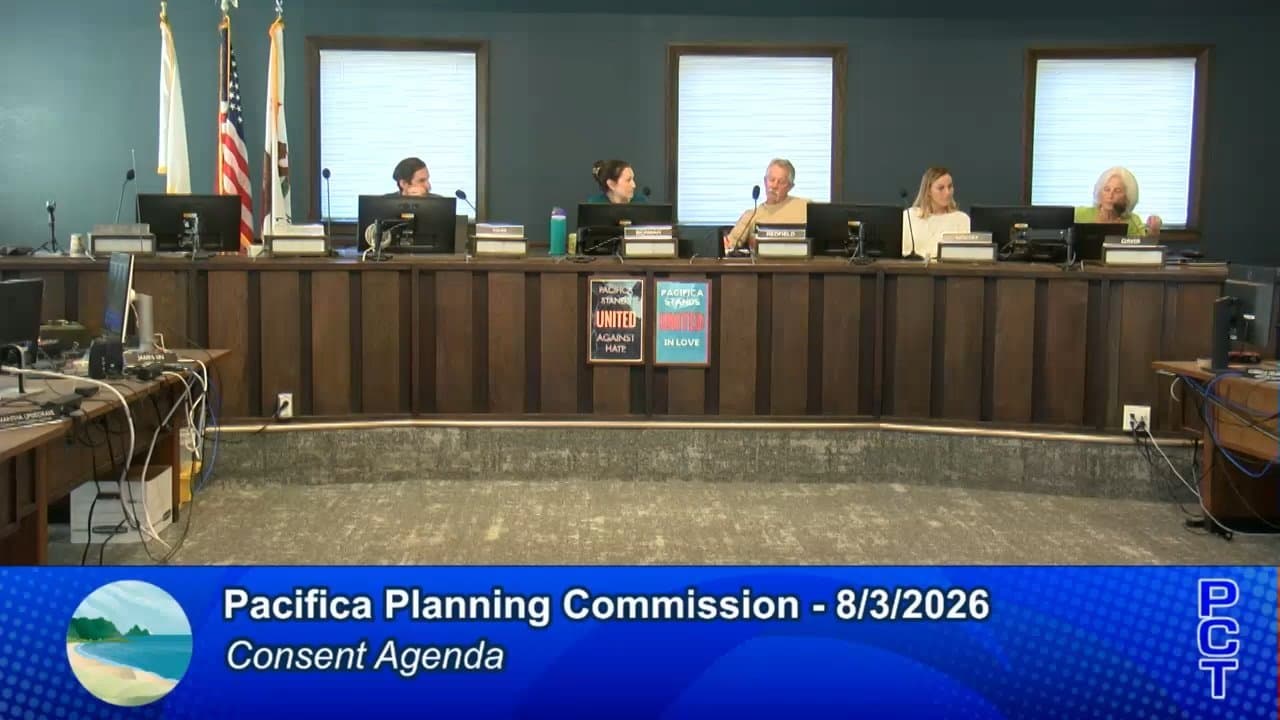
Vice Chair Lauren Berman, who chaired the meeting in Chair Samantha Hauser's absence, acknowledged both sides had engaged in proper due process. "I also appreciate the applicant's time in working with the city. I think everyone has gone through the due process necessary for development, and so I appreciate both sides of this appeal," she said, adding that she personally agreed with staff's recommendation.
Decisions: Commissioner Davis moved to adopt a resolution denying the appeal. Commissioner Redfield seconded. The vote was 5-0 (For: 5, Against: 0, Absent: 2 — Commissioner Ferguson and Chair Hauser).
What's next: The developer can challenge the decision in court or pursue a citywide ballot measure to authorize residential development on the quarry under Ordinance 391CS. The project cannot proceed as filed without addressing the voter initiative and extensive inconsistencies with the 2025 Local Coastal Land Use Plan.
Sales Tax, Rental Rules, and Road Woes
City Manager Sean Charpentier announced a special City Council meeting Wednesday at 6 p.m. to consider placing a 1-cent general sales tax on the November ballot: "There is a special City Council meeting this Wednesday at 6 p.m. and the item on the agenda is consideration of a $0.01 sales tax measure for the November ballot." Revenue would fund general government purposes including fire suppression and road repairs — a pointed need in a city that Commissioner Redfield noted remains on San Mateo County's list of worst streets.
Community Development Director Samantha Updegrave reported that Pacifica's short-term rental ordinance will go before the California Coastal Commission on Aug. 12: "The Coastal Commission staff at this point has recommended some pretty significant modifications." The modifications could substantially alter Pacifica's vacation rental regulations.
Minor Items
Emergency Coastal Development Permit CDP 479-26 for a retaining wall at 400 Belfast Avenue was approved 5-0. This is the second emergency permit for the project after the applicant could not secure a contractor within the original 30-day window. A contractor is now in place with a Sept. 22 completion deadline. Two arborist reports confirmed a nearby city-owned cypress tree is healthy and will not be affected by construction.
Commissioners Redfield and Hauser were designated as Planning Commission liaisons for the Aug. 24 City Council meeting on the density bonus and inclusionary housing ordinance.
Commissioner Davis reported completing a site walk on Light Lot 7 for the continued Harmony 1 project.
Vice Chair Berman asked about the city's transition to a new agenda management system with video integration and a potential shift from verbatim to action-style meeting minutes.