
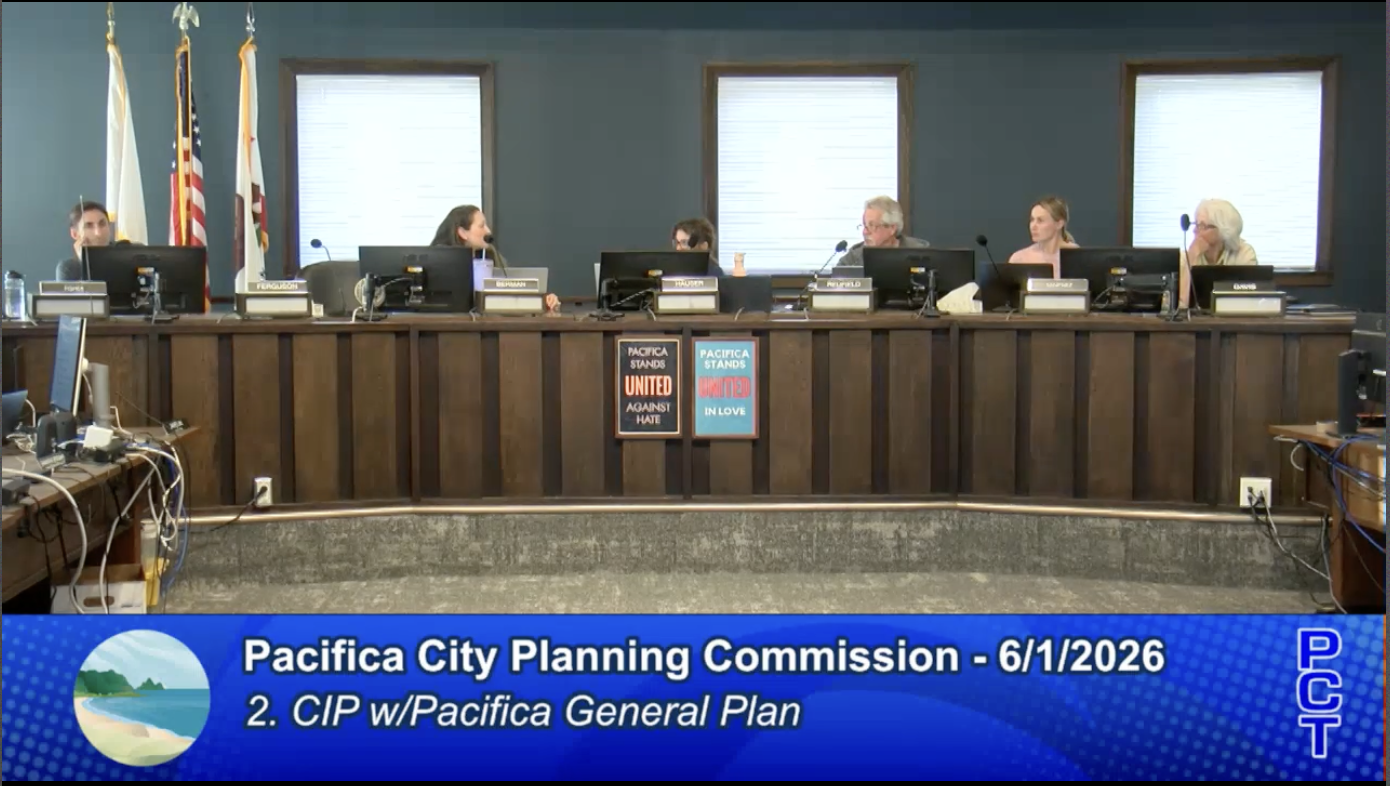
Planning Commission - Jun 01, 2026 - Meeting

Planning Commission - Jun 01, 2026 - Meeting

Planning CommissionPacificaJune 1, 2026

Sources:

Locunity is a independent informational service and is not an official government page for this commission.We use AI-assisted analysis and human editorial review to publish information.

Pacifica Advances Housing Rules as 1,892 New Units Loom

Pacifica's Planning Commission unanimously advanced an overhaul of the city's affordable housing regulations in more than three decades, replacing a density bonus ordinance untouched since 1992 and rewriting the inclusionary housing program just as nearly 1,900 new units become possible under recent rezoning. The commission also signed off on a five-year capital improvement plan spanning fire stations, wastewater upgrades, and coastal trails — but parts of it remains unfunded.

  • Density bonus and inclusionary housing ordinances get a complete rewrite to comply with state law, with 99-year rental affordability terms and new Below Market Rate (BMR) phasing rules

  • Coastal zone carved out of the density bonus update pending Coastal Commission coordination; staff will return next fiscal year

  • Commissioners clash over generational wealth implications of deed restrictions that reset when affordable homes change hands

  • 2026-2031 Capital Improvement Program approved for general plan consistency, covering fire stations, wastewater, and trail projects

  • Rockaway Beach bridge remains closed due to severe rust; city denied Coastal Conservancy grant funding

  • San Mateo County median income hits $200,800 for a family of four, up 8% year-over-year


Pacifica's Housing Playbook Gets a 30-Year Update

The basics: The Planning Commission recommended city council approve Text Amendment TA129-26, which repeals and replaces both the city's 1992 density bonus ordinance (Article 41) and its 2007 inclusionary housing program (Article 47). The overhaul brings Pacifica into compliance with Government Code 65915 and sets the framework for how affordable housing will be built as development applications arrive for sites rezoned under the housing element.

Why it matters: Pacifica's housing element rezoning created the regulatory space for 1,892 new units across roughly 30 sites — the most new development potential the city has seen in 40 years. Without updated rules, the city had no enforceable, state-compliant mechanism to ensure those projects deliver affordable homes.

Where things stand: Community Development Director Samantha Updegrave told commissioners the update was urgent: "Our housing element rezoning program provided the regulatory framework for an additional 1,892 units. I think in the end, we rezoned 30 sites. So that is quite a bit of new development potential that the city has not had until recently."

Key changes in the new ordinance include: fewer affordable units required to qualify for density bonuses (matching state law), 99-year affordability terms for rental units, 45-year deed restrictions on ownership units that reset upon sale or transfer, mandatory incentives and concessions for qualifying projects, applicability to more housing types, and CEQA exemptions for density bonus projects.

Consultants Tim Davis and Alex Wagner from Hart of San Mateo walked the commission through the draft section by section. The hearing was a continuation from May 4.

Coastal Zone Carved Out — For Now

Commissioner Fisher questioned why the density bonus provisions wouldn't apply in the coastal zone, asking whether it made sense to wait for the Coastal Commission and do everything at once. Director Updegrave explained that coordination with the Coastal Commission revealed the provisions would require far more detail than the simple ABAG model template the city used: "The examples that we're seeing from Laguna Beach, Humboldt County have far more detail, including things like application processing, how to deal with coastal resources, different kinds of analysis that's needed."

Chair Samantha Hauser pushed from the other direction, asking whether the city could adopt the density bonus conditionally for the coastal zone: "Is there a way to adopt this in a qualified way in the coastal zone that says until such time as the Coastal Commission finds this consistent, this will not apply to the coastal zone, but if upon their approval, it will automatically apply?"

Staff said the Coastal Commission's requirements remain too uncertain and complex for that approach. The commission also noted that the Sharp Park Specific Plan requires local coastal plan amendments, and the city is limited to three general plan amendments and three local coastal program amendments per year — though both can be batched.

What's next: Staff will return next fiscal year with coastal-zone-specific density bonus provisions after further Coastal Commission coordination.

Deed Restrictions and Generational Wealth

The sharpest policy debate centered on what happens when an affordable homeowner dies or transfers their property. Under the new ordinance, the 45-year affordability deed restriction resets upon sale or transfer — meaning a family that owned an affordable home for decades could not pass it to their children free of restrictions.

Vice Chair Lauren Berman raised the concern directly: "If a home were owned by a family in Pacifica for 44 years and then the homeowner wanted to downsize and transfer their home to their children, I feel like that's a prime opportunity for that family to build generational wealth."

Alex Wagner from Hart explained that the reset-on-transfer provision prevents exploitation through off-the-books transactions and is standard practice across jurisdictions. Assistant City Attorney Karen Murphy noted that some cities allow transfers via will or trust if the recipient qualifies as an affordable household, offering a potential middle ground. Tim Davis added that even when the 45-year restriction expires, state density bonus law requires an equity sharing agreement under which the city recaptures a portion of appreciation: "State density bonus law requires an equity sharing agreement that some of it is recaptured by the city even if you expire at 45 years. So that wealth creating issue is still an issue even in that respect."

The commission ultimately accepted the reset provision but the discussion signaled this tension — between keeping units affordable long-term and allowing low-income families to build wealth — will likely resurface at city council.

BMR Phasing: How Fast Must Affordable Units Be Built?

Commissioners spent significant time on when below-market-rate units must be constructed relative to market-rate units in the same project. Vice Chair Berman, citing conversations with affordable housing developers and providers, argued that requiring BMR units to be built before or simultaneous with market-rate units is burdensome: "Over the past couple of weeks, I was talking to a few different affordable housing developers and affordable housing providers. And this was an item that others run into as issues in cities that they try to provide housing in."

Tim Davis warned sharply against too much flexibility, drawing on personal experience: "I have worked in a city where we allowed developers to get an off-site without any building selected, and they only had to bring in the units before they got their CFO. And it was a nightmare."

Commissioner Marjory Davis reinforced the concern: "Even if it's not intentional on the part of the developer, things happen. I can think of any number of projects in Pacifica that ran out of money. And whether it's intentional or not, I think we want to avoid the risk of not having the BMR units built."

The commission settled on adding "proportional" language — ensuring BMR units are built proportionally alongside market-rate units rather than requiring strict prior-to-or-concurrent construction — balancing flexibility with accountability.

Cost Reductions and State Law Constraints

Chair Hauser flagged a drafting issue around density bonus concessions, citing Government Code 65915 to argue the city cannot legally require developers to quantify cost reductions: "I don't think we're supposed to ask for a cost reduction. If you look at 65915 subdivision D1, it says that we shall grant the concession or incentive requested by the applicant unless the city makes a written finding based on substantial evidence."

Commissioner Marjory Davis helped resolve the question, clarifying: "If they're requesting a concession, we're asking them to provide the category or the area in which they expect a cost reduction, not the dollar value or a percentage of total cost. So it's qualitative, not quantitative."

The commission also discussed off-site preservation requirements, in-lieu fees, land dedication timing, and maximum sales price calculations based on Health and Safety Code definitions of affordable housing cost.

Decisions: The commission voted 6-0 (Commissioner Ferguson absent) to adopt the resolution recommending city council approve the text amendment as amended during deliberation, finding the draft ordinance exempt from CEQA. Commissioner Marjory Davis moved; Vice Chair Berman seconded.

What's next: The ordinance goes to city council for final approval. Coastal zone provisions will follow separately.


Five-Year Capital Plan Approved, but Funding Gap Looms

Why it matters: The 2026-2031 Capital Improvement Program catalogs the city's infrastructure priorities — fire stations, the wastewater treatment plant, coastal trails, bike lanes, and bridge repairs — but many projects remain unfunded, leaving Pacifica dependent on grants and development impact fees to maintain critical facilities.

Where things stand: Senior Planner James Lin presented the CIP, noting the Planning Commission's role is limited to determining general plan consistency — not project priorities or funding levels. Deputy Director Roland Yip from Public Works fielded detailed questions.

Commissioner Chris Redfield asked about the San Pedro Creek and Linda Mar Beach monitoring program, which is funded through a Resource Conservation District contract. The program is skipping the current fiscal year, with $88,000 requested for next year. Redfield also asked how CIP projects are prioritized. Yip explained the process spans multiple levels: "On the highest level it starts with the city council and their prioritization and that's the goal setting. Then we look at our master plans and there's priorities in all of them like whether it's the ped bike master plan, local roadway safety plan."

Vice Chair Berman praised the CIP's new formatting with photos and stressed the broader fiscal challenge facing Pacifica: "We need to welcome quality development in our city to help support these facilities." She asked about Calera Creek Wetlands monitoring — which appears in the wastewater section because the treatment plant outfalls into the creek — and about how long completed projects remain in the CIP (standard practice: one year).

Chair Hauser urged staff to investigate Bond Opportunities for Land Development (BOLD) and Statewide Community Infrastructure Program (SCIP) programs — state infrastructure financing tools that help developers form community facilities districts: "One thing that I've seen a lot of cities start to do, starting in Central California, but starting to really percolate through the Bay Area, is participate in Bold and SCIP, which use CIPs to help developers." She also asked whether the city has impact fees for community facilities like fire stations. Administrative Services Director Marisol Gomez confirmed a general development impact fee exists and that a fee study is underway.

Rockaway Beach Bridge Deteriorating

The Rockaway Beach bridge remains closed after inspections revealed severe rust underneath the structure. Deputy Director Yip described the problem: "On the appearance of the top level, it doesn't look terribly deteriorated. But then if you would like to see photos on the underside, it's completely rusted out. And so we can't continue to have foot traffic going over it."

The city was denied a Coastal Conservancy grant and is exploring other funding options. Yip noted the original bridge was funded privately by commercial area businesses.

Commissioner Marjory Davis asked about Cattle Hill CIP projects and a general plan policy referencing land transfer to the Golden Gate National Recreation Area. Staff clarified the reference may have been incorrectly included and is not part of current CIP projects.

Decisions: The commission voted 6-0 (Ferguson absent) to adopt the resolution finding the CIP consistent with the General Plan 2040. Vice Chair Berman moved; Commissioner Redfield seconded.


One More Number: Newly released area median income data shows San Mateo County's family of four median income reached $200,800 — up 8% year-over-year. As Chair Hauser put it: "If you're a family with two parents and two children, the median income in this county is $200,800." That figure drives every affordability calculation in the ordinances the commission just rewrote.


Minor Items

  • Agenda and minutes: The commission approved the order of the agenda (5-0; Commissioners Ferguson and Sanchez absent). Minutes from April and May meetings were pulled due to technology issues and will return at a future meeting.

  • Commissioner Sanchez arrived during the CIP item and participated in both subsequent votes.

  • Commissioner Ferguson was absent for the entire meeting.