
City Council - Aug 05, 2026 - Meeting

City Council - Aug 05, 2026 - Meeting

City CouncilPacificaAugust 5, 2026

Sources:

Locunity is a independent informational service and is not an official government page for this commission.We use AI-assisted analysis and human editorial review to publish information.

Council Sends $5 Million Sales Tax to November Ballot as Deficit Hits Crisis Level

Pacifica's City Council convened a special meeting Aug. 5 to confront a stark fiscal reality: without new revenue, staff warned, the city will begin dismantling core services — police patrols, fire response, childcare, parks — as early as next year. After nearly four hours of staff presentations, public debate and council deliberation, the five-member body voted unanimously to ask voters to approve a 1% transaction and use tax projected to raise roughly $5 million a year.

  • Council votes 5-0 to place a 1% transaction and use tax on the Nov. 3 ballot, projected to generate $5 million annually for general city services

  • State vehicle license fee (VLF) losses compound Pacifica's structural deficit, pushing projections to $7 million next fiscal year and $9.8 million the year after

  • Councilmember Espinosa votes yes reluctantly, warning of the regressive burden on residents earning under $50,000 and calling for accountability

  • Sunset clause rejected after extended debate; council instead commits to creating a citizens oversight committee by resolution

  • Public comment deeply split, with supporters citing the structural crisis and critics blaming the short-term rental ordinance and past spending decisions


A City Running Out of Options

The basics: Pacifica's general fund — roughly 70% of which goes to salaries — supports every municipal service from police and fire to parks and childcare. The city has fewer businesses than comparable cities, loses an estimated 67% of potential sales tax revenue to purchases made outside its borders, and has a limited visitor economy.

Why it matters: Staff told the council the city has exhausted its ability to balance budgets through spending cuts alone. The current-year budget was balanced only with one-time measures: delayed police and firefighter hires, frozen maintenance positions, eliminated senior transportation, reduced parks upkeep, and deferred retirement health-care contributions.

Where things stand: Assistant City Manager Yulia Carter delivered a critical update: because two fewer schools in San Mateo County now qualify as "non-basic-aid," the state's Vehicle License Fee backfill — money owed to county cities but redirected by Sacramento — will shrink Pacifica's share by an additional $2 million per year. Combined with existing VLF losses and rising costs, projected deficits now stand at $7 million in fiscal year 2027-28 and $9.8 million in 2028-29.

City Manager Kevin Woodhouse put the stakes bluntly: "If the new revenue is not materializing, if this sales tax measure does not proceed, what's at risk next year includes almost everything that we do. And at the end of that process, Pacifica will look different. Not in a good way."

Mayor Christine Boles illustrated the city's revenue disadvantage by comparing Pacifica unfavorably to its neighbor: "San Carlos only has a population of 30,000 and we have like 38. They're raising their tax by only a half cent and yet they're making $6 million where we're trying to raise it a whole cent and only making five."


How the Tax Works — and Why It Differs From Sales Tax

The basics: The proposed 1% transaction and use tax, or TUT, differs from the existing Bradley Burns sales tax in a key way: it applies at the point of delivery or use, not the point of sale. That means online purchases shipped to a Pacifica address, vehicle registrations, and goods bought elsewhere but used in the city would be subject to the tax — partially addressing the 67% sales tax leakage that has long starved the city's coffers.

Why it matters: Groceries, prescription medications, real estate, utilities, and professional services are exempt under state law. The measure would raise Pacifica's total sales tax rate from 9.875% to 10.875%. Exceeding the current state cap requires SB 762, which has passed both legislative houses and awaits the governor's signature.

As a general tax, it requires a simple majority (50% plus one) of voters to pass — but needs a four-fifths supermajority of the council (four of five members) to be placed on the ballot. A June poll showed 66% support among likely voters, dropping to 61% under negative push-poll questioning.

Multiple other San Mateo County cities are also placing revenue measures on the November ballot, meaning Pacifica's measure will compete for voter attention alongside a potential half-cent regional transit tax.


The Sunset Fight: Espinosa Pushes for a Time Limit

The most contentious deliberation centered on whether the tax should expire automatically.

Councilmember Mayra Espinosa argued passionately for a short sunset of three to five years, warning the tax would land hardest on families least able to absorb it. "We have 1,799 households making only under $50,000. We also have families making 2,163 making under $75,000. So that is already 39% plus 22% are making less than $100,000," she said. She added: "I don't want to put something there forever. This is going to cost for everything they buy in their house. So their dollar is going to only be $0.89."

Councilmember Sue Beckmeyer pushed back: "I'm not inclined to want to put a sunset date on this measure because there's no sunset date on the increasing costs of running the city." She noted that of 12 TUT measures across San Mateo County, eight have no sunset, and those that do range from nine to 38 years.

Mayor Boles and Councilmember Mary Bier expressed openness to a longer sunset of about 20 years, while Vice Mayor Greg Wright initially wanted more study time but ultimately supported 20 years. Staff noted the ballot question is capped at 75 words, making it difficult to fit both a sunset and oversight language.

The other side: City Manager Woodhouse reframed the trade-off directly: "It is true that a sales tax is a regressive taxation measure. It is equally true that municipal service reductions typically fall hardest on low-income households." Vice Mayor Wright put it more sharply: "A vote against this is basically a vote for an 11% across-the-board cut to city services."

Decisions: The council ultimately retained the original "until ended by voters" language — no fixed sunset. Instead, after City Attorney Michelle Kenyon worked in real time to draft amended language, the council added a new recital to the resolution committing to the creation of a citizens oversight committee. The switch came after Assistant City Manager Carter revealed that February polling showed "public disclosure" tested significantly higher than "community oversight" in the "much more likely to support" category — 43% versus 31%. The council kept the poll-tested "public disclosure" phrase in the ballot question and pursued the oversight committee as a separate council action.

Councilmember Espinosa voted yes reluctantly: "It's obvious that this is going to move forward. I'm going to vote. Not because that's what is in my heart, but I want to support" the city manager, she said, adding that she felt sad asking the community for more money and pledged to hold the city accountable.


Short-Term Rental Fallout Looms in the Background

Several speakers drew a direct line between the city's 2025 short-term rental ordinance and the current fiscal crisis.

A public commenter alleged the council was warned the STR ordinance would reduce transient occupancy tax revenue and is now asking residents to backfill the gap via sales tax. Mayor Boles asked staff for the actual revenue impact. Assistant City Manager Carter explained that initial TOT losses were less severe than mathematical projections because some operators adapted rather than ceasing operations — but warned that losses will continue as the ordinance is fully implemented. Critically, the coastal zone, where a significant share of STRs are located, still operates under the old ordinance pending Coastal Commission certification.

Councilmember Beckmeyer highlighted this timing issue, noting the projected revenue losses could still materialize as a delayed effect. Staff described the enforcement program as very difficult and potentially costing more than the revenue it generates.


Community Voices: Divided but Engaged

Eleven residents spoke during public comment on the tax measure, revealing a community grappling with the same trade-offs that divided the dais.

Supporters emphasized the structural nature of the crisis. Pete Shoemaker pledged to lead a campaign for the measure, calling the deficit a nationwide problem and framing the tax as an investment, not a burden. Mark Leach, representing Teamsters 856, endorsed the measure and pledged organized labor support, noting city employees are working harder to cover vacant and frozen positions. Adam said he doesn't like taxes but saw no alternative, citing deferred maintenance that turned a $20 million pier repair into a $60 million problem.

Critics were equally forceful. Dan Stegink called the measure doomed given competing ballot measures and criticized the council's track record on infrastructure at Linda Mar, Rockaway Bridge, and the pier. He accused the mayor of misleading the community about the STR ordinance's fiscal impact and questioned the $20 million civic center investment. Thomas Weissmiller warned that a half-cent regional transit tax also on the ballot could push the combined increase to 1.5% and cautioned that oversight committees typically lack teeth. Samuel Casillas, who announced his candidacy for City Council, criticized the lack of economic development leadership and cited the closure of the Seabowl entertainment venue.

Councilmember Bier spoke personally about why she supports the measure despite her own financial vulnerability: "I am a staff member for a school district. I fall into one of the categories you're talking about. I'm a renter who can be priced out of my next paycheck, but this will allow me to contribute through this kind of tax."

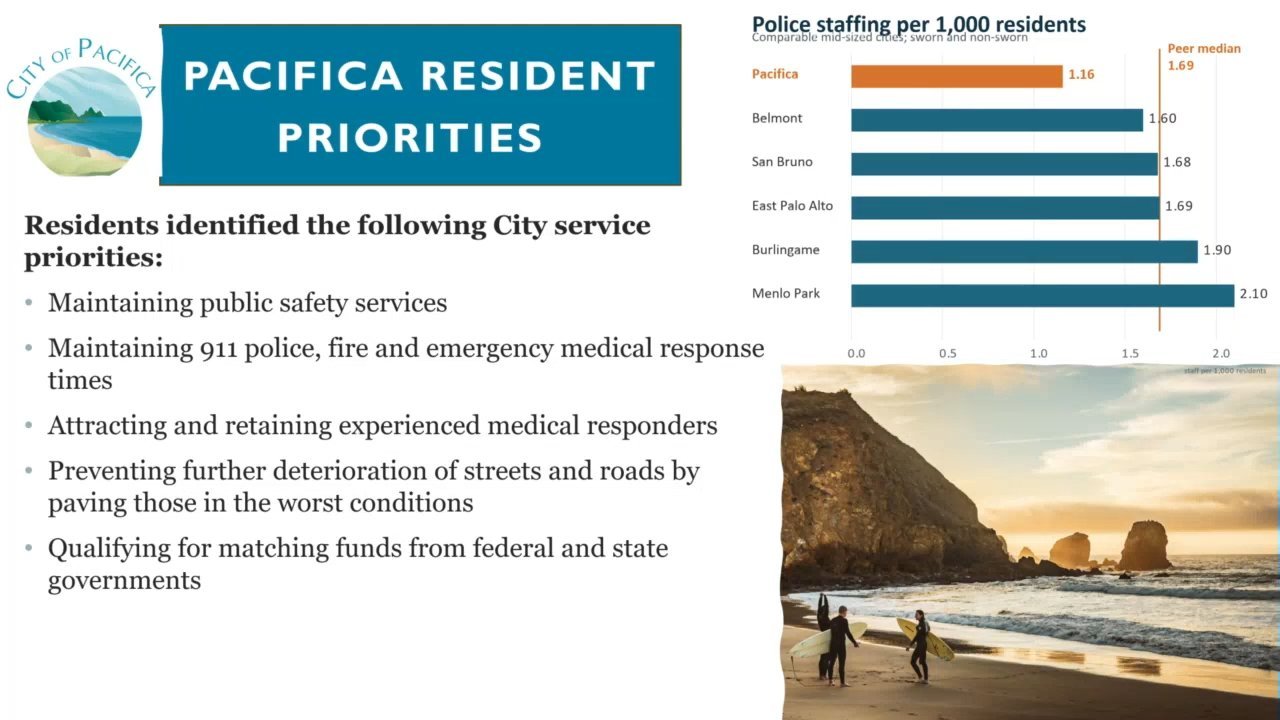
Vice Mayor Wright praised city staff who stretch thin resources: "Nobody in the county even comes close to that low number. They work miracles on a daily basis. At night, it's my understanding that we only have two police officers on duty. What's that mean if there's two domestic violence calls?"

Mayor Boles noted the city recently lost its senior public works engineer in the middle of ongoing coastal projects — a departure she attributed to unsustainable workloads.


What's Next

The resolution, as amended by the city attorney, now goes to San Mateo County for consolidation with the Nov. 3 statewide general election. SB 762 must be signed by the governor for the tax to exceed the current state cap. If voters approve, the tax takes effect and is collected by the California Department of Tax and Fee Administration. If it fails, the next opportunity for a ballot measure would not come until 2028 — by which time staff projects the deficit could approach $10 million.

The vote: For: 5 (Councilmember Sue Beckmeyer, Councilmember Mary Bier, Vice Mayor Greg Wright, Mayor Christine Boles, Councilmember Mayra Espinosa), Against: 0, Absent: 0. Motion by Beckmeyer, seconded by Bier.


Minor Items

  • Highway 1 maintenance: Public commenter Cyd Young urged the city to contact Caltrans about weed removal and corridor maintenance along Highway 1 through Pacifica, saying Caltrans District 4 significantly underperforms other districts.

  • Roundabout study: Public commenter Remi Tan suggested working with Caltrans and San Mateo County to study replacing traffic lights on Highway 1 with roundabouts, citing safety and cost-savings data from Indiana. Tan also encouraged the city to leverage popular events like the dog surfing contest and Fog Fest for economic development.