
Pacifica Opens Exclusive Talks on 131-Room Beachfront Hotel
City Council • PacificaOctober 26, 2026
Locunity is an independent informational service and is not an official government page for this commission. All information is sourced from public footage and an analysis of official agendas with the aid of responsible, fact-checked AI. to report an error or omission.
Pacifica took its biggest step in years toward a new revenue engine Monday. The City Council voted unanimously to enter exclusive negotiations with a developer for a hotel on city-owned land at 2212 Beach Boulevard. Earlier, in a marathon joint session with the Planning Commission, officials began shaping the city's first affordable housing project on public land. A wave of residents also pressed the council to drop its Flock license plate reader contract.
- Council unanimously approves exclusive negotiation agreement for a 131-room hotel concept on city land
- Hotel pitched at about $1.5M a year in hotel tax; critics cite flooding, beachfront sale
- Sanchez Library site test fits show 48 to 68 affordable units; families favored
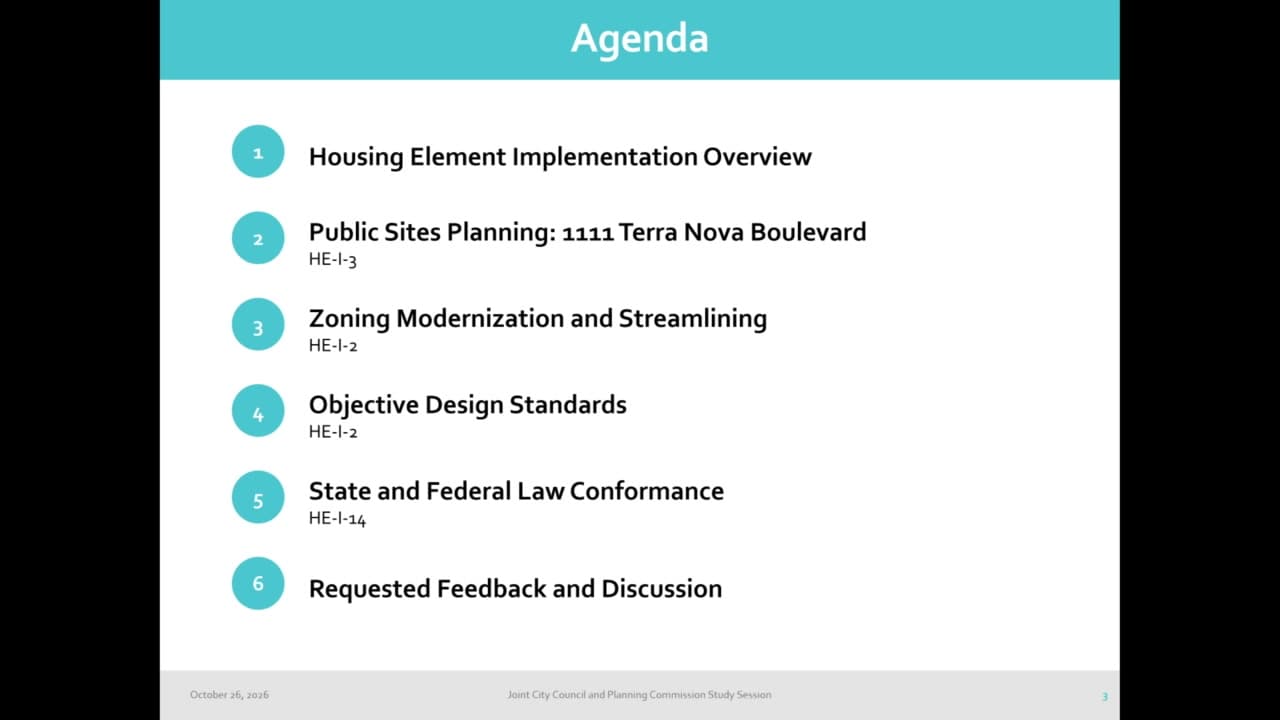
- Objective design standards may be fast-tracked ahead of an 18-month zoning rewrite
- Organized residents urge council to let the Flock contract lapse ahead of a looming vote
Beach Boulevard Hotel Talks Get the Green Light
Why it matters: City officials and consultants pitched the project as a recurring revenue source for a city with structural deficits. Critics see a one-way sale of scarce beachfront land.
The basics: An exclusive negotiation agreement, or ENA, bars the city from negotiating with other parties for a set period while one developer studies a site. "Approving ENA is not approving the hotel," said Assistant City Manager Yulia Carter.
Where things stand: The concept from Nirali Pacifica Ocean View LLC is a 131-room, four-story, V-shaped hotel with 8,000 square feet of meeting space. Estimates presented include $50M in private investment, about $1.5M in annual transient occupancy tax (TOT), about $500,000 in property tax (roughly $100,000 to the city), 50-plus jobs and $2M to $6M in offsite spending.
Several council members questioned the TOT and room-rate assumptions. Ken Hira, President, CosMc Companies, which presented alongside staff, defended them: "I would say the 260, which is their stabilized number, call it year 3 of operations, frankly is conservative."
Deal terms:
- The developer posts a $100,000 deposit, of which $10,000 is nonrefundable.
- A five-month due diligence period begins after Coastal Commission-related plan amendments.
- Six-month extensions are available.
- A later $400,000 deposit is required.
- The city recovers its costs.
- Any sale would require a future disposition and development agreement.
A $3M figure was described as a non-binding residual land value, not a price. Councilmember Mayra Espinosa pressed on when an appraisal would happen. Council members also asked about jobs and the competing proposal.
The other side: Public commenter Zach Navarra warned against over-reliance on hotels, rosy projections and selling beachfront property. Public commenter Jessica Shepherd questioned the need for an eighth hotel, the modest nonrefundable deposit, shading and flood risk. She floated a small-business market modeled on San Francisco's Ferry Building instead.
Public commenter Summer L. urged members to hold firm on transparency, engagement and union labor. Ruben Galvan, Field Representative, North Coast State Carpenters Union Local 217, asked for strong labor standards, including fair wages, health insurance and apprenticeships. He said the union wants to meet the developer.
On the other side, public commenter Tiger Jaspie cited decades of study and the city's financial need. Public commenter Connie Menefee cited TOT, jobs and tourism, and she urged a yes vote on Measure BB as a bridge.
Decisions and stakeholder impacts: The council twice extended the meeting, to 11:30 and then 11:45, to finish the item. It then adopted the resolution on a unanimous voice vote, with no individual tally announced. The vote also found the action exempt from CEQA, the state's environmental review law. Councilmember Sue Beckmeyer moved the item and Mayor Christine Boles seconded. "This exclusive negotiating agreement is a big step," said Beckmeyer, who stressed it is not a commitment to marry. "The work that the ad hoc committee has done on this has been extraordinary," said Councilmember Mary Bier.
The developer funds due diligence, so city exposure stays low for now. The labor union, hotel competitors and coastal neighbors all have leverage points ahead.
What's next: Final sale terms, design and environmental review all require future council votes.
Library Site Could Become City's First Public-Land Affordable Housing
Why it matters: The city-owned site at 1111 Terra Nova Boulevard is one of Pacifica's few realistic chances to deliver below-market housing under its 1,892-unit regional allocation. "This is perhaps the number one tool that the city has to help actually build affordable housing," said Aaron Aknin, Principal, Good City Company.
Where things stand: Staff stressed there were no decisions. The roughly 1.6 buildable acres at the Sanchez Library site are bisected by a 54-inch concrete drainage pipe, and moving it would cost an estimated $1.2M to $1.9M. Three test fits were presented:
- Keep the library and the pipe: about 48 units.
- Keep the library and relocate the pipe: about 63 units.
- Build a mixed-use building that incorporates the library: about 68 units.
Tim Davis of HART explained that state tax-credit scoring awards no points to housing not targeted to a specific population. That leaves large-family and senior housing as the feasible options.
The debate: Members raised several questions:
- Parking tradeoffs
- Easements and the need for a survey
- The 50-foot height limit
- Daylighting the stormwater pipe
- Trees
- Whether Surplus Land Act exemptions preserve city control
Opinions leaned toward families or a mix. "We also might want to contemplate the idea of 2 structures," said Vice Mayor Greg Wright, who also asked staff to test deed-restricted for-sale units as a path to generational wealth. "If we want our young people that are growing up in Pacifica to be able to live here, then we should probably have some units that they can afford," said Bier. Espinosa urged mailers and door-knocking: "A lot of people are not on social media."
The other side: Public commenters split between senior and family housing. Public commenter Kimberly Finale first praised senior housing, then suggested the site may suit families with green space. Galvan of Carpenters Local 217 asked for strong contractor prequalification language in the request for proposals (RFP) to screen out firms that misclassify workers.
What's next: Staff expects a 100% affordable project. A community workshop is planned for winter 2026-27, with a return to council in spring 2027. "I do believe that is a manageable schedule," said Community Development Director Updegrave.
Design Standards Likely to Jump the Zoning Queue
The basics: Objective design standards are measurable rules that replace subjective design judgment. Jake Garcia, Senior Planner, Good City Company, offered an example: "building exteriors shall utilize at least 2 different colors." Under state law, these standards limit subjective review of many housing projects.
Where things stand: The full zoning modernization would run from September 2026 to February 2028, with standalone standards targeted for fall 2027. Nearly all speakers backed adopting the standards first. They also called for more accessible engagement, such as open houses and pop-up events. Council members asked for graphics and focused tables in outreach materials.
The Brown Act wrinkle: Staff recommended a three-member Planning Commission ad hoc subcommittee meeting up to six times. A joint council-commission panel hit a legal snag. "The exception of the Brown Act for ad hoc committees is for groups that are solely a member of a legislative body," said the City Attorney. A mixed group would therefore need public noticing. The alternatives are separate subcommittees or noticed joint study sessions.
The other side: Public commenter Dan Stegink claimed the meeting itself violated the Brown Act because page 16 of the packet was obscured, and he threatened to file. Mayor Boles and Vice Mayor Wright offered to read the page aloud. The City Attorney said the faint page "doesn't affect the noticing of the meeting in terms of the Brown Act." The page concerned racially concentrated areas of affluence. A council member later noted the content appears on packet page 6 and urged demographic study of south-end census tracts. Public commenter Ken Miles asked for a wildfire ordinance and a study session on the Hillside Preservation District.
Flock Opponents Mobilize Ahead of Contract Vote
Why it matters: The Flock automated license plate reader contract is expiring. That makes it the city's most contested near-term surveillance decision.
Where things stand: Speakers described a renewal vote as roughly two weeks away. They objected to a rumored delay past the Nov. 3 election, possibly to Thanksgiving week. They cited:
- A petition with more than 270 signatures and more than 100 emails
- Other California cities that ended Flock contracts
- Fears that the data could aid immigration enforcement
- Data "side sharing" and legal liability
- Camera placement near a pharmacy and a Title I school
Who spoke: Public commenter Liz asked the city to turn off the cameras and not switch to another vendor. Public commenter Max Marino linked the cameras to ICE arrests and fear in immigrant families. Public commenter Paige Lee, a registered nurse and 29-year resident, called the technology error-prone. Public commenter Wren Murphy offered a volunteer community care team as an alternative. Summer L. urged warrants and local data control. Navarra said the council could vote no now and revisit a new framework later. Public commenter Tyler Cabana criticized delaying the vote past the election.
What's next: The council took no action. Watch for the renewal item on an upcoming agenda.
Minor Items
- Commission charter rewrite: The ordinance renames the Emergency Preparedness and Safety Commission, adds a non-voting youth seat and removes its parking-appeal role. First reading passed unanimously by voice vote.
- Consent calendar: It passed unanimously and included a pool MOU extension that public commenter Jean Brink backed to keep talks alive.
- July 4 report: It showed 15 $1,000 citations and fog that kept drones grounded ("Visibility was only 100 feet," said Police Captain Bill Glasgow). Revenue roughly offset costs.
- Pier and grant: City Manager Kevin Woodhouse said pier shoring begins, targeting completion in late January or February. A new engineer helped prepare a $14M federal application for the Esplanade project.
- Safe parking: Suzanne Moore of Pacifica Housing for All urged extending the program, which is credited with housing 131 people.
Looking Ahead
Applications for the SamTrans coastside board seat are due Nov. 1. Twenty Arbor Day trees will be planted at Sanchez Park on Nov. 7.