
Pacifica Drops Flock, Delays Axon Plate Reader Deal to Nov. 23
City Council • PacificaNovember 17, 2026
Locunity is an independent informational service and is not an official government page for this commission. All information is sourced from public footage and an analysis of official agendas with the aid of responsible, fact-checked AI. to report an error or omission.
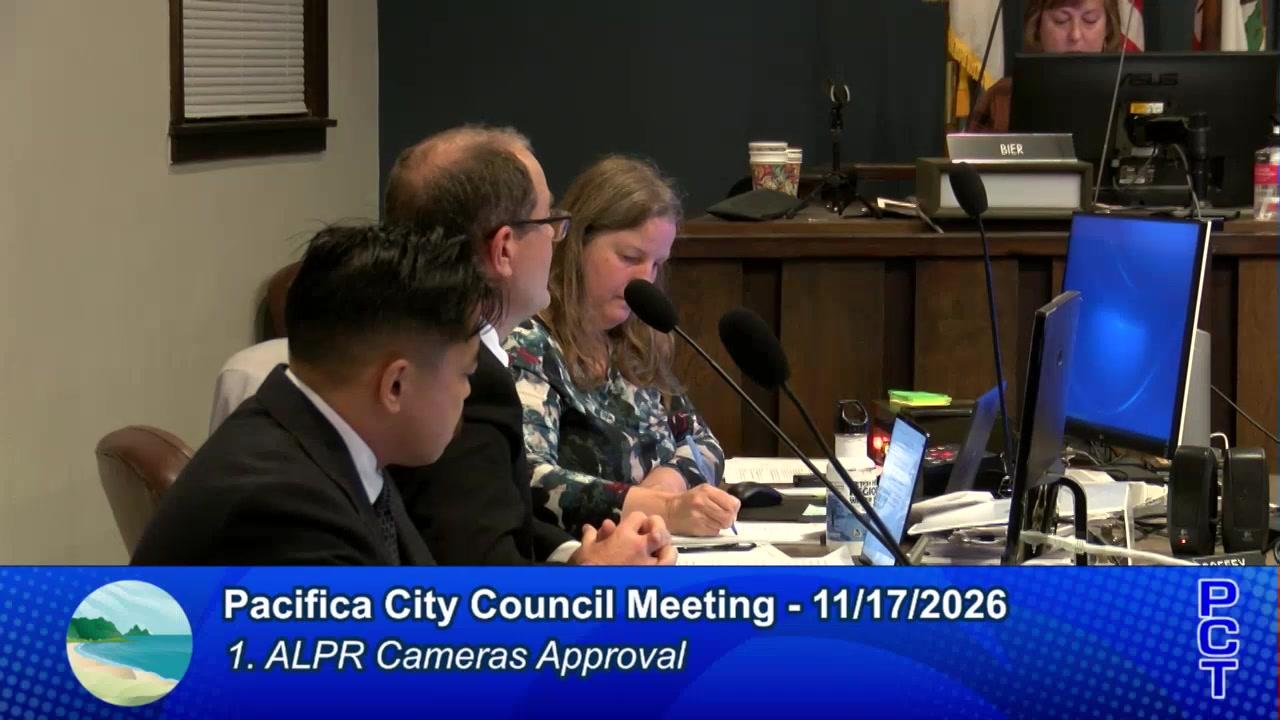
Pacifica will end its contract with Flock Safety, the license plate reader vendor that drew months of community criticism. A replacement is not settled yet. After a special meeting that ran past midnight, the City Council unanimously authorized Flock's non-renewal but put off a vote on a five-year, $123,965 Axon contract until Nov. 23, leaving the city's camera program in limbo.
- Flock is out: council unanimously authorizes non-renewal ahead of the Nov. 24 auto-renewal deadline
- Axon decision continued to Nov. 23 after members cite too many open questions on the five-year deal
- About 30 speakers opposed, 18 supported license plate readers, by the city manager's count
- ICE fears dominate: immigrant-rights groups and two councilmembers flag Axon's federal ties
- Police argue cameras offset staffing: 28 sworn personnel; 71 September cases involved plate reader leads
Flock Ends, Axon Waits
Why it matters: Pacifica's fixed automated license plate readers, or ALPRs, are cameras that capture passing plates and alert police to wanted vehicles. They now face a possible coverage gap. Flock's agreement expires Dec. 24, Axon's offer sunsets Nov. 27, and staff said installation takes 30 to 90 days after signing.
Where things stand: The city manager framed a two-part recommendation: "my recommendation is to not renew Flock and to enter into a 5-year contract with Axon for ALPRs," said the City Manager. The Axon deal covers 10 fixed cameras and related services for up to $123,965, about $24,793 a year. Flock costs about $30,000 a year.
Police Chief Maria Sarasua said two community forums and other outreach produced no consensus. Staff listed 12 program changes already made or built into the new deal:
- A standardized list of 42 offense types replaces free-text search justifications
- City IT audits every search; unusual searches trigger an automated flag
- Data deletes after 30 days, with a First Amendment protection added
- Under Axon, sharing is off by default and by invitation only
- No statewide or nationwide lookup is available to outside agencies
"We reduced our sharing relationships from 283 agencies down to 72 and established written criteria governing those relationships," said Sgt. Eric Martinez, Pacifica Police Department.
Contract terms include compliance with the California Values Act, the state's sanctuary law limiting local cooperation with federal immigration enforcement. They also bar using city data to train AI, require breach notice within 24 hours, add termination rights and relocate one camera.
The other side: Councilmembers pushed on term length and pace. "Do we have to rush? Because we don't know enough about Axon," said Councilmember Mayra Espinosa, who asked about a one-year term, quarterly audits, encryption and case-by-case outside searches. Chief Sarasua replied that the equipment's useful life is five years, a one-year term would still require buying the hardware upfront, and the contract has several termination provisions, including non-appropriation and for-cause exits. "For me, the decision to recommend Axon was incredibly intentional," said Chief Sarasua.
Mayor Christine Boles said she still had contract questions and would hold them for Nov. 23.
Decisions and stakeholder impacts: The council split the staff recommendation in two. Mayor Boles moved to authorize the city manager to send Flock written notice of non-renewal. Councilmember Mary Bier seconded, and the motion passed unanimously by voice vote. Boles then moved to continue the Axon item to Nov. 23, with Bier seconding, and that also passed unanimously by voice vote. Opponents won the Flock exit they demanded. Police lose certainty about when fixed-camera coverage resumes.
What's next: Staff will bring an installation timeline to the Nov. 23 meeting.
Opponents Frame Vote as Sanctuary Test
Why it matters: Most speakers rejected Axon as well as Flock, arguing that switching vendors does not end mass surveillance. Organized groups and at least one referendum threat raise the political stakes of the Nov. 23 vote.
Where things stand: Immigrant-rights advocates led the opposition. Kimberly Wu, a community organizer with Services Immigrant Rights and Education Network (SIREN), said surveillance data can be weaponized against immigrants. She also said the Axon contract allows termination for breach rather than convenience. A Deflock NorCal representative, Manny, welcomed dropping Flock but called Axon worse, citing its federal immigration contracts. "We've defeated Flock more than 18 times across Northern California," he said.
Others went further. "Cancel the contract and do not replace it with a different ALPR," said public commenter Laura. She also criticized the city's listening sessions for not disclosing the Axon quote. Bill Christ, a public commenter, said activists would pursue a referendum if the council approved Axon.
Some speakers suggested alternatives: a public request for proposals, a city- or county-owned system, or simply slowing down. Brian C., a public commenter, said the process may sidestep the state public-comment requirement and urged a public RFP. Several commenters weighed the $123,965 cost against unmet needs, including senior programs, police radios and the seawall.
The concern reached the dais. "I am really concerned about Axon's ties to ICE and DHS especially," said Mayor Boles. Councilmember Bier described ICE-related fear while defending local police:
"This is weighing heavily on my heart, and in no way am I saying that the Pacifica Police Department had anything to do with these detentions or sharing of any information," said Councilmember Bier.
The other side: Axon said it would not hand over city data on federal request. "If we get a request from the federal government, we would direct that request to the agency that owns the data," said Jake Boro, Director of Systems Engineering, Axon. Asked about misuse, the chief said: "We have discovered no misuse of the system in any of our audits."
The legal backdrop: The city attorney said the only binding authority is a 2007 Ninth Circuit decision, U.S. v. Diaz-Castaneda, which found no expectation of privacy in license plates. No binding ruling has extended Carpenter, the Supreme Court's cellphone-location case, or a June 2026 Supreme Court location-data decision to ALPRs. An Oklahoma federal district court ruling is not binding in California. The attorney also flagged Munn v. Axon, a class action alleging Axon lacks a required ALPR usage policy, and said Pacifica's posted policy avoids that exposure. The attorney cautioned that the law could change.
Police Pitch Cameras as Force Multiplier
Why it matters: Supporters argue the cameras substitute for patrol capacity the city cannot afford. Department staffing is at its lowest since 2014.
Where things stand: Chief Sarasua said only 28 sworn personnel are available, and one detective handles all property and person crimes. In September 2026, 71 cases involved an ALPR alert or lead.
The police sergeants' and officers' associations, a county prosecutor and several former police leaders backed the program. "Having LPRs is not a mere preference, but it makes accountability possible," said Morris Maya, Assistant District Attorney, San Mateo County District Attorney's Office, who cited unsolved homicide cases. Ryan Bianculli, President of the Pacifica Police Sergeants Association, voiced "strong support for the approval of the new agreement."
Matt Lujan, speaking for the Pacifica Police Officers Association, said: "We're asking you to support the ALPR contract with Axon because this service helps us do our job and better serve Pacifica." Dave Bertini, a former Pacifica officer and Menlo Park police chief, called the technology a force multiplier as staffing shrinks. Sgt. Brandon Smith read a mother's statement crediting ALPR with helping find her abducted daughter.
Councilmember Sue Beckmeyer asked how the cameras help prevent crime, including repeat crimes such as catalytic converter theft. The chief said ALPR sends alerts to officers who otherwise cannot be visibly present.
The other side: Opponents called the evidence anecdotal and said Pacifica is already very safe. Cynthia Young, a public commenter, said she is being stalked and believes a Flock camera is being used to track her car.
Vice Mayor Greg Wright sought middle ground: "This is a good thing, not a divisive thing, and I appreciate the fact that our officers were willing to sit here and listen to that when I don't think they deserved it."
- Late night: Council voted twice to extend the meeting, first to midnight and then to 12:30 a.m. Both votes passed unanimously by voice vote.
- Former councilmember's view: Sue Waterloss said the original ALPR approval drew no opposition. "Not one person got up and spoke against it."
Looking ahead: The council takes up the Axon agreement again Nov. 23. Flock's non-renewal notice is due Nov. 24, and Axon's term sheet expires Nov. 27. Residents on both sides can weigh in before or at that meeting.