
Pacifica Approves Axon Plate Readers 3-2 With a Free Exit Year
City Council • PacificaNovember 23, 2026
Locunity is an independent informational service and is not an official government page for this commission. All information is sourced from public footage and an analysis of official agendas with the aid of responsible, fact-checked AI. to report an error or omission.
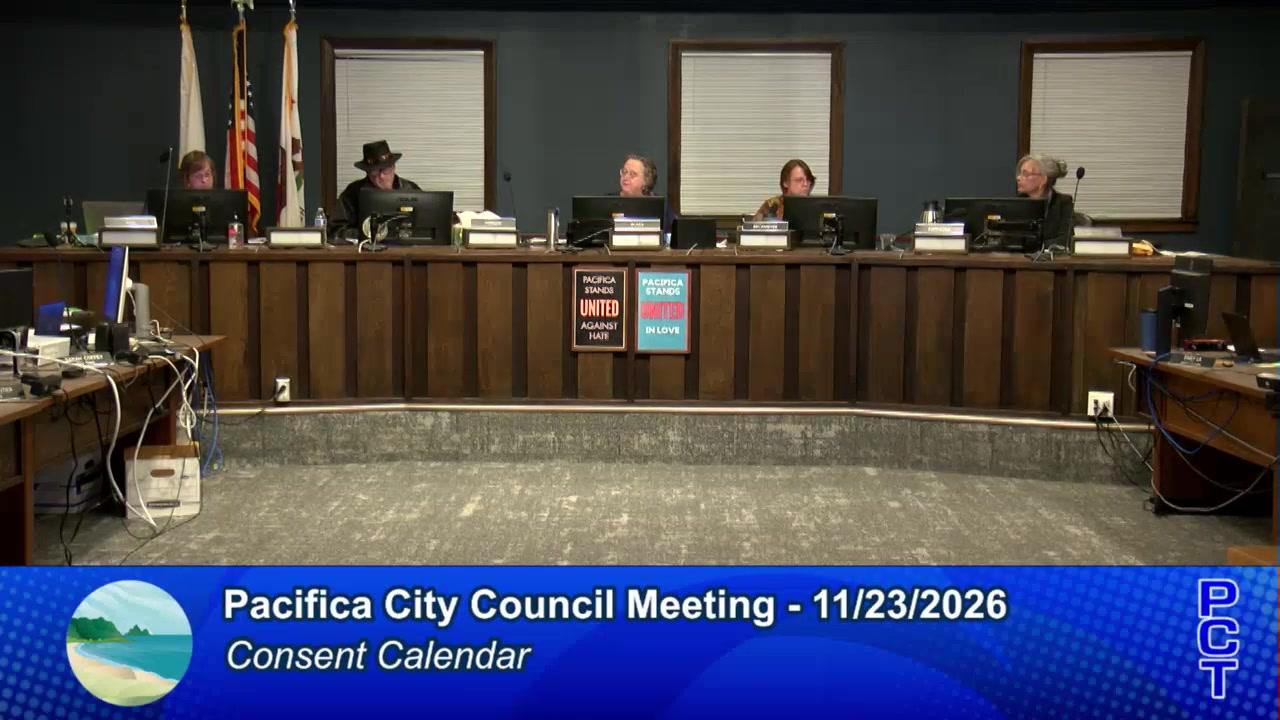
Pacifica will get license plate reader cameras again, but on a one-year trial the city can cancel at no cost. After roughly 30 public speakers and a session that ran past midnight, the City Council voted 3-2 on Nov. 23, 2026, to approve a five-year Axon Enterprise contract. The deal carries a set of oversight conditions that a newly seated council will have to enforce.
- Axon license plate reader deal approved 3-2 for 10 fixed cameras, not to exceed $123,965.36
- 12-month no-cost pilot lets the city exit without paying hardware fees
- Fears about federal immigration enforcement (ICE) dominated a deeply split public comment period
- No cameras go live until audit procedures are in place, and data sharing is narrowed to San Mateo County agencies
- Safe parking extended through June 30, 2027, with $68,458 from the Housing Action Fund
Axon Cameras Approved, With a Built-In Off-Ramp
The basics: Automated license plate readers (ALPRs) are fixed cameras that photograph passing plates and alert police to vehicles tied to crimes. Pacifica had canceled its contract with Flock Safety. The council continued this Axon item from Nov. 17.
Why it matters: The vote settles how Pacifica handles plate readers after Flock. The 3-2 split shows how contested surveillance technology remains in a sanctuary city.
Where things stand: On the day of the meeting, City Manager Sean Charpentier presented a revised Axon quote. It sets a five-year term with a 12-month no-cost pilot. In year one, the city can terminate for convenience with no MSRP fee, and Axon removes the equipment at no cost. After year one, an MSRP reconciliation fee applies on a declining schedule.
City Attorney Mark Tran said the fee does not apply if the city cancels for three reasons:
- the council doesn't fund the contract (non-appropriation)
- Axon violates the contract's legal-compliance section, which covers state, federal and California law
- the city terminates for cause
Tran also said Axon's cyber insurance is set at $2 million per claim and in the aggregate. During a recess, he wrote the new termination language and fee table into a proposed Section 16.4 of the amendment.
Police Chief Sarasua said the city would control camera settings and own the hardware outright for the first time. “We never owned our cameras. Now we would own them,” said Sarasua, Police Chief.
Charpentier named the core of the opposition directly. “I'm just gonna come out and say that it's about the ICE tensions,” said Charpentier, City Manager.
The other side: Mayor Christine Boles and Councilmember Mayra Espinosa wanted more time to review the final contract language. Vice Mayor Greg Wright countered that a delay would leave the city without cameras and noted the quote expires on the 27th.
“I wanted to have a clear understanding, 100%, if I vote tonight, that this is the best for our community,” said Mayra Espinosa, Councilmember.
Councilmember Mary Bier backed the technology but not this version of the deal. “I think we should have less cameras, but I think we should keep the cameras,” said Mary Bier, Councilmember.
Decisions and stakeholder impacts: Wright moved to adopt staff's recommendation with council direction, and Councilmember Sue Beckmeyer seconded. Boles added a friendly amendment to move cameras, including one near a school, and to review the contract around the third quarter.
The motion passed. For: 3 (Wright, Beckmeyer, Boles). Against: 2 (Espinosa, Bier). Absent: 0.
“I don't like 3-2 votes. I prefer 5-0 votes, but we're not going to always get them,” said Greg Wright, Vice Mayor.
Police gain a tool officers said they need. Critics gain a set of enforceable checkpoints, outlined under "What's next."
What's next: Staff committed to five follow-up steps:
- Brief the council on the policy and audit procedures in the first quarter.
- Relocate the camera within about two blocks of a school, and consider moving the one near Walgreens.
- Keep Axon service off until audit procedures exist.
- Return within the pilot year to help the council decide whether to use the cancellation clause.
- Amend the policy to limit sharing to local San Mateo County jurisdictions.
Any council member can also place an emergency discussion on the agenda.
ICE Fears Split a Packed Public Hearing
Why it matters: Concern about federal immigration enforcement was the central objection. It divided immigrant-rights advocates, police representatives and the council itself.
Where things stand: Staff proposed cutting routine data sharing from 72 agencies across nine Bay Area counties to law enforcement in San Mateo County and San Francisco. The chief could still approve emergency sharing case by case. The council's final direction narrowed sharing to San Mateo County jurisdictions, though members discussed whether San Francisco should stay on the list.
The chief described several safeguards:
- Sharing defaults to off.
- Partner agencies sign agreements that bar using the data for immigration enforcement, First Amendment activity or reproductive care.
- Every search requires a case number and one of 42 listed offense types.
“We don't share ALPR data with NCRC or fusion centers, so I want to be clear about that,” said Sarasua, Police Chief. Fusion centers are regional hubs where police agencies pool intelligence.
An Axon representative, Jake Burrow, said company policy and system design both bar Axon from accessing customer data. He said the company encrypts data and would redirect any federal request to the city. “It's a layered approach,” said Jake Burrow, Axon representative.
The other side: Opponents argued that policies cannot stop "side-sharing," where a partner agency passes data along to someone else.
“No matter how many agencies you remove from your data sharing list, all it takes is one agency, one person, one mistake to share data with an unauthorized agent,” said Kimberly Wu, SIREN (Services Immigrant Rights Education Network).
Vera Toth-Bale pointed to Axon's federal ties. “Why would a sanctuary city consider a contract with a vendor who has known contracts with ICE,” said Vera Toth-Bale, public commenter.
Other speakers objected to the timing, since the revised contract arrived the same day. “Hit pause. Give everyone time to thoroughly read and understand the new Axon contract,” said Sara Matlin, ACLU of San Mateo County volunteer, speaking on her own behalf.
Residents also disputed whether the cameras actually reduce crime. Gary Furlong cited 71 ALPR alerts or leads through Sept. 26, which he said led to 24 arrests and involved 12 violent-crime cases. Tyler Cabana set those 71 leads against 1,188 crimes. “Is an entire city's privacy worth less than 5% of our annual leads?” said Tyler Cabana, public commenter.
Supporters: Will Smith of the Pacifica Police Officers Association said ALPR alerts give officers leads during staffing shortages and can reduce dangerous pursuits.
San Mateo County Supervisor Ray Mueller argued that regional crime rings target cities without plate readers. He added that Pacifica can exit the contract if its limits aren't met.
Former Pacifica Police Chief Daniel Steidle praised the restricted sharing and proposed audits. “I'm extremely proud of her and proud of the department for the way they responded,” said Daniel Steidle, former Pacifica Police Chief.
Decisions and stakeholder impacts: The safeguards won over three council members but not most of the organized opposition. Immigrant-rights groups and privacy advocates now shift their focus to the first-quarter audit review and the end-of-pilot decision.
Safe Parking Extended Through a Forecast El Niño Winter
The basics: A 2021 settlement in Geary et al. v. City of Pacifica requires the city to run a safe parking program that accepts oversized vehicles. The ACLU, Legal Aid Society and Disability Rights Advocates brought the case. The council's new agreement clarifies the settlement's term and ends the city's obligation July 1, 2028.
Why it matters: The extension goes beyond the settlement minimum. It shelters vehicle dwellers, including families and people with special needs, through a winter forecast to bring a severe El Niño.
Where things stand: Staff recommended keeping five spaces on Milagra and five at the RV park from February through June 2027, which is above the required minimum.
The $68,458 budget amendment brings current-year commitments to $230,625. It covers RV park spaces, waste service and community service officer time. Pacifica Resource Center (PRC) provides case management using carryover funds.
Boles noted the settlement also required the city to repeal its human habitation ordinance and to map roads where oversized vehicles can park.
The other side: One resident asked the city to move all oversized vehicles into the RV park. “Please do not allow oversized vehicles on our city streets,” said Mike Wallman, public commenter. Suzanne Moore, a PRC board member speaking for herself, supported both resolutions.
Decisions and stakeholder impacts: Boles moved the item, Wright seconded, and it passed unanimously. Vehicle residents keep their spaces through June 30, 2027. The money comes from the Housing Action Fund.
What's next: Charpentier said the program's future design will run through the council's spring strategic priorities and the next budget.
- Coastal plan: The council unanimously adopted technical amendments to the 2025 Local Coastal Land Use Plan. They add Mixed Use 30 and Mixed Use 60 categories and match the plan to the 2040 General Plan and Sharp Park Specific Plan. The amendments now go to the California Coastal Commission.
- City manager contract: The council unanimously approved an amendment to Charpentier's employment agreement, including $20,000 in deferred compensation. Wright said Charpentier's pay remains about 5% below the county average.
- Impact fees delayed: The development impact fee study hearing was continued to a date uncertain and will be re-noticed next calendar year.
- Pier boulders: As part of the unanimous 15-item consent calendar, contractor Dutra will replace about 300 boulders supporting the Beach Boulevard pier abutment. Staff are targeting mid-December, weather permitting.
- Public comment: PRC reported 101 unhoused residents across seven encampments and 202 families helped through its Thanksgiving program. Residents asked for an ICE response plan like Half Moon Bay's.
Looking ahead: The first-quarter briefing on plate reader policy and audits will land before a newly seated council. Locally, the Rockaway Beach tree lighting runs Dec. 6, from 4 to 7 p.m.