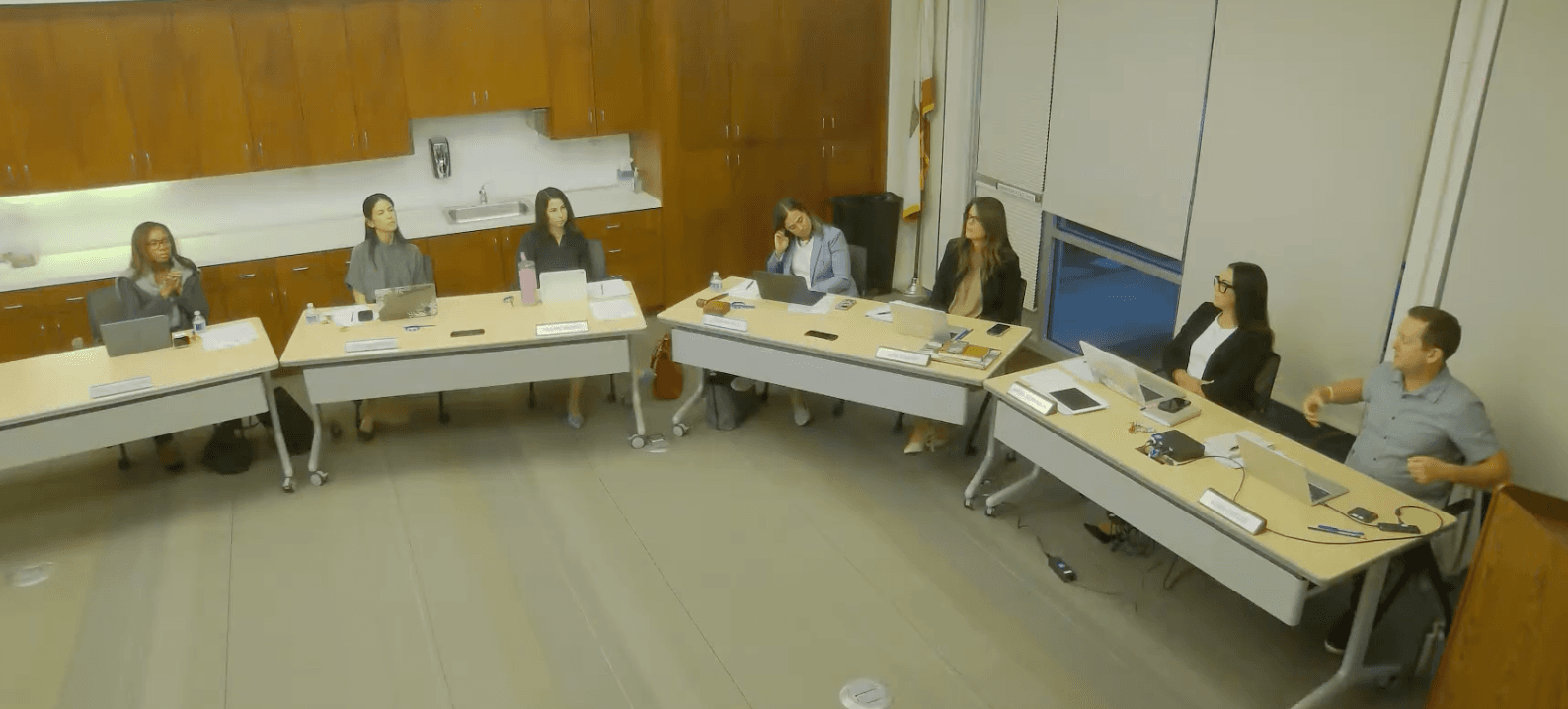
Governing Board - Sep 14, 2026 - Regular Meeting
Governing Board • Orinda Union School DistrictSeptember 14, 2026
Locunity is a independent informational service and is not an official government page for this commission.We use AI-assisted analysis and human editorial review to publish information.
OUSD Launches AI Tutoring Tool as Bond Surplus Surprises Board
The Orinda Union School District's Governing Board covered sweeping ground at its Sept. 14 meeting, from deploying a teacher-controlled artificial intelligence tool in classrooms to discovering an unexpected $8 million surplus in its bond construction program. The board also opened collective bargaining with teachers, approved six resolutions unanimously, and heard early returns on the district's revamped school day schedule.
District deploys Brisk Teaching as AI tutoring tool at OIS, blocks ChatGPT and Claude on all student devices
Bond programs Measure E and I project ~$8M in unspent funds, opening the door to unfunded facility work
District and Orinda Education Association open contract negotiations on compensation, teaching hours, and class size
$7.8M deferred maintenance plan highlights urgent roofing needs in 1950s-era buildings, with state funding years away
Fiscal year closes strong: revenue up $470K, fund balance at ~$8M, but COVID-era grants are spent
New school day schedule draws positive early reviews from teachers after initial bus hiccups
AI Comes to Orinda Classrooms — Carefully
The board received the meeting's most extensive presentation — nearly 45 minutes — on how the district is navigating artificial intelligence in the classroom, a question districts nationwide are confronting with widely varying results.
The basics: After a two-year pilot at Orinda Intermediate School, the district selected Brisk Teaching as its approved student-facing AI tool for the 2026-27 school year. The tool's "Boost" feature functions as a Socratic tutor — it doesn't give students answers, but instead coaches them with follow-up questions tied to teacher-selected resources, rubrics, and standards. Teachers activate sessions via codes and monitor all interactions on a live dashboard.
Why it matters: Commercial AI engines like ChatGPT and Claude are completely blocked on all student accounts and devices. The district developed a set of approved and prohibited AI uses in partnership with Common Sense Education, the County Office of Education's EdTech Subcommittee, and OIS's own AI Task Force. Students may use AI for brainstorming and targeted guidance on grammar and conventions, but not for generating complete answers, taking assessments, or writing essays.
Where things stand: Educational Technology staff member Kevin explained the distinction between Brisk and open-ended chatbots. "It's a teacher-guided feedback tool," he said, adding that "commercial AI engines like ChatGPT and Claude are blocked on all student accounts and devices. This also ensures compliance with student data privacy laws."
The district also updated its K-8 digital citizenship curriculum, introducing AI awareness in 3rd grade and advancing to algorithmic bias, data privacy, and academic integrity at the middle school level. Technical safeguards include Securly Filter for content blocking, Securly Aware for scanning student Google Drives for indicators of distress, and Securly Classroom for real-time screen visibility.
Board President Katie Shogan raised a pointed concern about the emotional risks of AI interactions. "I just want to make sure there's no emotional connection to it, because that can go down a slippery, dangerous slope," she said. She also questioned whether AI should assist with higher-order thinking tasks, invoking Bloom's taxonomy as a framework. "The slippery slope is using AI for higher-order thinking skills," she said, recalling her credential training.
Superintendent Aida Glimme defended the district's approach as necessary preparation for a world where students already encounter AI outside school. "For us not to have any access to any AI would just unleash all these children — first graders, youth coming with work done by ChatGPT. We can tell. So that's done at home, that's not done here," she said.
What's next: The district will form a parent-staff technology work group — modeled on its prior homework committee — to develop guidance on screen time, app usage, and developmentally appropriate implementation. Applications go out Wednesday. Superintendent Glimme said the group's purpose would be to "examine how technology is used across Orinda schools, develop some guidance for screen time, app usage, developmentally appropriate classroom implementation."
Bond Program Reveals ~$8M Surprise Surplus
All six active modernization projects under Measure E ($50 million, STEAM-focused) and Measure I ($55 million, repair and safety) are in their closeout phase — and the numbers are coming in well under budget.
Why it matters: The combined program, which totals roughly $112 million including accrued interest, is projected to see about $100 million in total expenditures. Measure E has approximately $2.7 million remaining; Measure I has about $5.5 million. Combined with roughly $7 million in accrued interest, the surplus creates an unexpected opportunity to fund previously unfunded facility projects within the bond language.
Where things stand: The Swinnerton Management representative explained the math. "The original budgets that were set back in 2023 were conservative in the sense that it included contingency amounts that were not fully expended," the representative said.
Board President Katie Shogan said she was caught off guard. "I'm pleasantly surprised by this, but I have to say I'm quite confused by this dollar amount because it's significantly higher than had been projected before," she said.
What's next: Superintendent Glimme proposed scheduling a bond executive team meeting with Board Members Hillary Weiner and Katie Shogan to review remaining bond language, identify unfunded priorities, and determine what work could be accomplished next summer. A Q3 update with more precise numbers is expected in November.
District and Teachers Union Open Contract Talks
Both the district and the Orinda Education Association sunshined their collective bargaining proposals for 2026-27, with negotiations scheduled to begin Oct. 14.
Why it matters: The outcome will determine teacher compensation, working conditions, and class sizes across the district — directly affecting educator retention in a community that relies heavily on local revenue to remain competitive.
The district's proposal covers compensation (Article 5), teaching hours (Article 10), and evaluation (Article 14) for certificated employees. OEA Vice President Sean Brennan outlined the union's priorities: "We have chosen to open articles relating to teaching hours and class size. We feel that some collaborative refinements in these areas will help us to best serve our students and retain quality educators."
In later communications, OEA Vice President Brennan struck an optimistic tone: "We're looking forward to having productive, good faith conversations with the district about how we continue to make OUSD a place where excellent educators want to make a career."
Decisions: Both sunshine proposals passed unanimously by voice vote (For: 4, Against: 0, Absent: 1). November negotiations will follow the October opening session.
$7.8M Maintenance Plan Faces Funding Gap
Facilities staff member Dalwin presented a four-year deferred maintenance plan totaling $7.8 million, shifting emphasis from painting — largely addressed during recent bond-funded modernization — to roofing, mechanical/electrical/plumbing infrastructure, fencing, and asphalt.
Why it matters: Many OUSD buildings date to the 1950s with original MEP systems. Roofing was largely untouched during bond-funded modernization (except Sleepy Hollow, where it tied into that project) and represents the highest-priority need. OIS and Glorietta face the most urgent conditions. Current routine restricted maintenance funding (3% of total expenditure) and Fund 40 fall far short of what is needed.
Where things stand: Superintendent Glimme noted that Prop 2 state money is scheduled for its first allocation in December 2029 for facility repair, amounting to several million dollars. In the interim, the district is patching and prioritizing to prevent structural damage from failing roofs. Some asphalt work may be coverable by remaining bond dollars, since it was damaged during modernization construction.
What's next: The board requested a breakdown of funding sources for past projects. The surprise bond surplus (see above) could provide partial relief, depending on the bond language review.
Fiscal Year Closes Above Projections
Business staff member Mika presented the 2025-26 unaudited actual financial report showing revenue exceeding estimates by approximately $470,000, primarily driven by $420,000 in home-to-school bus pass fee collections that arrived earlier than expected.
Why it matters: Expenditures came in approximately $287,000 below projections due to reduced speech and behavior services and lower maintenance contracts. The unrestricted fund balance stands at approximately $8 million, with $2 million restricted. However, most one-time COVID-era grants — including educator effectiveness, arts/music, and instructional materials — have been fully spent, increasing pressure on the general fund going forward.
Revenue composition breaks down as follows: 61% state sources (property tax, EPA, state aid based on ADA), 29% local (11% parcel taxes, 12% parent donations, 5% other), 9% restricted state (lotteries, block grants), and 1% federal (special education, Title II).
Mika explained the bus pass fee timing: "Initially when we were creating the budget, we thought we would receive it in new year. So it was not included in the estimated revenue. But we received it before we close the book."
Decisions: The report was approved unanimously (voice vote, For: 4, Against: 0, Absent: 1).
New Schedule Running Smoothly After Bus Hiccups
The district's year-long redesign of the school day schedule — aligning elementary grades 2-5 to a consistent 8 a.m. start and 2:35 p.m. dismissal — is getting positive early reviews from teachers, though initial bus coordination required adjustments.
Where things stand: Three of four elementary schools saw improved carpool flow with the staggered schedule. Sleepy Hollow experienced bus-related challenges that were resolved after the first week. The biggest frustration point was side street traffic from Moraga Way, not school-site pickup and drop-off. La Morinda bus coordination required adjustments due to new drivers and students initially boarding wrong buses.
Grades 2-3 teachers report having more planning flexibility after the split schedule (previously "early/late") was removed from those grades. Kindergarten teachers found the compressed assessment window more challenging. Assessment days were redistributed from 12 at the start of the year to eight at the start plus two at the end of each trimester. Before-and-after-school care programs saw high enrollment, particularly for TK/K.
What's next: A comprehensive spring update will include formal feedback collection and instructional impact analysis.
$20M Retiree Benefit Liability Gets Fresh Look
The district's OPEB (Other Post-Employment Benefits) trust has grown from $1 million in 2015 to $2.2 million, using a conservative investment strategy with a 6.25% net return. But the net OPEB liability stands at approximately $20 million.
Superintendent Glimme was direct about the current approach: "We are not recommending $2.2 million to be moved into OPEB. Staff is not recommending it." The actuarial recommendation calls for that $2.2 million transfer, but the district currently operates on a pay-as-you-go basis at about $750,000 annually — an approach that is not meaningfully reducing the liability. Staff plans to engage a consultant to develop a more strategic long-term approach.
Board Backs Acalanes Parcel Tax Measure
The board unanimously adopted Resolution 27-08 supporting Measure W, placed on the Nov. 3 ballot by the Acalanes Union High School District, OUSD's partner feeder district (For: 4, Against: 0, Absent: 1).
Why it matters: Acalanes UHSD is among the lowest-funded districts in California despite being among the highest-achieving, relying heavily on local parcel taxes and donations. Existing parcel taxes lack cost-of-living escalators and have lost purchasing power, and the district has already made millions in reductions affecting electives, class sizes, and college and career services. The temporary parcel tax aims to restore that funding.
Minor Items
Resolution 27-04, Bullying Prevention Awareness Month: Adopted unanimously (For: 4, Against: 0, Absent: 1). The district maintains anonymous tip lines, student surveys, and the Second Step curriculum's bullying prevention unit.
Resolution 27-09, Diverse Abilities Awareness Month: Adopted unanimously (For: 4, Against: 0, Absent: 1). Main "DALL Week" activities move from October to January to ensure dedicated attention; approximately 456 students (17% of enrollment) have IEPs or 504 plans.
Resolution 27-05, Week of the School Administrator: Adopted unanimously (For: 4, Against: 0, Absent: 1).
Resolution 27-06, GANN Limit: Annual compliance resolution adopted unanimously (For: 4, Against: 0, Absent: 1).
Resolution 27-07, Sufficiency of Instructional Materials: Adopted unanimously after public hearing (For: 4, Against: 0, Absent: 1), certifying all students have sufficient materials as required by state law.
Board of Trustees 2026-27 goals and handbook: Both approved unanimously by voice vote with minor refinements.
DSA closeouts approved: Sleepy Hollow (classroom relocation and HVAC), OIS (HVAC), and Glorietta (HVAC) — all passed unanimously.
Wagner Ranch additional services: Dry rot structural engineering and path-of-travel civil engineering corrections approved unanimously.
No-cost time extension: District-wide modernization contractor received additional time to complete punch-list items at no extra cost.
Board policies 10B-G: Batch of updated CSBA-recommended policies approved.
Consent calendar: Approved without discussion.
OIS leadership students presented their "Paws Up" core values program emphasizing kindness, accountability, growth, and respect through student-led initiatives including spirit week competitions, kindness awards, and mentoring partnerships.
Public comment: Pamela West, a former OUSD board member running for the Contra Costa County Board of Education Area 2, shared priorities including cybersecurity, AI monitoring, and reading programs.
Note: Board Member Eve Phillips was absent from the meeting. All votes passed with four members present.