
Orinda Approves 23-Unit Downtown Condo Project Under State Density Bonus
City Council • OrindaNovember 22, 2026
Locunity is an independent informational service and is not an official government page for this commission. All information is sourced from public footage and an analysis of official agendas with the aid of responsible, fact-checked AI. to report an error or omission.
Orinda's City Council approved a 23-unit condominium building at 23 Alta Rinda Road, which city records describe as the first downtown multifamily project and one that relies on state density bonus law. The council approved the project by voice vote after an evening-long hearing. Staff told members that state rules sharply limited their power to deny waivers or save 25 protected trees. The council also pulled a one-year license plate camera report off the consent calendar to question the police chief on privacy safeguards, and heard that self-service Sunday library hours are expected in early 2027.
- 23-unit condo project approved at 23 Alta Rinda Road with 19 waivers and a state CEQA exemption
- 40 trees, 25 of them protected, will come down; most replacements will be covered by a $125-per-tree in-lieu fee
- Police chief credits license plate readers with better solve rates; council asks for a written follow-up on safeguards
- Library visits climb more than 6%, and self-service Sundays are expected in early 2027
Density Bonus Law Ties the Council's Hands
Where things stand: The council approved the full entitlement package for 23 Alta Rinda Road:
- A statutory exemption from the California Environmental Quality Act (CEQA) under AB 130
- A vesting tentative map
- A state density bonus with 19 waivers
- An elevated deck permit
- A tree removal permit
Members also adopted the resolution, with conditions as modified by staff's late correspondence. The Planning Commission had recommended approval 7-0.
The project replaces a 5,779-square-foot medical office with a 68,536-square-foot building on 0.73 acres.
"At 0.73 acres by 25 density units per acre, we're looking at 19 base units, and then 20% of that rounds up to 4 bonus units for a total of 23 units at the site," said Associate Planner Darren Hughes.
One unit is restricted to very-low-income households. The other 22 will sell at market rate.
The basics: California's density bonus law lets developers build beyond local limits in exchange for affordable units. It also entitles them to waivers of development standards that would physically block the project. The AB 130 exemption removed CEQA review entirely.
Late changes: Staff added a condition requiring a Phase 1 environmental site assessment. Staff also struck a PG&E easement requirement and a trip generation condition, No. 20.
Trees and Decks Draw the Sharpest Pushback
Where things stand: The project removes 40 trees, including 25 protected trees. City rules call for 53 replacement trees.
The applicant proposes 11 trees, up to three native shrubs and a $125-per-tree in-lieu fee for the rest. Staff said required findings and density bonus law limited the council's ability to demand tree preservation.
Elevated decks total 12,852 square feet, including a 1,679-square-foot rooftop deck. The applicant offered larger replacement trees and an HOA restriction on hours.
The other side: Public commenter Nick Warnoff asked the council to deny the elevated deck permit over noise concerns. "The density bonus law waivers are not a basis for the elevated deck," said Warnoff. He also urged denial of waiver No. 19, which reduces stopping sight distance, on public safety grounds. Warnoff took credit for the added Phase 1 assessment.
The sight-distance waiver: The city engineer said the encroachment is about 3 feet, and staff recommended allowing it. The applicant's representative then offered to drop the waiver.
"We'd like to propose that we remove the waiver request on that," said the applicant's representative.
Staff and the council chose to keep the waiver as proposed. The applicant agreed to work with staff on it.
The Earlier Warning
During the public forum, before the hearing began, Warnoff cautioned that density bonus law lets a 74-foot building override Orinda's 40-foot downtown height limit and its objective design standards. "The inclusion of a single low-income unit provides an entitlement for an unlimited number of waivers," said Warnoff. He asked the council to reconsider staff outreach aimed at recruiting developers downtown.
Decisions and stakeholder impacts: The motion, made by Mayor Brandyn Iverson, passed by voice vote. No tally was stated, and the second was not identified.
Several council members said they supported housing for residents looking to downsize.
- Developer: Secures a by-right path with few conditions.
- Neighbors: Residents near the site, including the Orinda Woods HOA area, get an hours restriction on the decks but lose the mature tree canopy.
- City: Collects in-lieu fees that some members viewed as low relative to the 25 protected trees lost.
Why it matters: The hearing showed how far state law now reaches into local land-use decisions. The council's remaining leverage came mostly from the applicant's voluntary concessions.
What's next: At the end of the meeting, the mayor asked staff for a memo on the history of the $125 tree in-lieu fee. The city manager said a memo can be provided without a formal agenda item.
License Plate Cameras Get a Privacy Check
Where things stand: The council pulled the one-year report on automated license plate reader (ALPR) cameras off the consent calendar for a full discussion. Orinda Police Chief Rossi said the cameras have raised both proactive policing and case solvability.
Orinda follows the Sheriff's Office ALPR policy, which:
- Requires a user ID, case number and stated purpose for each search
- Runs quarterly audits
- Bars use for immigration enforcement
"We hold the data for 30 days and then it's gone," said Rossi. He said he knew of no policy violations.
About 11 private cameras share data with police. Asked about expanding the network, the chief said, "We're adequately covered."
Public comment: Three residents spoke, and all backed the program.
- A Knickerbocker neighborhood resident cited 80 investigations and 24 incidents where cameras provided the first evidence. The resident asked the council to keep a city takeover of private neighborhood cameras on the table.
- Warnoff said he fully supported the program. He argued that most coverage presents a distorted anti-ALPR picture and that serious crimes have been stopped.
- Another resident welcomed the results and raised the issue of vehicles without front license plates.
The other side: One council member said teenagers fear a surveillance state. Members pressed the chief on policy compliance, data protection and enforcement.
Why it matters: The council is weighing local crime-fighting results against national privacy concerns. Its questions focused on misuse and data sharing.
What's next: No vote was taken. The chief will provide a written follow-up on ALPR policy, data security and enforcement.
Library Traffic Rises, Sunday Hours Return
Where things stand: Orinda Library Branch Manager Michael Beller reported 123,506 visits last fiscal year, up more than 6%. Other figures from his report:
- Print circulation fell 1.93%, to 112,332 items.
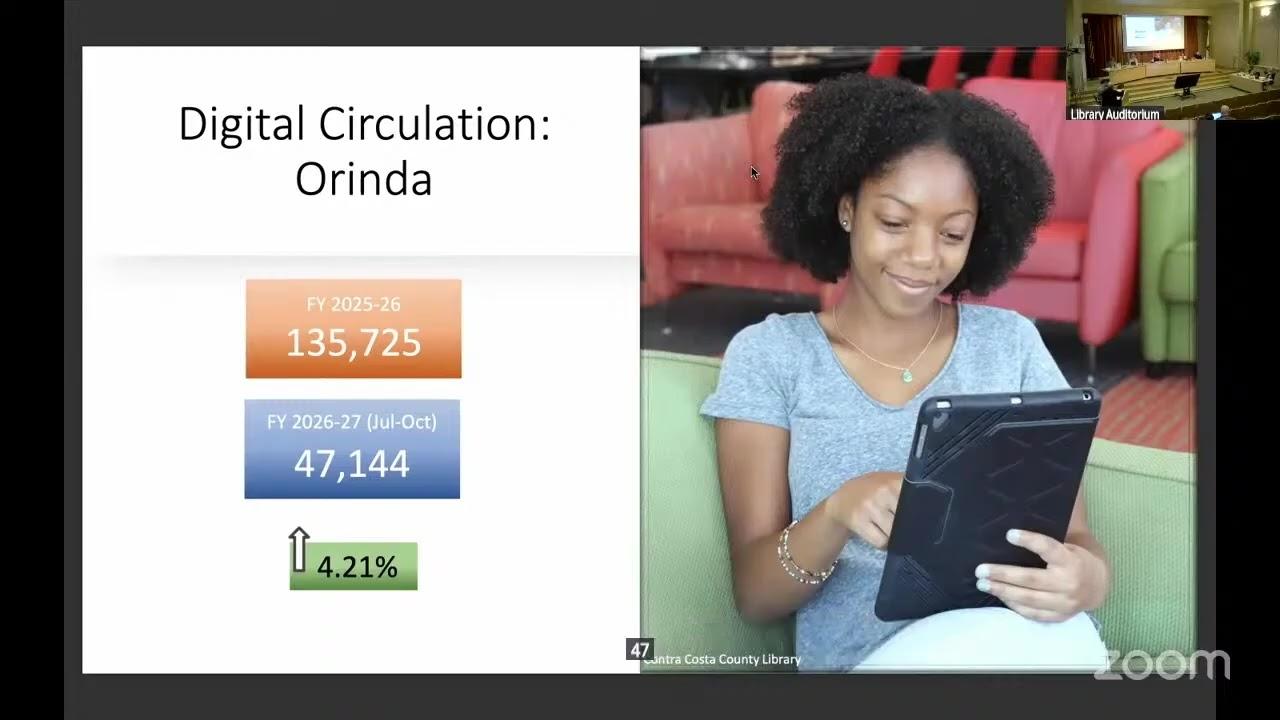
- Digital circulation rose 4.2%, to 135,725 items.
- The library hosted 286 programs and issued 1,051 new cards.
"Sunday hours are coming back," said Beller. The new Self-Service Sundays will be open to patrons 13 and older who hold a county library card. The start is expected in early 2027, though no firm date has been set.
Public comment: Warnoff said more Miramonte students rely on the library now that the school district has cut librarians. He also flagged an inappropriate book in the used bookstore on city property, and staff are expected to follow up.
Why it matters: Restored Sunday access answers a long-standing resident request.
Minor Items
- Agenda adopted by voice vote with all council members present.
- Consent items I1 and I2 approved by voice vote; I3, the ALPR report, was pulled for discussion.
- Caldecott Tunnel planned closures will not begin until April or May 2027, according to council reports.
Looking Ahead
Watch for staff's memo on the $125 tree in-lieu fee, which may shape future changes to the tree ordinance. Also watch for the police chief's written follow-up on license plate camera safeguards.