
Council Advances Inclusionary Housing Framework After Lengthy Study Session
City Council • OrindaJanuary 20, 2025
Locunity is an independent informational service and is not an official government page for this commission. All information is sourced from public footage and an analysis of official agendas with the aid of responsible, fact-checked AI. to report an error or omission.
Orinda's first detailed look at mandating affordable units in new developments revealed a council still searching for the right balance between encouraging construction and securing community benefits.
Ordinance 2506 adopted unanimously; officials clarify no immediate impact on existing Shell Station.
Storm drain survey contract expanded after crews discover far more assets—especially on private property—than anticipated.
Inclusionary housing study session surfaces council tension over 15% requirement; work referred to Affordable Housing Subcommittee.
City launches OrindaReady.com evacuation tool ahead of wildfire season.
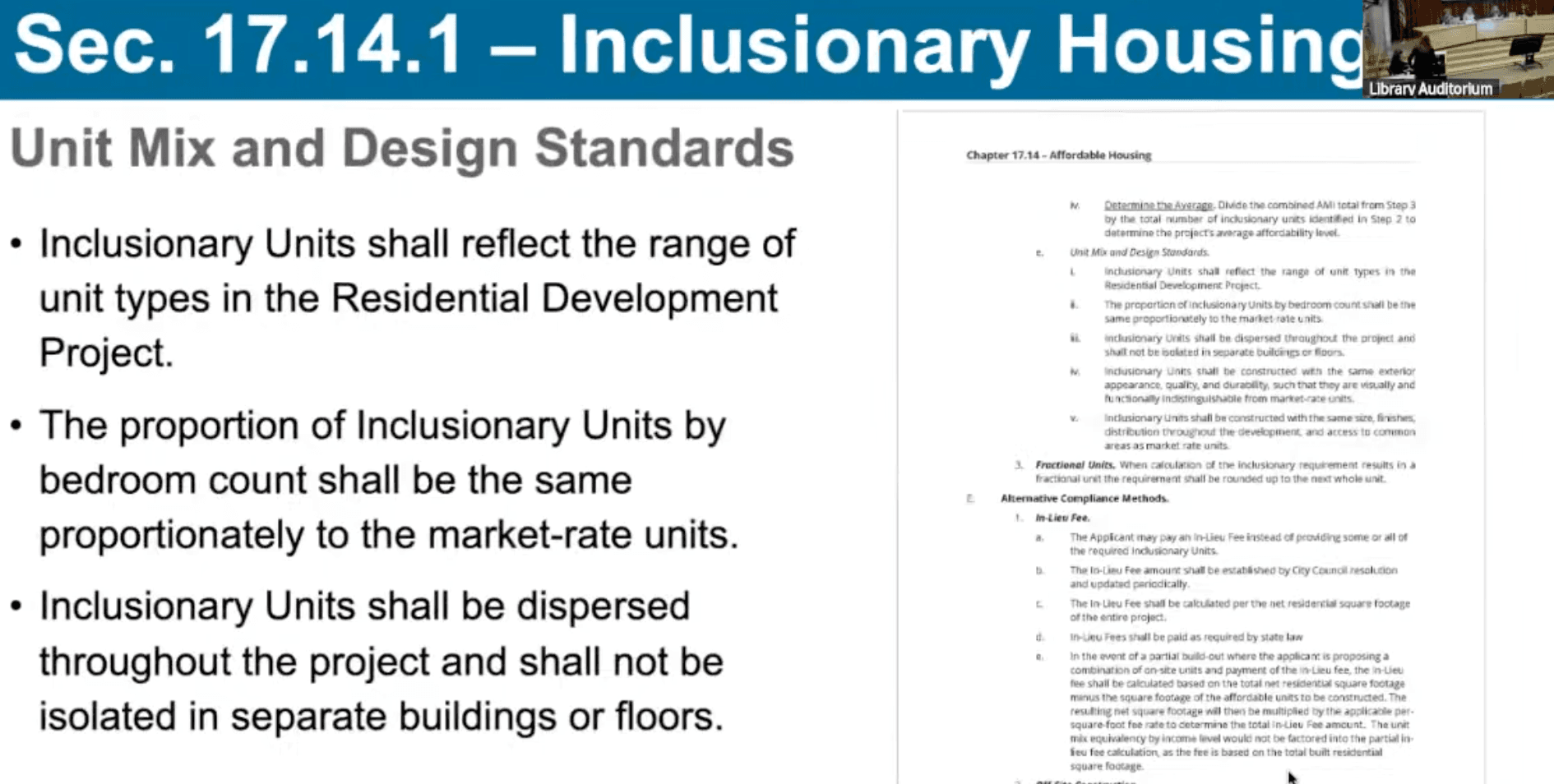
Inclusionary Housing: Council Debates Whether 15% Sets the Bar Too High
The centerpiece of Monday's meeting was a lengthy study session examining whether Orinda should require developers to include affordable units in new projects—and if so, at what percentage and under what terms.
Why it matters: Orinda has never had an inclusionary housing ordinance. With state law increasingly pushing cities to permit more housing and demonstrate progress toward affordability goals, the council is weighing a tool used by many peer jurisdictions. But setting the threshold too high could discourage the very construction the policy aims to shape.
State of play: A city planner presented draft parameters proposing that 15% of units in qualifying projects be affordable, with in-lieu fees as an alternative. The ordinance would interact with State Density Bonus Law, which allows developers to exceed zoning limits in exchange for affordable units—potentially stacking incentives or complicating calculations.
Staff noted that the state's evolving Transit-Oriented Communities (TOC) policy had envisioned a $100,000 per-unit base threshold for in-lieu fees and an inclusionary requirement, but recent signals suggest the state may pivot toward incentives and delay implementation.
"It sounds like they're going to kick this can until 2028," said a city staff member, summarizing the state's likely timeline.
The other side: Several council members questioned whether 15% would discourage development altogether.
"I'm wondering if our 15% encourages all that or if it's too high," said Council Member Janet Riley.
Council Member Cara Hoxie echoed the concern: "I'm concerned that the 15% is too high and I'd like to think about whether or not that should be at more of a 10 or 12%."
Hoxie also sought clarity on how the ordinance might help the city satisfy "no net loss" mitigation requirements under state housing law: "One statement that you made was that the inclusionary housing ordinance could mitigate no net loss. Can you explain that a little bit?"
Vice Mayor Darlene Gee advocated moving forward despite uncertainty: "I'm supportive of having an ordinance. I think that's important."
Mayor Brandyn Iverson urged caution, noting the policy cannot be evaluated in isolation: "The comment I make every time is that you can't just look at one thing." He emphasized that multiple project factors—land costs, construction expenses, parking requirements—compete for feasibility, and adding a new mandate requires careful calibration.
What's next: The council directed the Affordable Housing Subcommittee to refine recommendations on the percentage threshold, whether single-family projects should be included, in-lieu fee structures, and "partial build" mechanics before returning to the full council.
Storm Drain Survey Expands After Crews Find More Assets Than Expected
The council unanimously approved Amendment No. 1 to NCE's professional services contract for a citywide storm drain asset survey and GIS data collection, adding funds and extending the timeline after field crews discovered significantly more infrastructure than originally mapped.
Why it matters: Accurate drainage data is foundational to public safety, capital planning, and grant eligibility. Incomplete records leave the city exposed to liability and unable to prioritize repairs—particularly as climate-driven storms intensify.
State of play: Staff reported that the number of storm drain assets, especially those on private property, exceeded initial estimates. The expanded scope will allow NCE to complete a more comprehensive inventory.
"We are realizing that we didn't have correct mapping of all our publicly maintained storm drains, which is both unsettling and reassuring," said Council Member Latika Malkani, framing the discovery as a necessary step toward responsible stewardship.
Malkani also flagged the stakes: "With drains, the dangers if they fail are things like sinkholes."
Decisions: The council approved the amendment 5–0 (Aye: Iverson, Gee, Riley, Malkani, Hoxie).
Setbacks and Use-Permit Standards Ordinance Adopted; Shell Station Unaffected
A consent calendar item drew unusual attention after public commenters and a council member sought to clarify how Ordinance 2506—related to setback and use-permit standards—might affect the existing Shell Station.
Why it matters: Community members had raised concerns that the ordinance, prompted by a separate Chevron project, could force changes at Shell. Council discussion was intended to set the record straight.
State of play: Two public commenters spoke in favor of the ordinance during the public forum. Brad McCall supported changes benefiting the Chevron station and the city, saying negative arguments were "conjecture." Bill Waterman praised city and staff work on indemnity language and urged officials to "carry the Chevron project across the finish line."
Vice Mayor Darlene Gee pulled the item to address confusion: "Passing this ordinance has no effect on the Shell Station unless the Shell Station decides that they want to take some actions."
Staff confirmed the point, and Mayor Iverson noted the city had received letters on both sides of the convenience-store debate: "We got letters both saying it would be unfair not to give everybody convenience stores and letters saying it would be crazy to give everybody convenience stores."
Decisions: Ordinance 2506 adopted 5–0 on consent.
Minor Items
OrindaReady.com launched: The city's new evacuation planning tool is now available to residents; spring outreach events planned.
Commission applications open: Residents encouraged to apply for volunteer positions on city advisory bodies.
Agenda reordered: Council moved member and city manager reports ahead of the consent calendar to accommodate scheduling; all votes conducted by roll call due to a remote attendee.
What to Watch
The Affordable Housing Subcommittee's recommendations will shape whether Orinda adopts an inclusionary ordinance closer to 10% or holds at 15%—and whether single-family projects are folded in. Meanwhile, the expanded storm drain inventory will inform future capital budgets and could reveal additional infrastructure needs on private property, raising questions about homeowner notification and responsibility. Both threads are worth tracking as the council navigates state housing mandates and local infrastructure realities.