
Orinda Council Approves 23-Condo Downtown Project Under Density Bonus Law
City Council • OrindaNovember 18, 2026
Locunity is an independent informational service and is not an official government page for this commission. All information is sourced from public footage and an analysis of official agendas with the aid of responsible, fact-checked AI. to report an error or omission.
A single very-low-income unit gave a developer the right to exceed Orinda's downtown rules. On Nov. 17, 2026, the City Council approved a 23-unit condo building at 23 Alta Rinda Road by voice vote, despite objections over height, a rooftop-level deck, sight lines and the loss of 25 protected trees. The council also heard a one-year report on police license plate cameras and learned that self-service Sunday library hours are expected in early 2027.
- 23 condos approved at 23 Alta Rinda Road by voice vote. The project includes one very-low-income unit and removes 40 trees, 25 of them protected.
- Applicant offered to drop a sight-distance waiver. Staff and council kept the plan as proposed.
- License plate cameras, one year in: The police chief credits them with solving crimes. The council asked for a follow-up on safeguards and took no vote.
- Library visits up more than 6%. Digital borrowing rose 4.2%, and self-service Sundays are expected in early 2027.
23 Alta Rinda: State Law Sets the Terms
Why it matters: The approval shows how state density bonus law and streamlined state review limit local control over height, trees and design downtown. It also brings for-sale condos to the city center, with one below-market unit.
The basics: California's density bonus law lets a project build more units, and request waivers from local development standards, in exchange for setting aside affordable units. Here, one very-low-income unit unlocked a 20% bonus and an unlimited number of waivers.
Where things stand: The building will replace a 5,779-square-foot medical office on 0.73 acres. "We're looking at 19 base units, and then 20% of that rounds up to 4 bonus units for a total of 23 units at the site," said Darren Hughes, Associate Planner.
Key details of the project:
- The Planning Commission recommended approval 7-0 on Oct. 27.
- The project is statutorily exempt from CEQA, the state's environmental review law, under AB 130.
- It includes 48 parking spaces, although none are required because the site is within a half mile of BART.
- Of the 40 trees removed, 25 are protected. Replacement plantings total 11 trees plus up to three shrubs, along with a $125-per-tree in-lieu fee.
Staff proposed three changes to the conditions of approval. They added a Phase 1 assessment, struck language on a PG&E easement and dropped a trip-generation condition. Council members asked about views from Orinda Woods, traffic, parking and the mix of unit types.
The other side: Public commenter Nick Warnoff raised the alarm during public forum. He cited a proposed 74-foot building against the downtown's 40-foot limit. "The inclusion of a single low-income unit provides an entitlement for an unlimited number of waivers," said Warnoff, public commenter. He urged the council to reconsider its direction to staff to recruit more downtown developers.
At the hearing, Warnoff asked the council to deny two requests:
- The elevated deck permit, because he said noise would carry to uphill homes. "The density bonus law waivers are not a basis for the elevated deck," he said.
- Waiver 19, which reduces stopping sight distance, on public safety grounds.
He also noted that his earlier comment led staff to add the Phase 1 assessment.
A waiver offered back: In response, the applicant moved to concede. "We'd like to propose that we remove the waiver request on that," said the project applicant. The city engineer described the encroachment into the visibility zone as minor. "Staff recommendation is to move forward," said the City Engineer. The council left the waiver in place, and the applicant committed to work with staff on it.
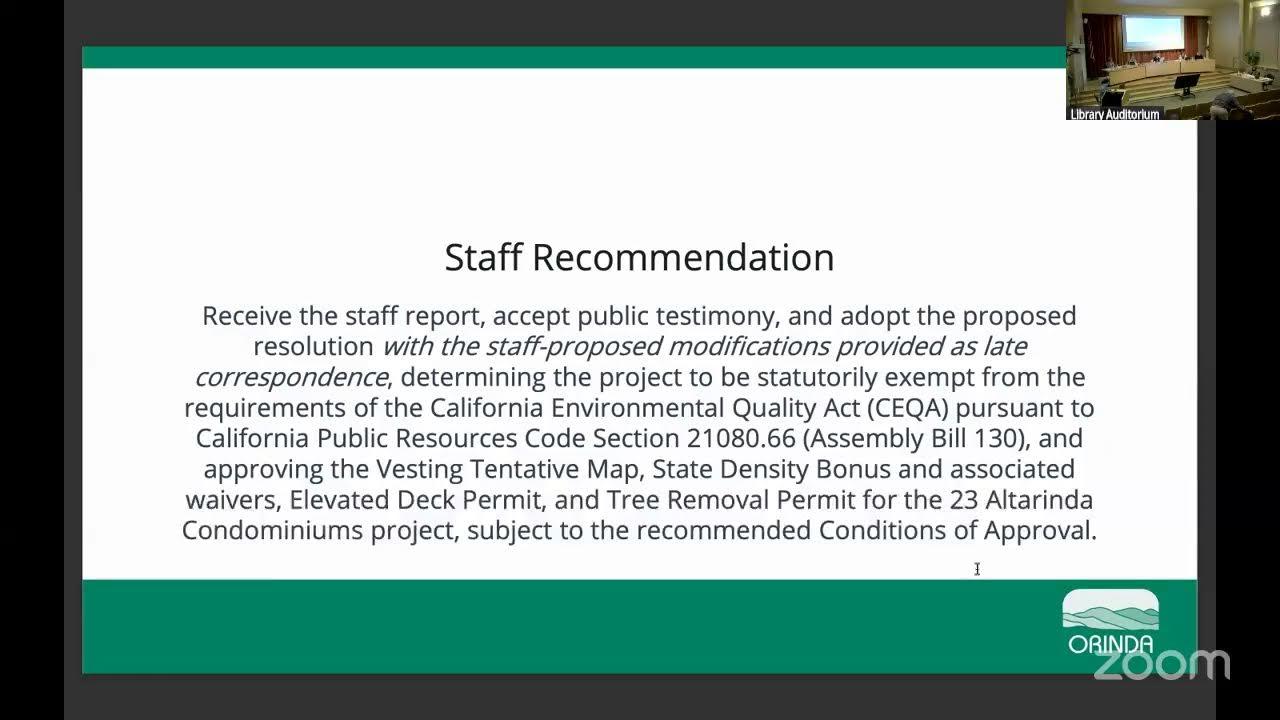
Decisions and stakeholder impacts: The council found the project CEQA-exempt and approved the following, subject to conditions as modified in staff's late correspondence:
- The vesting tentative map
- The density bonus and its waivers
- The elevated deck permit
- The tree removal permit
The motion passed by voice vote. No tally or seconder was announced.
Council members voiced support for more diverse housing, though not without regret. "I am so unhappy about 25 healthy protected trees," said a council member.
Downtown homebuyers and one very-low-income household gain new options. Uphill neighbors and tree advocates absorb the trade-offs.
What's next: A council member asked the city manager for a memo on how the $125 tree fee was set and whether commercial and residential rates differ. The city manager agreed to look into it.
License Plate Cameras: Results Versus Safeguards
Why it matters: The council weighed crime-solving gains against surveillance and privacy concerns. Residents will get more detail on how the camera data is protected.
Where things stand: The item was pulled from the consent calendar for a full report. The Police Chief said most automated license plate reader (ALPR) cameras have been deployed since August and have improved both proactive policing and the ability to solve cases.
A council member pressed on privacy, data security and enforcement. The chief described these protections:
- Access requires a user ID, a case number and a stated purpose.
- Use is audited quarterly.
- The Sheriff's Office policy applies.
- There have been no known violations.
- Data is not kept long. "We hold the data for 30 days and then it's gone," said the Police Chief.
- Policy bars using the system for immigration enforcement.
About 11 private neighborhood ALPR cameras also share data with police. The chief saw no advantage in the city helping pay for them.
The other side: No commenter opposed the program. A member of a Knickerbocker neighborhood group cited 80 investigations aided and 24 incidents in which the cameras provided the first evidence. That speaker asked the city to keep the option of taking on private cameras open for the future. Warnoff fully supported the program, argued that mainstream coverage of ALPR is distorted and said serious crimes have been stopped in progress.
Decisions and stakeholder impacts: The council received the report without a vote. Privacy-minded residents gain a promised accounting, while neighborhoods running their own cameras keep funding them.
What's next: The chief will return with a follow-up on data policies and safeguards.
Library Traffic Rises, Sundays Return
Where things stand: Michael Beller, Librarian and Branch Manager, Orinda Library, reported these fiscal 2025-26 totals:
- 112,332 physical items circulated
- 135,725 digital items circulated
- 123,506 visits
Early fiscal 2026-27 trends show physical circulation down 1.93%, digital circulation up 4.2% and visits up more than 6%. Beller attributed the print dip partly to the shift to digital and partly to the collapse of book distributor Baker & Taylor.
"Sunday hours are coming back," said Beller. Self-Service Sundays, likely starting in early 2027, will be open to patrons 13 and older who hold a Contra Costa County library card and complete an orientation video.
Public comment: Warnoff suggested that Miramonte students use the library more, given cuts to school librarians. He also flagged a book with a swastika on its cover in the children's section of the used bookstore on city property. Staff were asked to follow up.
Minor Items
- Consent calendar: Items I1 and I2 were approved by voice vote, and I3 was pulled for the camera report.
- Caldecott Tunnel: The Contra Costa Transportation Authority (CCTA) indicated that official closures begin in April or May 2027.
- Wildfire coordination: A council-fire district (MOFD) two-by-two meeting discussed Zone 0 progress, early-leave alert concepts and consolidating the chipper service.
- Community events: Light Up Orinda and Winterfest on Dec. 4 are coming up.
- Sports field lease: An East Bay MUD liaison meeting addressed the lease.
Looking Ahead
Zone 0 returns to MOFD in January. The council also awaits the police chief's ALPR safeguards follow-up and the city manager's memo on the $125 tree fee.