OUSD Board Accepts Budget Revision Amid Disclosed Errors and a $30M Gap
Board of Education • Oakland Unified School DistrictAugust 13, 2026
Locunity is an independent informational service and is not an official government page for this commission. All information is sourced from public footage and an analysis of official agendas with the aid of responsible, fact-checked AI. to report an error or omission.
The Oakland Unified School District's Board of Education opened the 2026-27 school year with a sharp clash over fiscal transparency, accepting a 45-day budget revision that showed $35 million in new state revenue but carried disclosed errors in restricted spending and an unresolved $30 million cut target that no one could fully explain. The three-hour-plus meeting also delivered a bright spot: Superintendent Denise Gail Saddler announced that 99% of teaching positions are filled for the first time in recent district history.
- Board accepts 45-day budget revision 5-1-1 after staff discloses errors in restricted expenditures and Director Hutchinson calls the presentation a fireable offense
- 99% of teaching positions filled as schools open — a district record — with only about 8 vacancies remaining
- $2.2M in pulled consent items spark debate over fiscal controls dating to OUSD's 2003 bankruptcy
- New Student Directors pledge to represent all 34,000 students, drawing a charge from the board to organize around the budget crisis
- Administrators union reports seven months of bargaining without a financial proposal from the district
- Student device policy resolution introduced and referred to Teaching and Learning committee
Budget Night: $35M in New Revenue, but Nobody Could Explain the Deficit
The centerpiece of the Aug. 12 meeting was the mandatory 45-day adopted budget revision for fiscal year 2026-27 — the document that updates the board-adopted budget to reflect the state budget signed in June.
The basics: Under state law, school districts must revise their adopted budgets within 45 days of the governor's budget signing to incorporate actual funding levels. This is not a new budget adoption; it is an acceptance of updated numbers.
Why it matters: OUSD's unrestricted fund balance stands at $53 million — but only if $30 million in planned cuts materialize. Without those reductions, reserves would drop below the board's own 3% policy, raising the specter of renewed state intervention over a district that emerged from receivership less than a decade ago.
What's New in the Numbers
Chief Business Officer Troy Christmas walked the board through two significant state funding increases: the Local Control Funding Formula's "Super COLA" rose from 2.87% to 4.31%, adding roughly $8 million in unrestricted revenue, and AB 602 special education funding jumped from $999 to $1,340 per average daily attendance, adding approximately $12 million in restricted dollars.
"OUSD can remain solvent, but only if 2627 is treated as a stabilization year and not a restoration year," said Christmas.
Then came the disclosure that would define the evening: staff had discovered an error in restricted expenditures that understated the deficit. Christmas could not provide corrected figures in real time.
"What we're doing is making an effort to make sure you get accurate information," Christmas told the board. "Given the lateness of determining that there was an error, we don't want to compound that error by giving you another error."
Hutchinson Presses for Answers
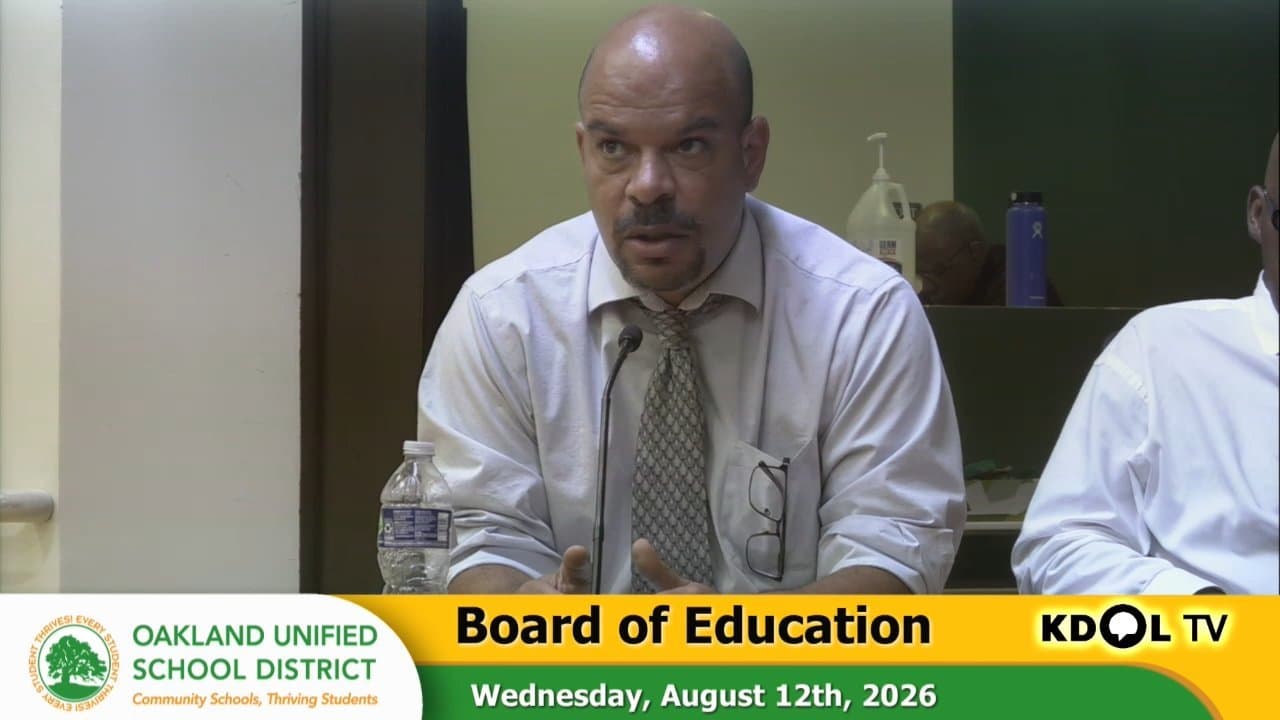
Board Member Mike Hutchinson launched an extended interrogation of the numbers, demanding the unrestricted-to-restricted contribution figure (approximately $147 million at adoption, down roughly $13 million at the 45-day revision), the plan for the $30 million budget plug on line 4395, and the true restricted expenditure total. Staff could not provide firm numbers during the meeting.
"We just do about the whole year without those things," Hutchinson said. "Somebody needs to be able to have a firm number because if you don't know the firm contribution number, you couldn't have made this chart."
His critique escalated as the discussion wore on. Hutchinson argued that expenditures had risen $17 million above the adopted budget without board authorization and that the $30 million reduction target remained an abstraction.
"For anyone to stand up here in the 45th largest city in the country with a billion dollar combined budget and say, 'Oh, well, we don't know that number,' or, 'We can't give it to you,' 'Oh, we found an error,' 'Oh, it's about 13 million' — to me, those should all be fireable offenses," Hutchinson said.
The Other Side
Board President Jennifer Brouhard framed the vote as procedural, noting that the acceptance of the 45-day revision is not a budget adoption and that unaudited actuals on Sept. 9 would provide the fuller data the board needs. Board Member Rachel Latta acknowledged the fiscal challenge but cautioned against conflating acceptance of a state-mandated revision with endorsement of spending patterns. Vice President Valarie Bachelor urged a forward-looking focus on the Sept. 9 presentation.
Public Comment: Frustration With Opacity
Four public commenters addressed the budget. Leanna Powell, an OUSD parent, captured the room's frustration: after multiple meetings, she said she still could not understand the actual deficit number and questioned whether intentional confusion around the budget served election-year interests. Carol Delton praised the planned variance analysis in the upcoming unaudited actuals and urged less contracting and more direct employment. Sada Olagbala raised concerns about federal revenue uncertainty and potential misuse of parcel tax funds. Sheila Haynes called for protecting arts and music funding, noting her online student had lacked services for over six years.
Decisions: The board accepted the 45-day revision 5-1-1 (Hutchinson voted no; Board Member Clifford Thompson abstained). Student directors are nonvoting members.
What's next: The unaudited actuals presentation on Sept. 9 will be the critical next inflection point, expected to provide corrected restricted expenditure figures and a clearer picture of the district's true fiscal position.
A District Record: 99% of Teaching Positions Filled
Superintendent Denise Gail Saddler delivered her first report of the school year with a piece of genuinely good news: OUSD has filled 99% of its teaching positions, with only about eight openings remaining.
"I'm happy to report today that we have over 99% of our teaching positions filled," Superintendent Saddler said. "This is the first time in my experience in the district. We think we only have about eight openings."
Why it matters: Chronic teaching vacancies have undermined literacy and classroom continuity across Oakland schools for years. If retention holds, near-full staffing could finally stabilize instruction. Saddler credited Chief of Talent Jeff Dillon and his team, highlighting diverse hiring of Oakland natives and career-changers.
Where things stand: Saddler detailed first-day visits to eight schools across all seven board districts, including McClymonds (where construction is underway and cell phone pouches are being deployed), Santa Fe's young adult special education program, and stops at Sankofa, Sequoia, UPA, Garfield, Greenleaf and Madison Park Academy.
The other side: Board Member Hutchinson offered a sharply contrasting assessment. He criticized the superintendent's report for omitting enrollment numbers — the first official count took place the day before the meeting but data was not shared — and for lacking a work plan or strategic plan.
"Not one word in your report, not one statement to the community, not one guarantee to the school board that we'd actually get the information," Hutchinson said. "Not one mentioned tonight about what our enrollment numbers look like to begin this year."
Board Member VanCedric Williams praised the staffing achievement and shared highlights from his own school visits. Board Member Latta echoed the positive tone while pressing for continued progress. Board Member Thompson asked the superintendent to examine A-to-G requirements and AP class availability across schools. Vice President Bachelor highlighted transitional kindergarten investments across East Oakland schools.
$2.2M in Contracts Spark Debate Over Fiscal Controls
Board Member Hutchinson pulled two items from the consent report, demanding fiscal impact analyses and questioning funding sources on contracts totaling over $2 million.
Street Academy Foundation — $789,878
The contract funds mentoring and academic support services at Street Academy. Staff confirmed the money comes from the central concentration resource code, already allocated in the budget. Staff member Vanessa Cipuentes confirmed the funding source and scope.
Elite Security Services — $1.4M
This contract provides unarmed security at school sites. The funding source was listed as AB 1840 — money tied to the state receivership era. Hutchinson questioned whether the district has received any new AB 1840 dollars in two years. Staff member Tara Guard confirmed a remaining balance exists from prior allocations.
Board Secretary Hollis Rakestraw provided important historical context, explaining that the agenda system was designed after OUSD's 2003 bankruptcy specifically to prevent unfunded items from reaching the board for a vote.
Public commenter Sada Olagbala questioned the limited legal authority of non-law-enforcement security personnel, noting they cannot make arrests, search bags without consent or intervene in active emergencies.
Decisions: Both items passed 6-0-1 (Hutchinson abstained on each).
Why it matters: The debate exposed gaps in OUSD's budget documentation practices and raised questions about whether the post-bankruptcy fiscal safeguards are functioning as intended.
New Student Directors Set an Ambitious Tone
Student Director Amina Tongun and Student Director Drew Bloch delivered their inaugural addresses to the board, each pledging to broaden student engagement beyond the All City Council's existing leadership pipeline.
"I want all the students to know one thing, that I'm here to represent them," Student Director Tongun said. "Not just the students who are already having a seat at the table."
Student Director Bloch highlighted his background in restorative justice and set a priority of increasing communication between the board and the district's 34,000 students.
Board Member Hutchinson gave the most substantive charge, urging both student directors to organize students around the budget crisis.
"If 60 students show up demanding some sort of action, you'll get movement," Hutchinson told them. "If it's 300 students that show up, you'll take the place over."
Vice President Bachelor encouraged both to lean into their shared love of Oakland. Board Member Thompson asked them to examine equity in course offerings across schools.
Administrators Union Warns of Stalled Contract Talks
During public comment, UAOS President Carrie Kaufman reported that administrators have been bargaining with the district for seven months without receiving a single financial proposal.
"Administrators' voice have continued to be dismissed and disregarded throughout the past year," Kaufman said.
She noted that administrators are the only employee group without a settled contract or raises — a pressure point that could intensify as the district navigates its fiscal crisis.
Peacemakers Push for School-Day Mentoring
Four representatives from Peacemakers Inc. — Corey Jeffries, Zalon Harrison, Rodney Brown and Hank Roberts — appeared during public comment to advocate for their school-day mentoring program. Roberts, who identified as the organization's founder and the NAACP California state parent engagement director, described a model that enhances Positive Behavioral Interventions and Supports (PBIS) through all-day prevention and structured parent-teacher communication. The organized showing signals Peacemakers is actively seeking entry into OUSD schools.
Minor Items
- Teacher credentialing resolutions (Q1-Q3) approved unanimously 7-0, authorizing 27 provisional internship permits, 11 variable term waivers for bilingual and specialist staff, and 4 local assignment options for speech-language pathologists. Public commenter Carol Delton noted each directly hired SLP saves at least $40,000 versus agency contracting.
- General consent report adopted 6-0-1 (Hutchinson abstained), covering dozens of contracts for facilities, special education services, arts programming and community partnerships.
- Parent and Student Advisory Committee announced a fall schedule including goal-setting retreats and budget education sessions. PSAC Lead Delegate Matt Glaser and CAC Co-Chair J.D. Walashin outlined plans to prepare community members for upcoming fiscal decisions.
- Resolution on responsible use of 1:1 student devices (Resolution No. 2627-0126) introduced by Directors Latta, Berry and President Brouhard as a first read and referred to the Teaching and Learning committee. Public commenter Sada Olagbala warned of potential litigation risk if the policy extends beyond the classroom mandate into lunch and non-instructional periods.
- Closed session report-out: The board approved settlements in three litigation matters (one unanimously, two with Board Member Berry abstaining) and gave direction on labor negotiations and real property matters. Hutchinson was absent from all closed session votes.
- Parent Rosa Vargas said she removed her daughter from OUSD due to resource cuts and urged the board to invest in mental health services.
- Jack Nelson requested a Saturday reading specialist for McClymonds and is planning an Oct. 8 fundraising run between Oakland schools.
- The meeting closed with a moment of silence for Kimari McLemore, a student killed near Parker Community Resource Center on July 31.