Board of Education - Jun 24, 2026 - Meeting

Board of Education - Jun 24, 2026 - Meeting

Board of EducationOakland Unified School DistrictJune 25, 2026

Sources:

Locunity is a independent informational service and is not an official government page for this commission.We use AI-assisted analysis and human editorial review to publish information.

Board Adopts $1.2B Budget Amid Bitter Fight Over Hidden Deficit

Oakland's school board locked in its fiscal future for 2026-27 in a marathon final meeting of the year, adopting a $1.205 billion budget over fierce accusations that staff obscured a $30 million structural deficit to manufacture a surplus on paper. The same evening, the board ratified a major teachers' contract, approved a half-billion-dollar school construction spending plan, and banned student cell phones — all before the clock forced adjournment near midnight.

  • Board adopts $1.2 billion budget 4-1 after Director Hutchinson alleges staff removed a $30 million deficit notation to fabricate an $8 million surplus
  • Fiscal stabilization plan commits to $41.5 million in savings for next year through contract reviews, management restructuring, and restricted-funds-first strategies
  • Two-year OEA teachers' contract ratified with salary increases and working condition improvements through June 2027
  • $27 million in Measure Y bond contingency redirected to McClymond's, Roosevelt, CCPA, and MLA school construction projects, plus $4 million for heat mitigation
  • Bell-to-bell student cell phone ban adopted ahead of California's July 1 deadline, with $500K projected implementation cost
  • LCAP final year approved, exhausting $30 million supplemental/concentration carryover and eliminating attendance case managers and community school managers

The Budget Battle: $8 Million Surplus or $22 Million Deficit?

The most contentious vote of the night centered on whether Oakland Unified's 2026-27 budget actually balances — or merely appears to on paper.

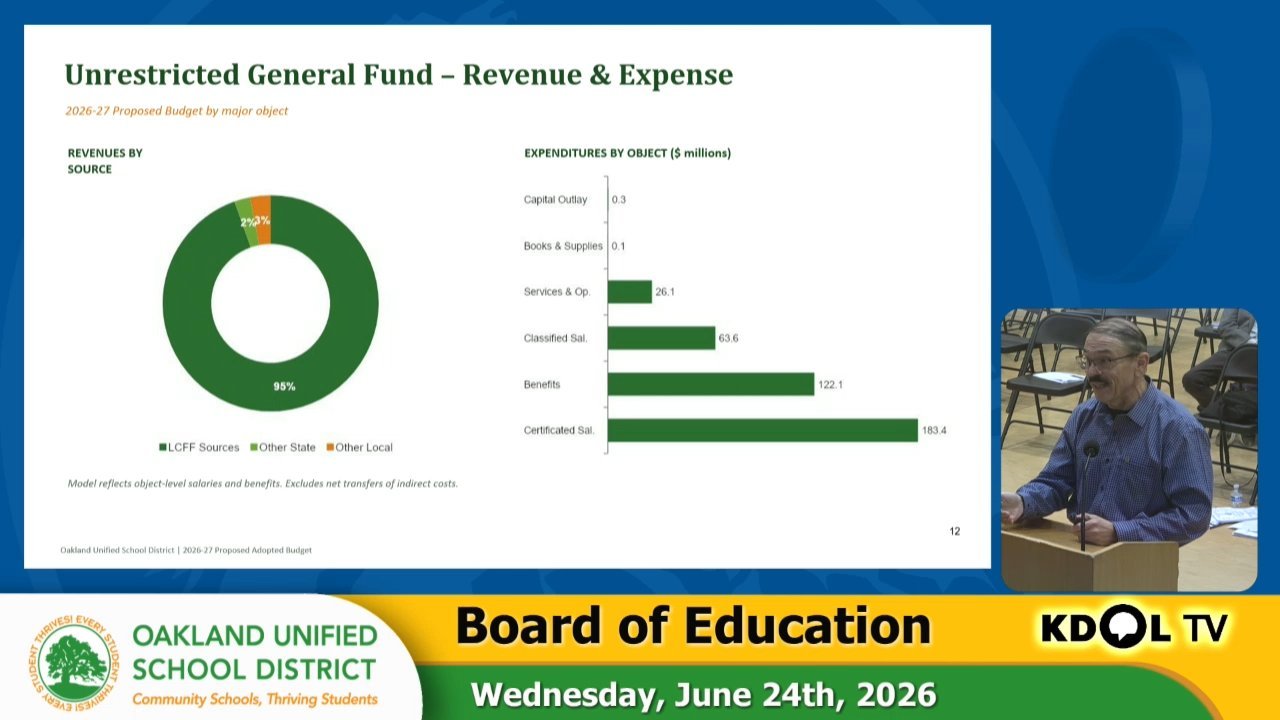
The basics: The $1.205 billion all-funds budget uses a conservative 2.87% cost-of-living adjustment, below the 4.31% the state is expected to provide. It does not yet reflect anticipated "Super COLA" or increased special education funding. Embedded in the budget's books-and-supplies line are two large entries: a $30 million "reduction designation" (object code 4395), representing cuts the board committed to through its fiscal stabilization plan, and a $16 million OEA reserve (object code 4394) for retroactive teacher pay under the new contract.

Why it matters: If the $30 million in cuts are executed, the budget shows an unrestricted net increase of approximately $7.9 million — a surplus. If they are not, the district is staring at a $22 million structural deficit that could trigger county disapproval or state intervention.

Where things stand: Board Member Mike Hutchinson challenged the numbers throughout the evening. He argued that between the June 10 public hearing and the June 24 adoption meeting, staff removed the $30 million notation from SACS summary forms to produce a surplus.

"If you knowingly put forward fraudulent numbers in the budget, that means you are committing fraud. And this is very serious because we're talking about a billion dollars," said Board Member Hutchinson.

Deputy Superintendent Tara Guard and consultant Dr. Reuben Frutos presented the budget, while CFO Ryan Nguyen walked through the SACS form reconciliation to explain how the $30 million reduction designation and $16 million OEA reserve net to an $81,000 display on the summary form while still reflecting the roughly $7.9 million unrestricted net increase. Staff maintained the budget is legally compliant and will be reviewed by the Alameda County Office of Education and independent auditors.

Board Member Patrice Berry pressed for clarity on the relationship between the $8 million surplus, the $22 million structural deficit, and the $30 million figure, extracting acknowledgment that the surplus exists only if the $30 million in cuts are executed.

"The plan, as it was clear today, is really just getting us through next year. There needs to be additional intensive work beyond next year," said Board Member Berry.

The other side: Public commenters echoed concerns. Oliver Brennan, a parent of two, told the board the math is straightforward: "$8 million minus $30 million equals a $22 million deficit; the $30 million has nothing behind it." Carol Delton questioned why any organization wouldn't simply insert a plug to balance its books.

Board Member VanCedric Williams defended the path the district has taken, noting it had avoided state receivership. "We had the CBO actually encourage us to take a $100 million loan out from the state and we chose to move in a different direction," he said. Board Member Rachel Latta praised the progress staff had made under difficult circumstances. Vice President Valarie Bachelor urged the public to demand full Proposition 98 funding from the state.

Board President Jennifer Brouhard urged a yes vote, noting the June 30 budget deadline.

Decisions: The budget passed 4-1 (For: Latta, Williams, Barry, Bachelor; Against: Hutchinson; Absent: Berry, Thompson). Berry was present for other items but had stepped away at the time of the vote.

What's next: The Alameda County Office of Education will review the adopted budget. The board extended the meeting to 11:45 p.m. to complete remaining business. Quarterly fiscal stabilization updates are promised starting in the fall.


Fiscal Stabilization: $41.5 Million in Savings or a Paper Promise?

Adopted just ahead of the budget vote, the fiscal stabilization plan is the mechanism by which the board intends to close the structural deficit — and the predicate for the budget's claimed balance.

Why it matters: Without executing the stabilization plan's savings targets, the budget surplus evaporates and the district risks losing local control.

Where things stand: Superintendent Denise Gail Saddler opened with a lengthy statement framing the plan as a roadmap. "Fiscal responsibility and educational excellence are not competing priorities. They are inseparable," she said.

Deputy Superintendent Tara Guard presented a three-bucket approach: $92.3 million in general fund savings already achieved this year, strategies carried forward from prior plans, and new strategies including deferring new programs and reviewing management positions. The plan projects $41.5 million in general fund savings and $13 million in restricted savings for 2026-27.

Board Member Hutchinson objected strenuously, arguing that nobody can explain the budget numbers and that the plan was not actionable. "You cannot have a surplus and a deficit in the same fund," he said.

Public commenters Asada Labala and Oliver Brennan both expressed confusion about the budget numbers and urged board members to demonstrate their understanding before voting.

Decisions: The plan passed 5-1 (For: Latta, Williams, Barry, Bachelor, Brouhard; Against: Hutchinson; Absent: Thompson).


Teachers' Contract Ratified, but Affordability Questions Linger

The board ratified the successor collective bargaining agreement with the Oakland Education Association, covering salary increases, class size reduction, preparation time, and working conditions from July 2025 through June 2027.

Why it matters: Public commenters estimated the contract's total cost at roughly $100 million over two years. The $16 million reserved in the budget for retroactive pay represents just the first installment.

Where things stand: Board Member Hutchinson pulled the item from the consent report and requested a conflict-of-interest ruling regarding Board Member Williams, alleging Williams is paid by the California Teachers Association. Williams denied being a CTA employee, and General Counsel Lindsey declined to find a conflict.

Hutchinson also challenged whether the "pending approval" conditions under AB 1200 were met, noting the Alameda County Office of Education's letter required a plan to address the $30 million deficit at the same meeting. Staff and counsel stated the stabilization plan vote satisfied that requirement.

Matt Glazer, a member of the district's Parent Student Advisory Committee, noted the OEA agreement is already producing savings in speech-language pathologist hiring and special education teacher retention, and urged the board not to over-cut positions only to hire contractors at higher cost.

Decisions: The agreement was ratified 5-0-1 (For: Latta, Williams, Barry, Bachelor, Brouhard; Abstain: Hutchinson; Absent: Thompson).


LCAP Final Year: Carryover Cushion Spent, Key Positions Cut

The board adopted the third and final year of its $504.6 million Local Control and Accountability Plan, which governs all supplemental and concentration spending for the district's highest-need students.

The basics: The LCAP is a state-mandated plan that directs how districts spend supplemental and concentration grant funding — dollars tied to low-income students, English learners, and foster youth.

Why it matters: The plan shifts $25 million in programs previously funded from the base budget into supplemental/concentration, and it exhausts the $30 million supplemental and concentration carryover cushion accumulated in prior years — leaving virtually no buffer for future adjustments.

Where things stand: Diana Sherman, the district's LCAP coordinator, presented the final year, which adds five new program areas into supplemental/concentration funding (small elementary schools, alternative education high schools, elementary supervisors, attendance specialists, and STIP substitutes). Eliminated investments include attendance case managers, community school managers, late-arriving continuation teachers, and various district-wide positions.

Student Director Maximus Simmons asked whether communities were consulted before positions were eliminated: "Was there any time in which the people who made the decisions to eliminate these positions went to any of the school sites and asked the people who worked there?" Dr. Sandra Aguilera acknowledged only a principal survey was conducted.

Sherman acknowledged that metrics will suffer and the district will not be able to do everything it has done previously.

Decisions: The LCAP passed 5-0 with three abstentions (Hutchinson and both student directors abstained; Thompson absent).

What's next: The next three-year LCAP cycle begins in the fall with new goal-setting.


$27 Million in Bond Funds Directed to School Construction and Heat Relief

Why it matters: Oakland voters committed $1.15 billion through bonds B, J, and Y for school facilities. This fourth amendment to the Measure Y spending plan directs the remaining contingency to prioritized projects using the adopted facilities master plan for the first time.

Where things stand: Thomas, the district's Chief Systems and Services Officer, presented allocations of $12.25 million to McClymond's, $6 million each to Roosevelt and CCPA, and $2.7 million to MLA. Heat mitigation — the top voter-identified priority — received $4 million for cool roofs and other measures. After contingency allocation, $30.3 million remains.

Board Member Hutchinson opposed the item, expressing concerns about spending contingency before major projects are complete and about multi-million-dollar program management contracts. Vice President Bachelor praised the progress and noted a zero-finding Measure Y audit by the Citizens' Bond Oversight Committee.

Decisions: The amendment passed 5-1 (For: Barry, Williams, Latta, Bachelor, Brouhard; Against: Hutchinson; Absent: Thompson). CCPA's groundbreaking was scheduled for the following day.


Bell-to-Bell Cell Phone Ban Adopted

The board adopted a district-wide ban on student cell phone use during school hours, complying with California's new requirement that all districts adopt phone-free policies by July 1, 2026.

Where things stand: Staff presented survey data showing 31 of 38 administrators support the full bell-to-bell ban over a partial ban. Middle schools had the highest rate of cell phone discipline incidents. The policy includes exceptions for emergencies and medical needs.

Board Member Hutchinson raised the fiscal impact, noting the memo projects $500,000 in costs for pouches and cubbies without identifying a funding source. Dr. Aguilera confirmed supplemental funds will cover implementation.

Decisions: The policy passed 5-0-1 (Hutchinson abstained; Thompson absent).


Equity Failures in Sharp Focus During Public Comment

Two powerful voices during public comment illustrated the district's unfinished equity work from starkly different perspectives.

Lisa Spielman, a 35-year veteran teacher and leader of strategic resource planning, announced she is leaving OUSD, citing a culture of discrimination against Jewish and Israeli students and staff. She described a professional development session where training was turned against Jewish staff, said she filed a uniform complaint with no response, and reported that approximately 100 Jewish students have left the district.

Asada Labala, an 81-year-old longtime Black community advocate, responded that African American students face far worse outcomes — 80% of students at McClymond's reading three grades below level, the highest suspension and expulsion rates, and the highest suicide rates for Black boys ages 16-24. Labala said the NAACP came for Jewish concerns but never for Black issues.

Both speakers underscored that the district's equity framework is not experienced equally across communities.


Minor Items

  • Pupil Discipline Consent Report adopted 5-0-1 (Hutchinson abstained; student directors recused; Thompson absent).
  • California School Dashboard report presented as informational; flagged a 44.8% teacher misassignment rate and only 50% of secondary students reporting feeling safe at school.
  • General Consent Report (230+ items) approved 5-1 after approximately 30 items were pulled for separate consideration; Hutchinson voted no, citing widespread missing fiscal impact analyses.
  • Edward Shands Adult Education Center site RFP for affordable housing withdrawn by Vice President Bachelor for future consideration.
  • UAOS President Kerry Kaufman told the board during closed session public comment that principals and assistant principals earn less yearly than teachers and have received no responses to bargaining proposals, calling the process bad faith.
  • Mario Cappitelli, an OUSD employee, parent, and taxpayer, alleged labor violations and Brown Act violations at a prior week's facilities committee meeting.
Board Adopts $1.2B Budget Amid Bitter Fight Over Hidden Deficit | Board of Education | Locunity