
Oakland Schools Clash Over $30M Cut Plan as Principals Work to Rule
Board of Education • Oakland Unified School DistrictOctober 28, 2026
Locunity is an independent informational service and is not an official government page for this commission. All information is sourced from public footage and an analysis of official agendas with the aid of responsible, fact-checked AI. to report an error or omission.
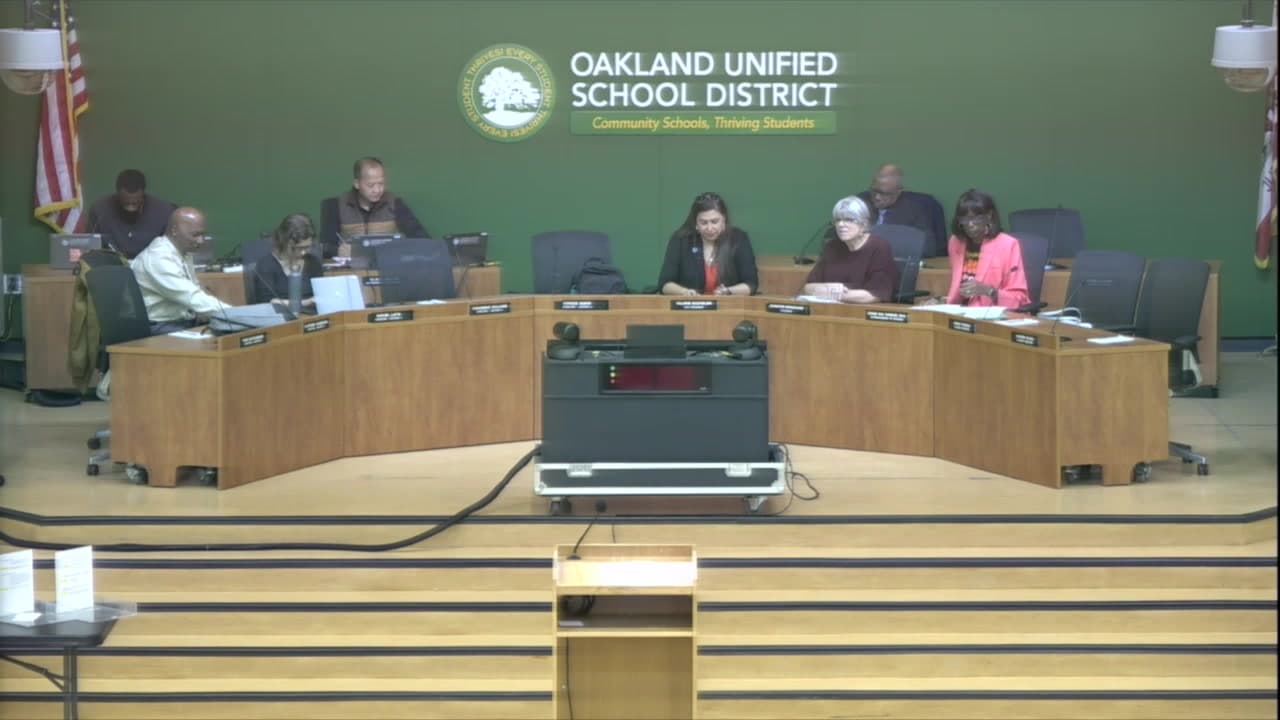
Oakland Unified's Board of Education spent its Oct. 28, 2026, meeting arguing over whether a real plan exists to close a $30 million unrestricted budget gap, with only a few meetings left before year-end. Outside the budget fight, the board renewed a top-performing charter, approved a $41 million after-school plan, raised developer fees and created a task force for the vacant Edward Shands site. School administrators also launched a work-to-rule action over a stalled contract.
- $30M cut plan unfinished: Director Mike Hutchinson says the update repeated September's document.
- Principals begin work-to-rule and demand the return of Measure H parcel-tax money.
- Downtown Charter Academy renewed 8-0 through June 30, 2032.
- $41M Expanded Learning plan approved 6-0-1 over process objections.
- Developer fees rise to $5.38 per square foot, and a Shands task force passes 6-1.
The $30 Million Question
Why it matters: The district has already cut about 400 positions. Board members agree that decisions on another $30 million in unrestricted cuts must come within roughly three meetings before year-end. They do not agree on whether staff has shown a plan to get there.
Where things stand: Staff described real progress. "We restored our required reserve and implemented $92.3 million in gap-closing measures, including $28.8 million in ongoing reductions," said Tara Gard, district business and operations staff. The district also kept a positive cash balance.
The remaining $30 million target relies on a 10% cut to the general fund's contribution to special education and on 336 vacancies. Director Rachel Latta confirmed that the special education reduction totals $14.6 million and is not in the adopted budget. She also confirmed $12.8 million in ongoing state money.
The other side: Hutchinson called the report a rerun. "This update reflects that no work has been done … in the last month on this plan," said Director Mike Hutchinson. He added: "This was the last chance, Superintendent, to present a plan, and again we get nothing but the same thing we had last month." Hutchinson said he would escalate the matter after Election Day.
Director VanCedric Williams and Board Vice President Valarie Bachelor defended the district's progress and the county's independent review. Director Patrice Berry asked for more substantive monthly updates and a formal plan by first interim, the district's first mid-year budget report. Public commenter Carol Dalton said the memo contains the detail and that the district is in a much better place than last year.
Enrollment adds pressure: Census-day enrollment is 250 students below last year and 152 below budget. Kindergarten fell about 100 students, and newcomer enrollment dropped nearly 1,000. Transitional kindergarten (TK) grew by 257 students.
A "hold-harmless" funding formula protects this year's revenue but not future years. The money that once paid for enrollment outreach is also gone. "Our department has none of that this year," said Killian Betlach, executive director of enrollment. Public speakers pointed to 25 schools with fewer than 300 students.
What's next: The board took no vote. Staff will provide monthly updates and bring more detail to the Budget and Finance committee.
School Leaders Escalate on Two Fronts
Why it matters: Principals and other administrators are the people who run school sites. They now say they are the only union without a new contract or a raise. At the same meeting, they also accused the district of diverting voter-approved money.
Where things stand: Before closed session, public commenter Carrie Kaufman spoke for the administrators' union. She said bargaining had seen minimal movement and at least 10 principals had taken leave for injury or unsustainable demands. She asked the board to negotiate on compensation, safety and workload.
Later, another union speaker announced work-to-rule. Members will strictly keep to their defined workday and take their unpaid lunch. Chen Kong Wick, an expanded learning program manager and union member, urged good-faith bargaining. Another speaker contrasted a 4.75% cost-of-living adjustment with 3.7% inflation.
From closed session, the board reported giving direction to its labor negotiators on a 6-0 vote. Hutchinson was absent.
The Measure H fight: Nydia Baez, principal of Fremont High School, and Shalonda Gregory, principal of Met West High School, said Measure H funds pay for teacher collaboration and internship coordinators. Both asked the board to return the money. Gregory warned that voters would hold the district accountable at election time.
Brandon Wall, commissioner on the Measure G1 Oversight Commission, cited a letter signed by 17 middle school principals. He said the audit did not address ballot-measure language requiring site-directed funds.
Staff said the contingency carryover went to allowable expenses. They added that the auditor advised spending parcel tax funds in the year they are received. About $3.5 million is in dispute, which raises voter-trust risk for future measures.
What's next: No action on Measure H was taken. The labor dispute continues in closed-session bargaining.
Charter Renewal Was Legally Settled
The basics: Under state charter law, schools in the "high tier" for performance carry a statutory presumption of renewal. Districts can deny them only on fiscal or governance grounds, and only after giving 30 days' notice.
Where things stand: Downtown Charter Academy, a Grades 6-8 school run by A-Method Public Schools, scored blue (the highest level) in English and math on the state dashboard.
Staff explained that the board had little legal room to deny the renewal. "There is a statutory presumption of renewal for schools in the high tier, and they cannot be denied based on their academic performance," said Kelly Krag-Arnold, director of the Charter Office. "OUSD did not send DCA a 30-day notice, and so that is not an eligible way to deny the school's renewal," she added.
Adrienne Barnes, CEO of A-Method Public Schools, and the school's principal presented gains for English learners and Black students and 97.8% attendance. Eleven speakers were scheduled, and students, parents and teachers urged approval. Among them was Meg Miller, an Arroyo High School principal and DCA parent.
The other side: One speaker raised concerns about segregation in Oakland schools and the school's demographics. That speaker also said the school may well be positive.
Decisions and stakeholder impacts: Berry moved and Director Clifford Thompson seconded a five-year renewal. The board approved it through June 30, 2032.
- For: 8 — Board President Jennifer Brouhard, Bachelor, Berry, Hutchinson, Latta, Thompson, Williams and Student Director Amina Tongun (advisory)
- Against: 0
- Absent: 1 — Student Director Bloch
$41 Million After-School Plan Passes
Why it matters: The Expanded Learning Opportunities Program (ELOP) is restricted state money. It pays for after-school, Saturday, intersession and summer programs that reach about 19,000 children a day.
Where things stand: "On average, we get about $41 million of ELOPE yearly," said Martha Peña, coordinator of after-school programs. About $30 million goes to direct after-school services, covering 84 programs at 79 schools.
The plan also funds YES Sports, Exlo Arts, a gaming league, TK-K programming, summer programs for 8,000 youth and a 30% cost-share for facilities upgrades. Directors asked about alignment with teachers, provider quality, peer mentors and classified staff.
The other side: A public speaker said program staff cannot evaluate themselves. The speaker called for independent performance reviews, citing too many programs and weak reading outcomes.
Hutchinson objected to the process. He called it "a $41 million plan to provide these essential services that should have been discussed in a deep way in committee and by the school board." Thompson called the report thorough.
Decisions and stakeholder impacts: Approved. For: 6, Against: 0, Abstain: 1 (Hutchinson). Providers and families keep their programs, but the call for independent evaluation went unanswered on the record.
Developers Pay More; Shands Gets a Task Force
Fees, by the numbers: The board voted 7-0 to adopt Resolution 2627-0102. It raises residential Level I developer fees, the per-square-foot charge on new construction that helps fund school facilities, from $5.17 to $5.38. Commercial fees rise by 3 cents. Student directors were absent.
Staff cited $3.15 billion in facilities master-plan needs. They projected 4,397 new housing units generating about 1,060 students, with a true cost of $14.46 per square foot against the $5.38 legal maximum. Fees are projected at $1.8 million to $2.5 million a year, compared with about $6.5 million in past market-rate years.
"So the increase in these impact fees is going to net us roughly, for residential units, $240,000 a year," Hutchinson said. Bachelor backed the increase, saying "new development needs to contribute its fair share towards schools and public infrastructure to make Oakland thrive."
Public commenter Asal Olabala disputed the projected enrollment growth and noted that nonprofit developers can seek waivers. Berry asked: "how does a school district respond to that?" Pranita Ranbhise, executive director of facilities planning, said fees can be waived for "affordable housing in some instances, but it's not a blanket exemption."
Fees can only be raised in even years, so the next chance comes in 2028.
The Shands site: On a 6-1 vote, the board adopted substitute Resolution 2627-0018, seconded by Williams. Instead of issuing an immediate request for proposals (RFP), the district will create an ad hoc task force. It will advise on affordable housing, workforce housing and community uses at the vacant former Edward Shands Adult Education Center.
General counsel said the superintendent appoints the task force and consults the Facilities Committee, and that the task force is time-bound. Supporters called the site an eyesore. Berry noted the task force will compete for staff time with the 7-Eleven committee and the superintendent search. Earlier, public commenter Marissa Mills, a parent, urged selling the property to fund teachers and principals.
The other side: Hutchinson cast the lone no. He questioned whether the resolution had been legally vetted and argued the site should serve adult education. "I have serious concerns about the prescriptive nature of designating who will be on that ad hoc committee and who won't," he said.
Minor Items
- Closed session: Settlement in existing litigation approved 5-0. Berry abstained and Hutchinson was absent.
- CCPA expansion hearing: No vote. Staff described vapor mitigation and a soil management plan overseen by the state Department of Toxic Substances Control (DTSC). Olabala raised contamination at McClymonds.
- Linked Learning: Pathway participation rose from 45% to 92% since 2013. Three pathways earned gold certification: Fremont's Architecture Academy, Oakland High's Law and Social Justice Academy, and Skyline's Green Energy Academy.
- Consent reports: The general report passed 6-0, with Hutchinson recorded absent. R.-7 was withdrawn and R.-76 postponed. Report No. 2 passed 5-0 after one recusal.
- Other votes: Pupil discipline report adopted 5-0, with Berry and Hutchinson abstaining. Credential waiver approved 7-0.
Looking Ahead
R.-76 returns at the next meeting with revised language, and finance staff owe the board monthly stabilization updates. The board adjourned in memory of Dolores Huerta, Gary Hendricks Sr. and a retired Prescott teacher.