
Oakland Board Takes Three Tries to Advance $41M Learning Plan
Board of Education • Oakland Unified School DistrictOctober 14, 2026
Locunity is an independent informational service and is not an official government page for this commission. All information is sourced from public footage and an analysis of official agendas with the aid of responsible, fact-checked AI. to report an error or omission.
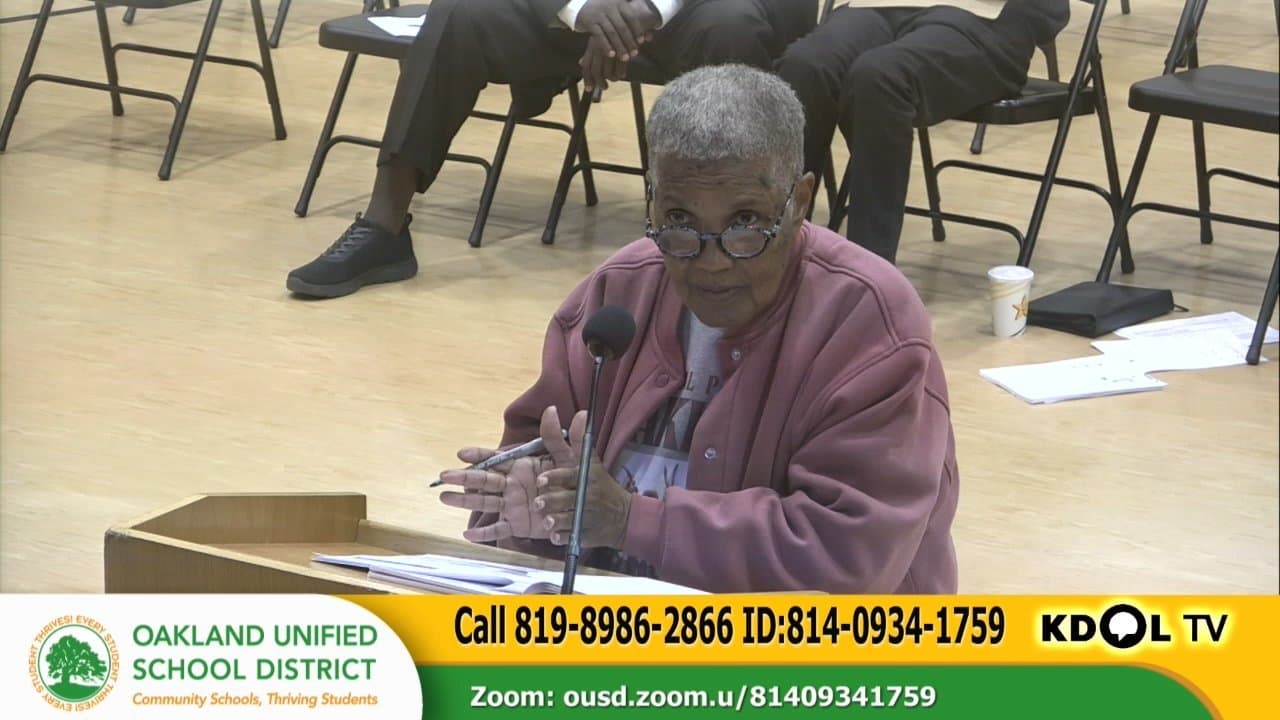
The Oakland Unified School District Board of Education needed three roll calls on Oct. 14, 2026, to settle what to do with a $41 million expanded learning plan. It landed on a conditional approval that returns the plan for public debate Oct. 28. Behind the procedural tangle sat a bigger fight: enrollment came in 60 students below projection, and directors and commenters pressed leaders on a deficit they say still has no plan.
- $41M expanded learning plan conditionally approved after a 3-3 tie and a failed motion.
- Enrollment fell 250 students year over year, missing projections by 60, with kindergarten down 103.
- Director Mike Hutchinson called the miss "gross mismanagement" and warned of a roughly $30M unrestricted gap.
- Literacy update drew sharp criticism for offering no disaggregated data on results.
- Measure G oversight chair says about half of parcel-tax dollars go to athletics and arts.
- $1.1M in violence interruption contracts passed 6-0 as Hutchinson faulted the funding source.
A $41M Plan, Three Votes and a Deadline Nobody Could Pin Down
The basics: The Expanded Learning Opportunities Program funds after-school and summer programming for students in transitional kindergarten through sixth grade. The district's plan requires board approval before it goes to the California Department of Education.
Why it matters: The plan directs $41 million in learning time for Oakland's youngest students. It arrived on the consent calendar, where items pass in a single vote without discussion.
Where things stand: Hutchinson opened the meeting by moving to pull the item. "I would like to pull item R22 from the consent report," said Mike Hutchinson, Director. He argued that a plan this size belonged on the regular business agenda. "A $41 million plan for how we're going to spend our expanded learning," he said.
Staff said board approval is a state requirement. After some uncertainty about timing, staff said a two-week delay seemed possible, but no one could confirm the state's deadline.
The other side: Other directors cited the risk to the funding itself and to the integrity of the board's process. Hutchinson pushed back. "Why wouldn't they just want to have a real discussion about $41 million?" he said.
Decisions and stakeholder impacts: The board then took three votes.
- Motion 1 (failed): Hutchinson moved, and Director Clifford Thompson seconded, to bring the plan back Oct. 28 with conditional approval. The clerk declared it not agreed to on a 3-3 tie. For: 3 (Hutchinson, Thompson, Director Patrice Berry). Against: 3 (Director Rachel Latta, Director VanCedric Williams, Board President Jennifer Brouhard). Absent: 1 (Vice President Valarie Bachelor).
- Motion 2 (failed): A motion to approve immediately and receive a report afterward. For: 3 (Latta, Williams, Brouhard). Against: 1 (Hutchinson). Abstain: 2 (Berry, Thompson). Absent: 1 (Bachelor).
- Motion 3 (passed): Hutchinson's renewed conditional motion. For: 4 (Latta, Hutchinson, Berry, Thompson). Against: 0. Abstain: 2 (Williams, Brouhard). Absent: 1 (Bachelor).
Under the adopted motion, the plan goes to the state as approved if the deadline falls before the next meeting. If it does not, the plan returns to the board unapproved. The outcome protects the funding stream for TK-6 families and after-school providers while giving the public a hearing. The split, though, shows a board divided between procedural caution and Hutchinson's insistence that big spending get public scrutiny.
What's next: The board will discuss the plan at its Oct. 28 meeting.
Enrollment Misses Target as Deficit Fight Sharpens
Why it matters: Enrollment drives state revenue. A missed projection shrinks the budget just as the board faces mid-year cuts, and no budget item was on the agenda.
Where things stand: The enrollment update ran inside the superintendent's report. "So we missed our enrollment projections by 60 students," said Killian Vetlock, Executive Director of Enrollment. Districtwide enrollment fell 250 students from last year, with kindergarten down 103. Vetlock said day-20 and Census Day counts show growth at transitional kindergarten hubs falling below projection. He also cited a rising population in self-contained special education classes, declining newcomer enrollment and the end of outreach funding.
Interim Superintendent Denise Gail Saddler described the decline as a statewide trend driven by demographics, immigration enforcement and the cost of living. She said those factors are not an excuse. "Our responsibility is not simply to manage declining enrollment," she said.
Berry asked about the revenue impact, noting the budget assumed 33,861 students. Williams, speaking during the advisory committee reports, pointed to newcomer losses. "We lost over 1,000 students and hundreds of family members," said VanCedric Williams, Director. Advisory leaders reported that the newcomer program is shrinking from 16 schools to seven.
The other side: Hutchinson called the lack of urgency "gross mismanagement." He cited a projected $20 million overspend and closed the night on the same theme. "There's no plan to cut $30 million from the unrestricted fund," he said.
Public commenter Oliver Brennan said the structural deficit is at least $65 million. He called for immediate public engagement on cuts and accused leadership of delaying for political reasons. Another commenter named gentrification, city employees living outside Oakland, charter enrollment and 41 excess facilities as factors. Sylvia Pfeiffer Williams, a District 4 candidate, offered a counterpoint during general comment. She said the trend lines show the district improving, with the deficit cut from $100 million to $30 million and teaching positions filled.
Decisions and stakeholder impacts: The board took no budget action. It adopted the general consent report minus three items. For: 5 (Thompson, Berry, Williams, Latta, Brouhard). Abstain: 1 (Hutchinson). Absent: 1 (Bachelor). "I'm going to continue my pattern that I started last April of not voting for the consent report," Hutchinson said. He cited $100 million in overspending last year. Berry asked for a report on contracts that fill gaps left by layoffs and on new or reclassified positions, and Saddler agreed.
What's next: Budget and finance discussion is planned for Oct. 28.
Literacy Plan Draws Fire Over Missing Results
Why it matters: Reading proficiency shapes both student outcomes and families' confidence in the district. Directors questioned whether the district's curriculum and assessment investments are moving the needle.
Where things stand: Early Literacy Director Jamila Sanchez walked through the district's framework:
- the uFLY foundational skills curriculum, now in its second year
- EL Education and the SIPS program
- tiered tutoring through Open Literacy and Ignite
- DIBELS and iReady assessments
- teacher coaching and an "Oakland Is a Reading Town" campaign
"We have about, I think, 89 early literacy tutors pulling small groups," Sanchez said.
Berry asked how educators give feedback, how schools use data and what is missing. Sanchez pointed to a monthly coaching collaborative and feedback forms. She described the work as a "marathon" and said literacy coaches need protection. Thompson asked which Tier 2 curriculum delivers the most value and how iReady aligns with the state's Smarter Balanced tests. Latta raised concerns about screen time and the length of the kindergarten day.
The other side: Hutchinson said the update should have been a business item. "This is the presentation on how we're going to fix literacy?" he said. The presentation included no data broken out by student group. That gap matters given figures cited earlier by public commenter John Jones III, a Roosevelt parent: Black students testing at 20% proficiency in English and under 14% in math.
What's next: Saddler promised a deeper agenda item on literacy.
Measure G Watchdog Flags Spending Drift
Why it matters: Voters approved the Measure G parcel tax for teachers, courses and libraries. The oversight committee warns that spending is drifting from those goals.
Where things stand: "We do have roughly half of the dollars going athletic league and arts," said Phil Patrick, Chair, Measure G Parcel Tax Independent Citizens Oversight Committee. He said $6 million in Measure G funds is not being spent on Measure G purposes. Patrick also said an Oakland Athletic League director had promised outcome data but never followed up.
Patrick recommended aligning spending with the measure's charter, expanding library access, distributing funds based on equity and using unspent dollars for pilot programs. Williams pressed for results. "What are the outcomes that we are monitoring and investing in?" he asked. Patrick answered that the district must set key performance indicators, including for teacher retention.
Decisions and stakeholder impacts: Hutchinson linked the report to similar concerns raised by the commissions overseeing Measures G1 and HN. Saddler offered to meet with the committee. The board took no action on the report.
Violence Interruption Contracts Pass, With Caveats
Why it matters: The district is taking over school violence prevention work the city previously funded, with $595K going to Communities United for Restorative Youth Justice (CURYJ) and $493K to Youth Alive.
Where things stand: Latta sought clarification on the contracts. Nelson, Executive Director of Safety, explained that the work moved to the district after a four-year city pilot. "We took that on from them," he said. He said violence interrupters work beyond school hours and "prevent a lot of retaliation that can happen from a violent incident on campus." Life coaches carry individual caseloads.
The other side: Hutchinson supported the contracts but called the process irresponsible. He objected to paying for them with central concentration dollars withheld from all schools. "It's very poor fiscal policy," he said. Brouhard called the approach equitable. Earlier, a commenter questioned awarding contracts to groups based outside Oakland. A Skyline High School parent, JT Meitz-Moschin, said the school has improved with the programs in place.
Decisions and stakeholder impacts: The board approved both contracts in a single roll call, recorded separately. For: 6. Against: 0. Absent: 1 (Bachelor). High-need high schools keep their violence interruption services, but the funding source remains a point of contention.
Minor Items
- Settlements: The board approved two closed-session litigation settlements without disclosing terms. For: 4. Abstain: 1 (Berry). Absent: 2 (Bachelor, Hutchinson).
- Expulsions: The board adopted six student expulsions. For: 4. Abstain: 2 (Hutchinson, Berry). Absent: 1 (Bachelor). Commenter Asada Ologbala said the agenda gave the public nothing to respond to.
- Discipline disparities: Ologbala said 57% of suspended students are Black. Hutchinson said the gap is worse than under an earlier voluntary resolution: "unless you believe there's something inherent in Black folks that make it where we get suspended more."
- Skyline lights: Meitz-Moschin said the field lighting project has not started, leaving 80 girls soccer players without practice or game sites. Light poles are expected Nov. 23.
- Labor: A BCTC representative said a tentative agreement is at the county and raises with retroactive pay are hoped for by mid-November. Fewer than 70 staff maintain close to 100 buildings, he said.
Looking Ahead
The board returns Oct. 28 for the expanded learning plan and budget discussion. The Parent and Student Advisory Committee holds community sessions on school staffing costs Oct. 17 and Oct. 21, and a language forum is set for Nov. 7.