
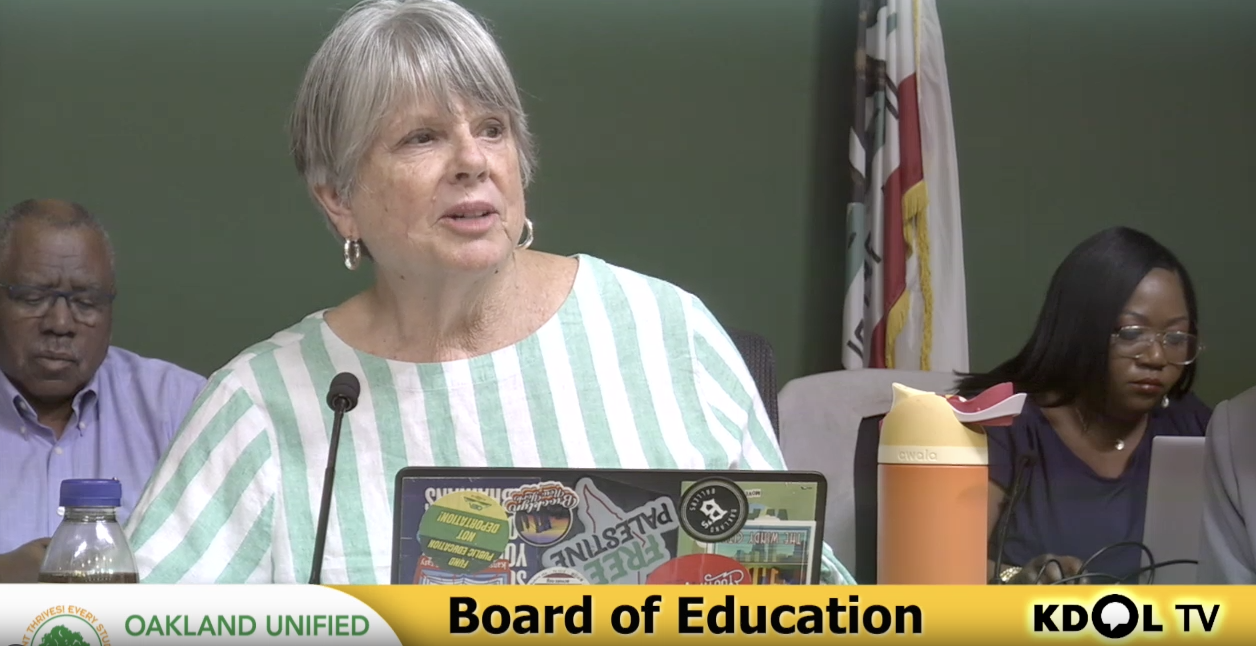
Board of Education - Jun 10, 2026 - Meeting
Board of Education • Oakland Unified School DistrictJune 10, 2026
Locunity is a independent informational service and is not an official government page for this commission.We use AI-assisted analysis and human editorial review to publish information.
Board Cures Historic Brown Act Violation, Clashes Over Budget Numbers and General Counsel Contract
The Oakland Unified School District Board of Education's June 10 marathon — stretching past 11:30 p.m. — laid bare governance fractures that threaten the district's ability to adopt a compliant budget by its June 30 deadline. The board unanimously acknowledged an unprecedented Brown Act violation, heard alarming student safety data, fought over three conflicting sets of budget numbers, and split 4-3 on a late-night contract extension for the district's top lawyer.
- Board unanimously admits it violated the Brown Act by adjourning its May 13 meeting without allowing registered speakers to deliver public comment — the first such cure in OUSD board memory
- Student safety survey finds nearly half of students feel unsafe at school, even as district reports dramatic drop in police calls under the George Floyd resolution
- Reopened budget hearing devolves into numbers fight, with three different budget totals in the packet and no staff member able to reconcile them
- General Counsel contract extended 4-3 at 11:30 p.m. through 2029 at $306,000 base salary — without a performance review
- Administrators demand fair bargaining, warning Oakland principals are the lowest paid in the region and colleagues are leaving for $30,000 raises elsewhere
- All 50+ consent report items pulled to a Monday special meeting over missing funding sources and resource codes
An Unprecedented Brown Act Cure
Why it matters: The Brown Act is the bedrock transparency law governing public meetings in California. OUSD's board had never, in anyone's memory, been forced to cure a violation of it.
Where things stand: On May 13, the board adjourned without providing the legally required non-agenda public comment period despite registered speakers still waiting to address the body. The June 10 resolution formally acknowledged the violation of Government Code Section 54954.3(a) and committed the board to cease and desist.
"This is the first time in my memory, and I checked with my mother, the first time in her memory that we've ever seen a school board item where they had to correct a Brown Act violation," said Director Mike Hutchinson, who characterized the failure as symptomatic of broader meeting mismanagement under President Jennifer Brouhard's leadership. He noted the board was also re-doing its budget hearing at this same meeting because the wrong document had been posted June 3.
As part of the cure, 15 community members denied their comment time on May 13 were invited back for two minutes each. Several used the opportunity to address antisemitism in OUSD schools (see below), while others spoke about administrator pay and facilities.
Decisions: The resolution passed unanimously, 9-0 (For: Directors Hutchinson, Williams, Thompson, Latta, Berry, Bachelor, President Brouhard, Student Directors Simmons and Smith; Against: 0; Absent: 0).
Jewish Community Members Press for Action on Antisemitism
Why it matters: The California Department of Education has issued formal findings regarding OUSD's handling of antisemitism complaints, and multiple speakers said the district has failed to respond with urgency.
Where things stand: During the Brown Act cure comment period, a stream of speakers detailed what they described as a hostile environment for Jewish students. Judith Klinger, a retired teacher, listed violent attacks on Jewish people globally that were accompanied by "Free Palestine" messaging and argued the phrase instills fear when displayed in classrooms. Ezra Barani asked whether discrimination complaints would take as long if the victims were any other group.
David Blum cited specific quotes from an OEA December 2023 teach-in that he characterized as anti-Jewish, including statements like "Both the West and Israel intend to exterminate indigenous people." He asked directors to reject what he called anti-Zionist, anti-Jewish teaching through a formal resolution.
Carol Dalton noted that district staff had not associated themselves with fighting back against antisemitism and criticized the use of a robotic voice to read CDE responses as inadequate.
What's next: No board action was taken during the comment period. Speakers called for a formal resolution and removal of political materials from classrooms.
Half of OUSD Students Say They Don't Feel Safe
The basics: Two complementary presentations — a student-led safety survey and a district safety update — painted a complex picture: progress in reducing police interactions alongside persistent student fear.
Why it matters: The data shows the district's George Floyd resolution has sharply reduced law enforcement contact, but students themselves report that everyday violence, gossip, and inadequate adult response remain pervasive. Budget cuts now threaten the programs credited with the improvement.
Where things stand: Augustine and Graciela, students from Oakland Tech High School serving on the OUSD Student Committee for Safety and Violence Prevention, presented findings from a survey of more than 700 students across 25 schools. Key findings: only 55% of students feel safe (rating four or five on a five-point scale); 75% of all suspensions stem from physical violence; the most frequent conflicts involve gossip, verbal arguments, and social media; and most students do not know what to do when they are involved in conflict.
Students recommended early adult intervention, restorative justice circles, anonymous reporting systems, de-escalation training, and improved facilities — especially bathrooms. Board members praised the work extensively.
In a separate presentation, Executive Director of Safety Nelson Allegra reported the district's central intake line received 877 calls this year, with one-third related to health or behavioral health. On-campus arrests dropped to just three school-related incidents. Nearly 90 culture keepers now serve across the district.
The other side: Director Hutchinson reminded the room of the George Floyd resolution's origins, recounting the 2011 killing of Raheem Brown by OUSD police. But he warned that gains are fragile: "I'm really worried because of our budget situation here as a district that we're going to lose some of the services we have, that we're going to lose our violence interrupters and some of these other programs that have really paid dividends."
Vice President Valarie Bachelor announced that Youth Alive received Oakland Fund for Children and Youth funding for life coaches at Skyline and Redsdale.
What's next: The board heard both presentations as informational items; no votes were taken. Budget adoption on June 24 will determine whether violence interrupter and culture keeper positions survive.
Reopened Budget Hearing Exposes Three Sets of Conflicting Numbers
Why it matters: The board must adopt a final budget by June 30 while facing a projected deficit exceeding $30 million. If directors cannot agree on which numbers constitute the proposed budget, a compliant adoption is in jeopardy.
Where things stand: The board reopened its statutorily required public hearing on the 2026-27 LCAP and district budget because the wrong budget document was posted at the June 3 meeting. But the do-over itself became a flashpoint. Director Hutchinson argued the hearing was not re-noticed in the newspaper as required, that no new LCAP presentation was given, and that a promised spreadsheet reconciling LCAP costs to the budget was never included in the packet. Most critically, he identified three different sets of budget numbers across the SACS form, multi-year projection, and PowerPoint presentation.
"So my question is, which of these three sets of numbers are the real numbers that we're talking about? Because they're different," Director Hutchinson said. Superintendent Denise Gail Saddler and staff attempted to explain that different reports serve different purposes, but Director Hutchinson rejected that explanation.
Director Patrice Berry pressed for a stronger financial stabilization plan. "I think that one of the most important things is building out or continuing to build out the stabilization plan, since that's the roadmap," she said, requesting budget assumptions, implementation risk analysis, and more robust community engagement provisions before the June 24 adoption vote.
LCAP Coordinator Diana Sherman explained the iterative budget development process. Most of the 15 registered public speakers had already left — the hearing began at approximately 9 p.m., two hours past its agendized 7 p.m. start.
Public commenter Carol Dalton raised concerns about contracting practices, noting OUSD's contracts budget exceeds its June budget every year and that the district contracts out at more than double the rate of peer districts.
Decisions: The hearing was closed after discussion. Budget adoption remains scheduled for June 24.
General Counsel Contract Extended 4-3 in Late-Night Vote
Why it matters: The General Counsel is one of only two positions the board directly hires. Approving a multiyear extension at 11:30 p.m. without a performance evaluation sets a precedent for how OUSD handles its most consequential personnel decisions — and concentrates legal, labor relations, governance, risk management, and ombudsman functions under one office.
Where things stand: The board considered extending General Counsel Jenine Lindsey's employment agreement from July 1, 2026, through June 30, 2029, at a $306,000 base salary with total first-year compensation exceeding $440,000 including benefits and fringe.
Director Hutchinson moved to amend the contract to a single year, arguing a three-year extension without any performance review at that hour was irresponsible. "To have a three-year contract really doesn't make sense. And what we should do if we were going to be conscientious about our job is at most we would do a one-year extension," he said.
Director VanCedric Williams was blunt: "Every single staff member gets a performance review. Every single. Top to bottom, the superintendent will get a performance review. And I am not giving out a contract without a performance review."
The other side: Director Rachel Latta argued that launching a General Counsel search while the district simultaneously conducts a superintendent search made little sense. "I don't think that doing also doing a general counsel search makes very much sense with that," she said, supporting the extension for stability.
Director Berry acknowledged the criticism had merit: "The most valid comments are the comments about the timing of this, the hour of the evening, and the opportunity we have to give this a little bit more rigor and curiosity and due process." She nonetheless voted yes.
Earlier in the evening, SEIU 1021 President Phoebe Wen had warned that concentrating oversight, labor relations, governance, risk management, and ombudsman functions under one office was dangerous for workers with the least institutional power.
Decisions: The one-year amendment failed 3-4 (For: Hutchinson, Williams, Barry; Against: Thompson, Latta, Bachelor, Brouhard; Absent: Student Directors Simmons and Smith). The main motion to approve the contract through 2029 then passed 4-3 (For: Thompson, Latta, Berry, Brouhard; Against: Williams, Hutchinson, Bachelor; Absent: Student Directors Simmons and Smith).
Oakland Administrators Say They're the Lowest Paid in the Region
Why it matters: Administrator attrition directly threatens school stability. When principals leave, the effects ripple through every classroom in a building.
Where things stand: Members of the United Administrators of Oakland Schools spoke during both the Brown Act cure period and bargaining unit comments. A joint salary study confirmed Oakland administrators are among the lowest paid in the region. An estimated 82% of members are stuck at the top of the salary schedule with no advancement. Some administrators supervise employees who earn more than they do.
Principal Shalonda Gregory of Midwest High School testified she is the lowest-paid principal in the small high school category. Friends, she said, have left for $30,000 raises at neighboring districts. Principal Anissa Rashid of Montera Middle School, a 33-year OUSD veteran, urged the board to come to the bargaining table.
BCTC Chief Steward Bedrudin Kukayovic questioned why an $85,000 vegetation contract was outsourced rather than done in-house and announced his union had reached a tentative agreement with labor relations.
What's next: UAOS bargaining is ongoing. The district's capacity to respond is constrained by the projected $30 million-plus deficit.
Community Schools Steering Committee Calls for Sustainable Policy
Why it matters: OUSD brands itself a community schools district, but it has no codified policy defining which schools qualify, how to sustain programs when five-year CASS grants expire, or how to implement the collaborative decision-making the model requires.
Where things stand: The Community Schools Steering Committee — established through the 2023 OEA contract and including parents, students, teachers, and representatives from AFSCME, BCTC, SEIU, and UAOS — presented its first formal recommendations. The committee developed a working definition of collaborative leadership emphasizing authentic engagement, transparent decision-making, and action steps reflecting community agreements.
Recommendations covered three areas: engagement through family walkthroughs and tours at community school sites; funding through higher allocation of CASS dollars to tier 2/3 SEL and behavior supports and state advocacy for continued funding; and collaborative leadership including inclusive decision-making, needs assessments at school sites, and a communications audit.
Director Hutchinson provided historical context on the national sustainable community schools model and criticized the district for never following through on the Brookfield school redesign. Director Williams praised the blueprint but asked about community school manager roles and how outcomes would be measured.
What's next: The committee's recommendations will be considered as part of the LCAP and budget processes.
Facilities at Skyline and McClymond's Draw Sharp Criticism
JT Mates-Mushen, speaking on behalf of Skyline High School students, described outdated weight rooms, a deteriorating stadium with lighting still in the bidding phase, a gym floor with holes and dead spots creating safety hazards, and a leaking gym roof during athletic events. He asked where Measure Y funding was being directed and demanded timelines.
Assada Olagbala detailed conditions at McClymond's High School, where a modernization project that began in 2021 is now projected to complete in 2029. The football field turf has not been replaced, the clock doesn't work, the intercom system was non-functional the entire school year — forcing culture keepers to watch the door instead of performing their regular duties — and two notices of environmental exemptions were requested. She called a planned celebration a "disgrace" given the lack of progress.
Advisory Committees Demand Meaningful Engagement
Parent and student advisory committees — including PSAC, DELLS, the Community Advisory Committee, and the Foster Youth Advisory Committee — urged the board to incorporate years of recommendations into the new LCAP and to engage stakeholders from the beginning of the budget cycle rather than at the end. Damani Jackson of PSAC pressed for a predictable process. Sayuri Valenza of the CAC and Patty Jurgens of the Foster Youth Advisory Committee called for disaggregated data, particularly for English learners with disabilities. Director Latta and Director Williams acknowledged the advisory committees' frustrations and pledged to address them before the June 24 budget vote.
Minor Items
- Pupil Discipline Consent Report adopted with student directors recused and Director Hutchinson absent from the vote (For: 5; Against: 0; Absent: 1).
- Motion to reorder the agenda — moving the school safety presentation (Q-2) earlier — failed 2-3 with 3 abstentions and 1 absent.
- All 50+ consent report items were pulled by Director Hutchinson, who cited missing vendor numbers, resource codes, and funding sources across items R-12 through R-24 and beyond. Everything was deferred to a Monday special meeting.
- Vice President Bachelor provided closing remarks expressing concern about concentrated authority under the General Counsel's office and urging the board to establish formal evaluation protocols for its direct hires.