
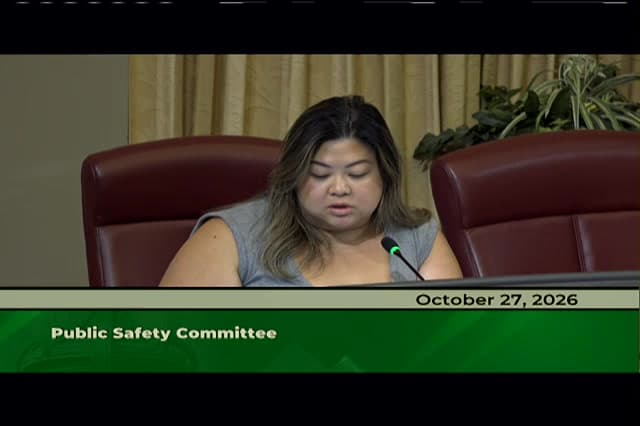
Oakland Police Watchdog Has Half the Investigators Its Charter Implies
Public Safety Committee • OaklandOctober 28, 2026
Locunity is an independent informational service and is not an official government page for this commission. All information is sourced from public footage and an analysis of official agendas with the aid of responsible, fact-checked AI. to report an error or omission.
Oakland's Community Police Review Agency is working with three field investigators when its charter benchmark calls for six, its director told the Public Safety Committee on Oct. 27, 2026, as the agency prepares to take on more cases from OPD Internal Affairs. The committee also received OPD's Part 1 crime data and its first Part 2 report in years, each on identical 3-0 votes with Councilmember Carroll Fife excused. No policy changed, but the requests for per-capita data, clearance rates and a new case database set up the next round of budget and staffing decisions.
- CPRA reports 3 of 6 charter-benchmark investigators and a failing case database it must replace.
- Part 1 crime fell about 6% citywide, but homicides rose in Areas 1 and 2.
- First Part 2 report in years shows human trafficking cases up 127% and runaway reports up 143%.
- Residents press OPD on data errors, staffing and clearance rates as crime declines.
Police Watchdog Short-Staffed as Caseload Grows
The basics: The Community Police Review Agency, or CPRA, is Oakland's civilian agency that reviews misconduct allegations against OPD officers. It presents a bi-annual report to this committee.
Why it matters: CPRA may absorb more investigations from OPD's Internal Affairs Bureau, or IAB. Whether it has the people and systems to handle them shapes police accountability and upcoming budget requests.
Where things stand: Director Lawson said staffing lags the charter formula.
“The charter mandate requires that we have one complaint investigator, field investigator, for every 100 officers. So we should have basically 6 right now. We have 3,” said Lawson.
The agency recently hired a director of investigations, a project manager II and a complaint investigator III. From January through September, CPRA reviewed 808 allegations, including 327 involving use of force and 331 involving performance of duty. It completed 240 investigations, has 62 ongoing and recorded 26 sustained findings.
The weakest link is technology. Lawson said the current database must be replaced next year and laid out three vendors. “Recon is by far the most comprehensive and a great system, but the cost is prohibitive,” he said, citing a three-year cost of $660,000. He prefers Wingswept, at roughly $100,000 a year; a third option is Civil. Lawson also cited approximately $200,000 for outside counsel and a proposed 21-position structure. His other priorities are written standard operating procedures, a new website, two attorney investigators and a ground-floor office.
Pressure from the dais: Councilmember Rowena Brown asked how staffing compares with the charter and whether cases are tracked by council district; Lawson agreed to ask OPD to add district numbers. Councilmember Charlene Wang, the committee chair, raised the fatal police shooting of Jose Angel Castillo. “I didn't think that level of — that it was necessary to shoot that person this many times,” said Wang. Lawson responded, “That particular case is likely one I will sign out to outside counsel.”
The other side: Public commenters praised CPRA's progress but questioned its readiness. “The goal should not be simply to transfer investigations from one agency to another, but ensure that whichever agency conducts them has the institutional capacity to do so effectively, fairly, and sustainably,” said public commenter Rajni Mandal. Public commenter Asada Olubala criticized CPRA's record on racial profiling findings and its lack of race data. “A letter should go out that says your complaint came under unfounded based on the evidence,” said Olubala.
Decisions and stakeholder impacts: The report was received and filed. For: 3 (Wang, Brown, Houston), Against: 0, Absent: 1 (Fife, excused). Complainants want faster, better-documented outcomes. Officers face a review agency still building its procedures. City budget writers will now be asked to fund the database and added positions.
What's next: Lawson promised a budget comparison the week after the Oct. 27 meeting. He also agreed to ask OPD to add council district data to its case reporting.
Crime Down Overall, but Homicides Rise in Two Areas
Why it matters: OPD's April-to-September 2026 Part 1 data shows broad declines but uneven results across the city's six police areas. Councilmembers want to know what is working where. Part 1 offenses are the most serious crime categories, such as homicide, robbery and burglary.
Where things stand: OPD reported Part 1 crime down about 6% overall; the presenter also cited an 8% figure. Larceny rose 11%. In Area 1, an OPD deputy chief said, “robberies did increase from 128 to 153 incidents, and homicides increased from 5 to actually 7.” Area 2 homicides rose from 2 to 3, even as Part 1 crime there fell 11%.
Elsewhere, results were stronger. Homicides fell 25% in Area 3 and 50% in Area 4. Robberies fell 40% in Area 5. In Area 6, Part 1 crime dropped 21% by staff's count (Wang cited 18%) and homicides fell 30%, which OPD credited to operations along the Hegenberger corridor and International Boulevard.
“My constituents are so happy about the crime reduction,” said Councilmember Ken Houston, who represents District 7.
Questions from the dais: Brown asked what guides area captains. “It appears to me that there is, like, an increase in sexual assaults both in Area 2 and Area 4,” said Brown. OPD pointed to human trafficking operations that produced more than 160 arrests.
Asked why results vary, Assistant Chief Casey Johnson cited the Ceasefire strategy and deployments of SRS and the Street Task Force. He said motor vehicle theft is flat year to date. Wang asked for per-capita crime figures for each area. Johnson said census data must be current and capacity is thin: “It's probably gonna be a heavy lift for analysts because we only have one analyst that does a lot of the crime data stuff here.”
The other side: “Declining crime does not mean that OPD has adequate staffing or that the current workload is sustainable,” said Mandal. She noted roughly 600 sworn officers against Measure NN's level of 700. Public commenter Damian Rainey flagged inconsistent Area 1 robbery counts in the tables. “We have a gap of about 843 crimes unassigned,” he said, warning that errors could undermine the city's recovery narrative. Olubala questioned the "hierarchy rule," which counts only the most serious offense in an incident; Wang agreed with that concern. Public commenter Blair Beekman said human relationships and tactics, rather than license plate readers, appeared to drive results.
Decisions and stakeholder impacts: The report was received and filed. For: 3 (Wang, Brown, Houston), Against: 0, Absent: 1 (Fife, excused). Wang's per-capita request could change how future reports compare neighborhoods, but it depends on analyst capacity that OPD says it lacks.
First Part 2 Report Shows Trafficking, Runaway Spikes
Why it matters: Part 2 offenses cover lower-level categories, such as vandalism, drunkenness and runaways, that Part 1 data omits. “For the first time in I don't know how long, but maybe ever, or in a decade, we are actually getting a Part 2 crime report,” said Wang. She said the report will now recur.
Where things stand: Johnson cautioned the figures are provisional because of reporting delays. “These numbers aren't going to be accurate. They're going to be a ballpark figure,” he said. He also noted a slide labeled "Part One" should have read "Part Two."
Part 2 crime rose 2% overall. Human trafficking cases climbed 127%, from 45 to 102, and vandalism rose 4%. Drunkenness jumped from 1 to 1,500, which Johnson tied to First Friday and downtown enforcement. Runaway reports, at 321, rose 143%. Responding to Brown, Johnson said the category includes missing persons and repeat runaways from group homes, and that OPD does not track recoveries separately. Wang asked about identity theft and mail theft; Johnson said mail theft is federal and may not appear in the data.
The enforcement argument: Houston said rising numbers can reflect more enforcement and reporting. “That percentage to me is a positive percentage instead of a negative,” he said of trafficking. Houston also said the governor had appointed him two days earlier to the State Advisory Group on Youth Justice, and he offered to work with OPD on state funding.
The other side: Olubala argued human trafficking should be classified as a Part 1 offense and asked for strategies on runaway juveniles. “We really need to have a discussion on clearance rates as well as conviction rates,” said Mandal. Rainey asked about World Cup-related federal support and data on arrests of non-residents.
Decisions and stakeholder impacts: The report was received and filed. For: 3 (Wang, Brown, Houston), Against: 0, Absent: 1 (Fife, excused). Youth and family service providers gain a regular data window into trafficking and runaways, though OPD warns the early numbers are rough.
Minor Items
- ICE warning: Wang opened the meeting by citing a resident taken from San Antonio Park in District 2 and hospitalized, and another apprehended in Emeryville and treated at Highland Hospital, during a 45-day enforcement surge across California.
- Minutes: Sept. 22 and Oct. 13 minutes approved, 3-0, with Fife excused.
- Pending list: Accepted as is, 3-0; Olubala urged review of OPD purchases the city administrator can approve up to $250,000, and Mandal sought a report on letting online crime reports accept photos and video.
- Safe Oakland Streets: The 2025 report moved to a Nov. 17, 2026, special committee meeting.
- Open forum: Speakers sought reports on the 911 backup failure and officer rifle access, and Edwin Hagler of Community Brothers asked for help with graffiti: “There's too much graffiti all over Oakland.”
Looking Ahead
Beekman asked across multiple items whether the city signed the Flock license plate reader contract promised for April. “Do we have a Flock contract at this time?” he asked. No official answer was given at the meeting, and the question may resurface when the Safe Oakland Streets report returns Nov. 17.