
Board of Supervisors - Aug 11, 2026 - Meeting
Board of Supervisors • Nevada CountyAugust 11, 2026
Locunity is a independent informational service and is not an official government page for this commission.We use AI-assisted analysis and human editorial review to publish information.
Board Approves 150-Foot Cell Tower 4-1 After Hours of Debate Over Coverage, Fire Safety and Rural Character
Nevada County supervisors waded through two of the most contentious issues facing rural communities — surveillance technology and cell tower siting — in a marathon session that laid bare deep tensions between public safety imperatives and residents' concerns about privacy, aesthetics, and local control. The board ultimately denied an appeal and greenlit a Verizon monopine tower on Purdon Road, while an earlier informational session on the sheriff's license plate reader cameras drew fierce public opposition that signals the fight over Flock Safety is far from over.
- Board votes 4-1 to allow 150-foot Verizon cell tower on Purdon Road near the South Yuba River State Park, denying neighbor appeal over aesthetics, fire risk, and noise concerns
- Flock Safety license plate readers draw organized public backlash over data privacy, search count discrepancies, and Fourth Amendment concerns; no action taken but oversight demands mount
- Tahoe Creek Ranch lot line adjustment appeal accepted with 29 written comments; hearing set for Sept. 15 after county processing delays
- $934K veterans housing purchase delayed after seller could not notarize documents from abroad; Stagecoach Motel item continued to Aug. 25
- Recreation Coalition earns Congressional recognition from Rep. Kevin Kiley's office as county marks $2.6M invested in outdoor economy over two years
Purdon Road Cell Tower Survives Appeal, but Not Without a Fight
The longest and most contentious item of the day consumed roughly two and a half hours as the board heard an appeal by Nels Atkinson and neighboring residents challenging the Zoning Administrator's approval of a 150-foot monopine wireless tower at 22044 Purdon Road in Nevada City.
The basics: Verizon, through tower developer Vertical Bridge and contractor Sequoia Deployment Services, applied for Conditional Use Permit CUP25-0009 to build the tower to close what it described as a significant coverage gap across 28 square miles, including evacuation routes and the South Yuba River State Park area. The Zoning Administrator approved the permit. Neighbors appealed on six grounds covering Brown Act compliance, zoning compatibility, aesthetics, federal Spectrum Act height limits, whether the coverage gap was truly "significant," and the adequacy of alternative site analysis.
Why it matters: The decision tests how much authority a rural county retains under federal telecommunications law, which sharply limits local governments' ability to deny cell towers based on RF health concerns and requires decisions within specific timelines. Supervisors acknowledged the county's old telecom code governed this application; a new wireless ordinance will apply to future proposals.
Where things stand: Assistant Planner Alina Church presented staff's analysis addressing each of the six appeal grounds and recommended denial of the appeal. Sanjeev Sanadure, Verizon Wireless RF system performance engineer, presented propagation data showing 93% of the area lacked satisfactory coverage and that the nearest existing site at Oregon Peak was at 100% capacity utilization. Pete Shubin of Sequoia Deployment Services/Vertical Bridge testified that the company evaluated 16 alternative sites over four years before selecting the Purdon Road location.
The appellants pushed back hard. Nels Atkinson, lead appellant, argued the tower would not meet code requirements for visual compatibility: "The Nevada County code does require that the tower be effectively unnoticeable." He contended that required vegetation removal for fire mitigation around the tower would only increase its visibility, and raised concerns about generator noise exceeding nighttime limits during non-emergency power outages and microplastic debris reaching a nearby protected wetland.
Supervisor Hardy Bullock, District 5, zeroed in on a credibility gap in Verizon's own materials: "The connection between your spectrum analysis, the map that you outlined, coverage analysis portion versus what you advertise online — they're two completely different exhibits." He questioned why Verizon's consumer-facing marketing maps showed coverage in the area while engineering propagation maps showed a massive gap.
Multiple residents opposed the tower, citing fire hazards, RF health concerns, property value impacts, and a lack of demonstrated community need. Johanna Finney of Nevada County for SafeTech argued that the burden of proof had been incorrectly placed on the appellants rather than on Vertical Bridge, urging the board to exercise its legal authority under the Telecommunications Act to deny the permit.
The other side: Paul Albritt, outside counsel for Verizon, walked through the legal framework constraining the county's options, presenting the alternative site analysis and coverage data as meeting all federal and local requirements. Supervisor Sue Hook, District 4, offered a personal counterpoint to opponents, describing her direct experience with having no cell service during the Jones fire — a visceral illustration of the coverage gap's real-world stakes in wildfire country.
"I was in the Jones fire, and there was no cell service," Supervisor Hook said, noting the tower would serve emergency communications along evacuation routes.
Decisions: The board amended Finding No. 8 to soften the language from "the appellant failed to prove" to "the record did not show" that alternative feasible sites existed — a distinction Supervisor Bullock and others felt was more appropriate given the evidentiary standard. The final vote was 4-1, with Supervisor Heidi Hall, District 3, casting the lone dissenting vote. The motion to deny the appeal and uphold the Zoning Administrator's approval of CUP25-0009 was made by Supervisor Rob Tucker, District 2, and seconded by Supervisor Hall herself — an unusual procedural step that allowed the dissenting vote to still move the item.
What's next: The 150-foot monopine tower will proceed through the building permit process. Future cell tower applications in the county will be governed by the newly adopted wireless ordinance.
Flock Safety Cameras Draw Organized Opposition, Unresolved Data Questions
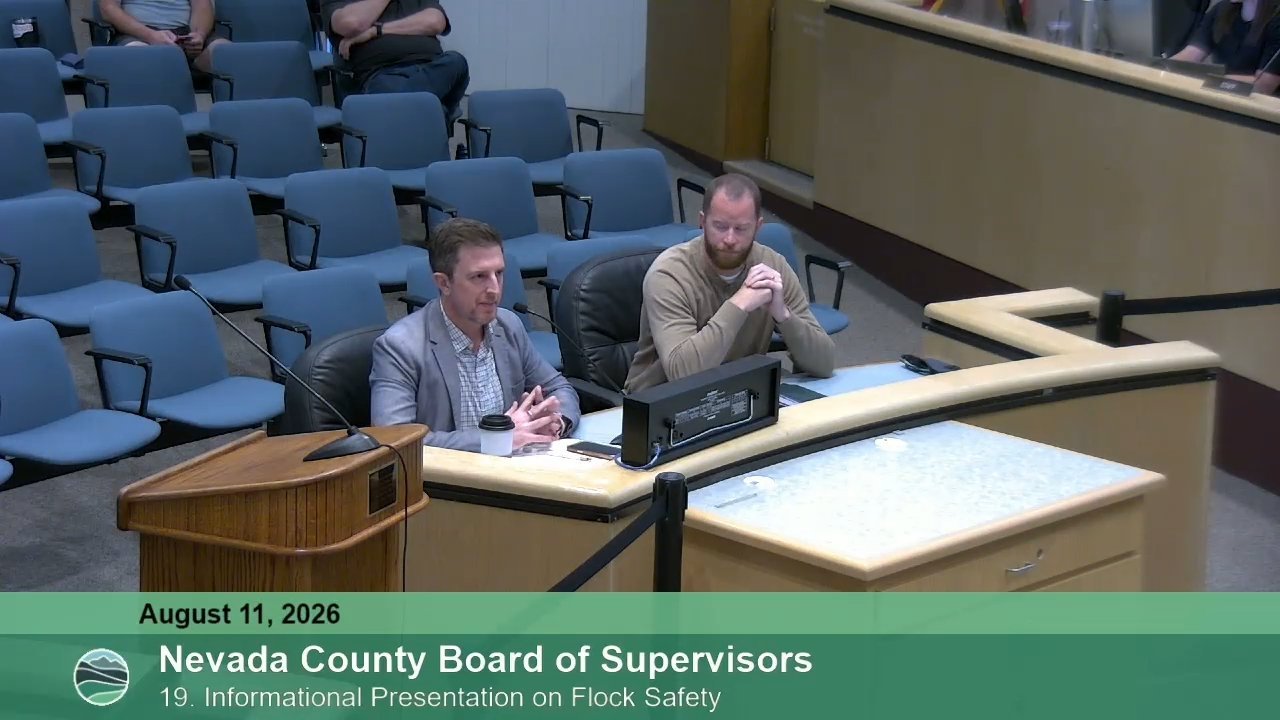
An informational presentation on the sheriff's office network of 25 Flock Safety automatic license plate reader cameras drew the session's most passionate public comment period, with multiple residents demanding the cameras be removed and calling for formal oversight.
Why it matters: The county's $411,552 contract with Flock Safety runs through June 2029, covering cameras across approximately 750 miles of public roadway. The presentation — and the public response — exposed unresolved questions about data ownership, search volume transparency, and the adequacy of internal auditing that could force the board's hand in future meetings.
Where things stand: Undersheriff Sam Brown and Administrative Lt. Dennis Hack walked the board through the program's origins, beginning with a pilot approved in March 2023. Lt. Hack presented law enforcement use cases including a Sacramento carjacking arrest, a missing juvenile located in Florida with human trafficking implications, a juvenile rape suspect arrested in Nebraska, and a Stockton homicide suspect arrested in Penn Valley.
Lt. Hack also disclosed that a January 2025 internal audit discovered a "national lookup" setting had remained enabled, allowing out-of-state database searches. The setting was turned off in February 2025. Flock subsequently disabled national lookups for all California agencies in June 2025.
Trevor Chandler, Senior Director of Public Affairs for Flock Safety, addressed data concerns directly: "First and very clearly, Flock does not sell data. We are not a social media company. We are not an advertising company. We are a public safety company." He said less than 1% of captured data — stripped of all metadata — is used for machine learning to improve camera accuracy, and that deleted data is irretrievably sanitized. He also acknowledged the company should have acted sooner on compliance defaults: "We fully acknowledge that had we done that earlier, could have saved a lot of heartburn for the agencies we work with."
The other side: Residents lined up to challenge those assurances. Anthony Kaiser, a video engineer from District 1, delivered one of the sharpest critiques: "I have no doubt this mass surveillance network is incompatible with modern liberal democracy." He cited concerns about mission creep, false positives, and data mining.
Lindsay, a District 3 resident, presented a data discrepancy that drew supervisors' attention: "In a 30-day period, Flock's public portal shows 103 searches. And our CPRA data shows for that same time period there were 271,000 searches." The gap between the transparency portal and records obtained through a California Public Records Act request remains unreconciled.
Matt Johnson, an IT director, challenged Flock's data ownership claims and cited an ongoing Oklahoma legal case involving data allegedly leaked to immigration services. Michael Taylor, a District 1 resident, said he was torn on the technology but criticized the original consent calendar approval process and the absence of cancellation provisions, requesting a public workshop.
Several speakers identified themselves with the "DeFlock" movement and requested the board establish a civilian oversight committee under AB 1185.
Supervisor Bullock engaged most directly with the tension: "I'm fully willing to raise my hand and cancel this contract and remove all the cameras. As one board member, if I feel like the scale, the balances of justice versus privacy are outweighed, I will do that on behalf of my constituents."
Supervisor Hall acknowledged the same friction, saying she shared the conflict many residents described between supporting law enforcement tools and protecting data privacy. She asked pointed questions about whether data could truly be retrieved after deletion.
Decisions: The board accepted the informational presentation on a 5-0 vote. No policy action was taken.
What's next: The volume and organization of public opposition — along with the unresolved search count discrepancy and calls for a formal oversight body — signal this issue will return to the board.
Tahoe Creek Ranch Appeal Heads to September Hearing
Supervisor Bullock pulled Item 16 from the consent calendar to discuss the appeal of a Zoning Administrator decision approving lot line adjustments at Tahoe Creek Ranch near Truckee. He noted significant public interest and county processing errors, including an incorrect assessor's parcel number used in public noticing.
Why it matters: Twenty-nine residents submitted written comments opposing the adjustments, reflecting community tensions around development activity near the Austin Ridge project on Martis Peak.
Martin Wood of SCO Planning Engineering, representing the applicant, said the properties are currently in escrow and requested the earliest possible hearing date. Sandy Korth, the appellant, called in to confirm her filing.
Decisions: The board voted 5-0 to accept the appeal and schedule the hearing for Sept. 15 at 10 a.m. — earlier than the originally proposed Oct. 8 Truckee meeting date.
Recreation Coalition Earns Congressional Nod
The board received a presentation on the Nevada County Recreation Coalition's progress, including the second annual Recreation Fair on April 25, which drew 64 exhibitors, hundreds of attendees, 24 volunteers, and eight sponsors.
Shivati Karki Pearl, CDA senior administrative analyst, outlined the coalition's four focus areas — parks, recreation outposts, towns to trails, and a resiliency hub concept — and noted the county has invested $2.6 million over two years through GAP loans for parks, outdoor visitor safety funds ($84,000), and AB 1600 capital projects.
Shalisa Horvat from Congressman Kevin Kiley's office presented a Congressional Certificate of Recognition for the 2026 Recreation Fair.
Supervisor Bullock highlighted two NACO resolutions he helped pass on public land staffing and recreation infrastructure: "I focused my NACO, National Association of Counties, effort in getting two resolutions. One of them is a public land staffing resolution." He noted rural economies are shifting from resource-based to recreation-based models. Chair Swarthout emphasized the need to continue supporting park districts struggling for funding.
Public commenters Dawn Zaidanis, Nevada City Parks and Recreation manager, and Kurt Stevens, president of Bicycle Nevada County, spoke in support of the coalition's work.
Minor Items
- Consent calendar approved 5-0, covering 14 items including a $6.7 million Pacific Clinics crisis intervention services contract, a PLHA housing fund MOU extension, FFPSA child abuse prevention contracts, and county staffing and salary amendments.
- Stagecoach Motel veterans housing purchase ($934,000 under Homekey+) continued to Aug. 25 at 9 a.m. after the seller was unable to notarize documents from abroad.
- Sanitation district consent approved 5-0, accepting final completion of Penn Valley groundwater monitoring well destruction.
- Closed session on two anticipated litigation matters yielded no reportable actions.
- Michael Taylor raised FPPC enforcement findings alleging Nevada County used public funds to campaign for Measure V, citing seven violations with a proposed $31,500 penalty, and called for an independent investigation.
- Gil Matthew, executive director of the Nevada County Economic Resource Council, promoted the Sierra Foothills Food Festival on Sept. 24-26, a collaboration between Sierra Harvest, Sierra Commons, and the Economic Resource Council.
- Gordon Gossage of Regenesis Planet read a statement from a resident calling for wildfire resilience efforts to include mental health services, housing development aligned with emergency capacity, and financial transparency around insurance premiums and PG&E rates.