
Board of Supervisors - Jul 28, 2026 - Meeting
Board of Supervisors • Nevada CountyJuly 28, 2026
Locunity is a independent informational service and is not an official government page for this commission.We use AI-assisted analysis and human editorial review to publish information.
Board Kills RV-as-Housing Ordinance, Approves $8M in Wildfire Grants
Nevada County's Board of Supervisors unanimously rejected a first-in-California zoning ordinance that would have allowed permanent RV dwelling on rural parcels, capping a months-long debate that drew near-universal opposition from both sides of the housing fight. In the same marathon session, the Board locked in more than $8 million in wildfire resilience funding and a landmark Good Neighbor Agreement with Tahoe National Forest, and adopted the county's first Drought Resilience Plan.
- RV dwelling ordinance dies 5-0 after public hearing draws organized opposition from neighbors, fire-safety advocates, and even the project's original proponents
- $8M+ in wildfire grants secured, including a $7M National Forest Foundation award and $1.03M Sierra Nevada Conservancy grant for fuels reduction
- Fifth Good Neighbor Agreement with Tahoe National Forest approved, authorizing landscape-scale work on 200,000 acres through 2035
- Drought Resilience Plan adopted, identifying 7,000+ domestic wells at risk of going dry
- Child support program ranks No. 1 in California on four federal performance measures, collecting over $8M annually
A First-in-California Experiment Collapses
The centerpiece of the July 28 meeting was the public hearing on a zoning amendment that would have allowed recreational vehicles as permanent additional dwelling units on developed rural parcels — a concept no other California county has attempted.
The basics: The ordinance, which first came before the Board on March 10, would have amended Section 12.03.150 of the county code to permit RV dwelling on parcels in rural zoning districts. Planning Director Brian Foss presented revisions made since the spring, including an income qualification set at 50% of area median income (roughly $45,000 for an individual), removal of a 3-acre minimum parcel size that expanded eligible parcels from about 11,000 to roughly 18,000, and options for a pilot program with a sunset clause.
But the revisions failed to move the needle. Of approximately 75 written comments received since March, the opposition was overwhelming: "Based on my read through, I would probably say ninety to ninety-five percent were in opposition in some shape or form," said Planning Director Brian Foss.
Where things stand: Over a dozen speakers testified against the ordinance during the hearing, raising concerns about wildfire risk from combustible RVs, insufficient evacuation routes, well and septic contamination, lack of county code enforcement capacity, and property value impacts. Multiple speakers also noted that the state does not count RVs toward housing element goals — meaning the ordinance would bring neighborhood disruption without helping the county meet its mandated housing numbers.
The other side: Perhaps the most striking dynamic was that even advocates who had championed the concept turned against this version. Tom Durkin, director of the No Place To Go project who originally requested the ordinance seven and a half years ago, told the Board the current draft would make RV living impossible rather than possible due to excessive compliance requirements. Brad Pesummer, who described placing 385 trailers for families over the past decade, said 90% of the ordinance's accommodations were unachievable for the low-income households it was meant to serve.
Public commenters mounted a broad case against passage. Joe Lasoni argued the ordinance was constitutionally overbroad and vague and recommended sending the matter to ballot. Ursula Donofrio warned it would attract people seeking cheap RV living and increase fire risk. Maureen Graber cited RV combustibility, insufficient fire hydrants, and exorbitant insurance costs. Teresa Kingsbury questioned whether the county had personnel or funding to enforce a new class of residential occupancy requiring ongoing inspections. Scott Norp argued it would lower housing standards rather than create affordable housing and burden only unincorporated areas while cities remained exempt.
One commenter, Gordon Gussage, urged the Board to consider that low-income residents are often too embarrassed to speak publicly and asked supervisors to weigh the emotional dimension of housing need alongside the rational concerns.
Decisions: Every supervisor found a reason to oppose the ordinance, though from different directions.
Supervisor Rob Tucker moved to deny, arguing the ordinance disproportionately targets rural unincorporated communities: "I feel like the rural areas that are mostly going to be impacted by it are, in my opinion, opposed to it. Surely in my district I would think other ones and yet a lot of the advocates or the benefits are coming from the incorporated areas."
Supervisor Bullock took a more measured approach, acknowledging the ordinance was one incremental tool among many: "I think our job is to strike balance. One of the things that came to mind as I listen to the comments are essentially this is one more piece and a complement of solutions to create a fix or move closer to a solution on the housing crisis." But he concluded the balance hadn't been struck.
Supervisor Heidi Hall expressed deep frustration, directing her disappointment not at her colleagues but at the community's resistance to any alternative housing solution: "I'm going to say that we have failed and we're continuing to fail our lowest income people in this community. That's on all of us."
Supervisor Sue Hook and Chair Swarthout agreed the ordinance could not be supported as written. Chair Swarthout seconded Supervisor Tucker's motion to deny. The vote was unanimous: For: 5, Against: 0, Absent: 0.
What's next: Chair Swarthout urged the community to support future legitimate housing projects and suggested exploring a public-private RV park partnership at a January workshop. The denial also ends the associated code enforcement moratorium on RV dwelling cases, meaning enforcement actions can resume.
$8M in Wildfire Grants and a Decade-Long Federal Partnership
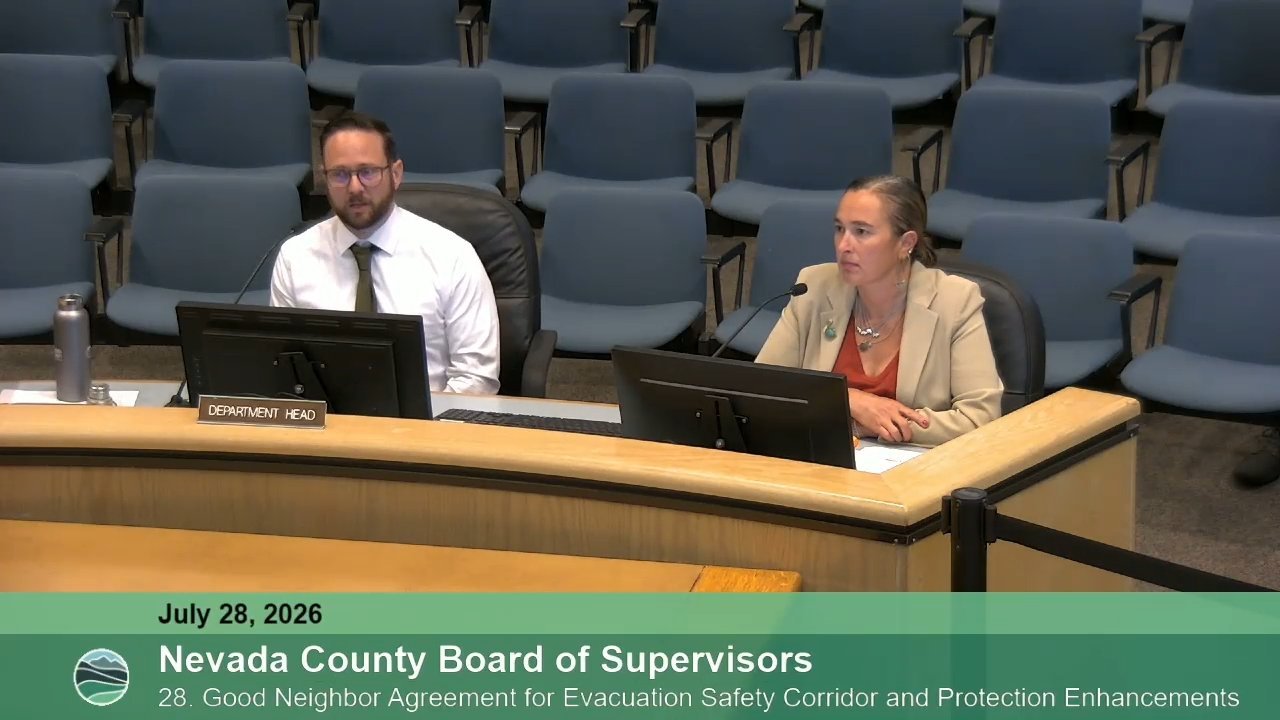
The Board approved three linked items that together represent the county's most ambitious wildfire resilience package to date: a new Good Neighbor Agreement with Tahoe National Forest and two major grants totaling more than $8 million.
Why it matters: Nevada County sits in some of the most fire-prone terrain in California, and the county's ability to do fuels work on federal land has historically been limited by jurisdictional boundaries. The new agreements tear down those walls.
Where things stand: OES Director Alex Keeble-Toll framed the significance: "Today, I am so pleased to bring you our fifth agreement in two years with Tahoe National Forest and our fourth good neighbor agreement." The ESCAPE Good Neighbor Agreement, running through 2035, provides the broadest authorities yet — allowing county crews to work on both federal and non-federal lands, conduct commercial timber harvests up to 30-inch diameter, perform biomass removal and air curtain incineration, and apply targeted herbicide.
Forestry Project Manager Alex Garritz detailed the scope, which covers roughly 200,000 acres of national forest within the county. Acting Tahoe National Forest Supervisor Matthew Lane emphasized there is no shortage of collaborative projects available.
The $7M National Forest Foundation grant will fund roadside shaded fuel breaks and sustain OES limited-term staff through August 2028. The $1.03M Sierra Nevada Conservancy grant funds hazardous fuels reduction around the Town of Washington, including a new partnership with a tribally led fuels crew.
Herbicide Concerns Surface
Supervisor Heidi Hall pressed staff on herbicide use under the GNA, specifically the toxicity of glyphosate: "The issue for me is not whether it's effective or not, it's the risks of its toxicity, the glyphosate. The fact that it's a probable carcinogen, likely an endocrine disruptor." Staff committed to holding a community Town Hall on Aug. 27 and providing the Board with an informational memo on public feedback afterward.
Supervisor Bullock praised the self-sustaining timber revenue model, in which commercial timber harvests generate revenue to fund ongoing maintenance: "I just came back from NACO and there's a lot of communities across the nation who raise their hand to complain about how they can't work with the forest service. And I stood up and was like we have four good neighbor agreements." He also highlighted the potential for Secure Rural Schools and Payment in Lieu of Taxes money to flow back to the county.
Decisions: All three items — the GNA, the $7M NFF grant, and the $1.03M SNC grant — passed unanimously, 5-0 each.
7,000 Wells at Risk: Drought Plan Adopted
Why it matters: With 19,000-plus domestic wells and no municipal water across much of unincorporated Nevada County, a severe drought could leave thousands of residents without water.
Where things stand: Environmental Health Director Amy Irani-Leaverton presented the county's first Drought Resilience Plan, required under SB 552 (2021). A risk analysis by Stantech found that more than 7,000 of the county's domestic wells are at critical risk of going dry in a significant drought. The plan was developed in collaboration with Nevada Irrigation District, the cities of Grass Valley and Nevada City, the Town of Truckee, the Farm Bureau, and OES.
Short-term strategies rely on emergency response coordination through OES. Long-term strategies include improved well logging, water quality monitoring, and exploring consolidation of small water systems.
The other side: Supervisor Heidi Hall raised a pointed concern the plan does not address: arsenic contamination from the Lavacap Mine Superfund site. "The arsenic coming out from that site is extremely high and extremely dangerous. And the down water benefits so the impacts through Little Clipper Creek are to personal wells and ultimately to Rollins Lake." Staff acknowledged the plan's focus is on drought but committed to taking the concern seriously.
Supervisor Bullock asked whether the plan would be annexed to the county's Resource Resilience Climate Action Plan.
Decisions: The resolution passed 5-0.
Child Support: No. 1 in California
Why it matters: Nevada County's child support program, which operates with no general fund dollars, is outperforming every other agency in the state on key federal metrics — a rare bright spot for a small rural county competing against large urban programs.
Where things stand: Child Support Services Director Paul Johnson reported the agency ranked second statewide among 47 agencies last federal fiscal year and has climbed to No. 1 in the first four federal performance measures through the current year. The program serves more than 2,300 families and projects to collect over $8 million this year.
Johnson highlighted a case where a $100,000-plus payment was collected after a parent's passport was suspended for non-payment lasting more than four years, calling it transformative for the family. He also described community outreach including a virtual service portal at the Joseph Center and backpack and sanitation kit drives conducted in partnership with Bright Futures for Youth and Probation's Youth Crime Prevention Fund.
On the legislative front, Johnson flagged the Universal Enrollment Bill, which died in the state Senate but is expected to return, and SB 1055, which limits driver's license suspensions as an enforcement tool.
Decisions: The resolution proclaiming August 2026 as Child Support Awareness Month passed 5-0.
Minor Items
- Consent calendar (22 items) approved 5-0, including over $2.6M in behavioral health contract renewals: Granite Wellness Centers ($1.17M), Placer County psychiatric services ($500,000), Willow Glen Care Center ($300,000), a $334,000 Proposition 36 grant, Homekey+ Phase I agreement with AMI Housing ($269,000), and a CAL FIRE wildfire coordinator grant augmentation ($151,500).
- Katherine Thompson of the Sierra Express/Bicycle Club requested secure, lit bike parking for the Homekey+ Stagecoach project and asked that the Nevada County Transportation Commission advance active transportation routes connecting communities.
- Sanitation District consent (Items 23-24) approved 5-0, including a $103,000 wastewater rate study that could lead to rate adjustments across all Sanitation District zones.
- Probation Services Week proclaimed 5-0; Chief Probation Officer Jeff Goldman introduced Officer of the Year Aaron Carver, who supervises high-risk adult offenders. The department runs DUI Court, Mental Health Court, Adult Drug Court, and YES Court for juveniles.
- Hidden Grow Project drew opposition from three public commenters during general public comment, including one citing a petition with nearly 2,600 signatures against industrial uses near a residential neighborhood. No Board action was taken.
- Sam Conough Clad of Community Roots School Food Services Agency reported the organization served over 1 million school meals in its first year across all western Nevada County school districts — the only countywide school food joint powers authority in California.
- Closed session on two potential litigation matters produced no reportable action.
- Board member reports touched on NACO conference outcomes including data centers and HR-1 impacts, an East County visioning process launch, and Pacific Crest Commons housing on track for Sept. 1 completion in Truckee.