Board of Supervisors - Sep 15, 2026 - Meeting
Board of Supervisors • Nevada CountySeptember 15, 2026
Locunity is a independent informational service and is not an official government page for this commission.We use AI-assisted analysis and human editorial review to publish information.
Parking Bans Pass Unanimously, but Board Pivots Toward Safe Parking Solutions
The Nevada County Board of Supervisors tackled a packed Sept. 15 agenda that swung from celebration to confrontation — honoring the Food Bank's 40th anniversary and rallying IHSS caregivers one moment, then wrestling with the human cost of banning overnight parking on four county roads the next. The board approved every action item on the docket, but the parking debate revealed a clear policy tension: how to address public safety complaints without displacing the county's most vulnerable residents.
- Four overnight parking restriction ordinances adopted 5-0, but board directs staff to explore safe parking alternatives
- IHSS caregivers rally for higher wages as United Domestic Workers negotiations continue
- Board denies Tahoe Creek Ranch appeal, orders countywide notification reforms after procedural errors
- $55M Scotts Flat spillway replacement endorsed with Prop 4 grant support for Nevada Irrigation District
- ADU ordinance adopted to avoid state penalties, increasing multi-family lot limit from 2 to 8 detached units
- 3,500+ petition signatures against Hidden Grove development presented during public comment
Parking Restrictions Approved, Safe Parking Fight Begins
The board adopted four ordinances banning overnight parking on Combie Road, East Bennett Road, Old State Highway 49 and Van Norden Lake Road — roads where complaints about litter, sanitation and public safety had accumulated since a January 2026 board workshop. All four passed 5-0.
Why it matters: The ordinances address real public safety concerns, but they also remove some of the last legal places where vehicle-dwelling residents can sleep in their cars — without offering an alternative.
Where things stand: Principal Engineer Pat Perkins presented each ordinance as a response to specific complaints: illegal dumping, human waste and safety hazards for road crews. Supervisor Hardy Bullock noted that most county roads already carry a 72-hour parking limit, making these restrictions a formalization of existing policy for particularly impacted corridors.
But the public hearing turned into a broader reckoning on homelessness. Tom Durkin of the No Place to Go Project warned that the restrictions would scatter homeless residents deeper into neighborhoods and forests. "The effect of this ordinance, especially the East Bend, that's where a lot of homeless people camp, and if you're moving them out of these parking places, they're going to move in two places," said Durkin. He argued that pushing people off roads without alternatives increases wildfire risk and makes it harder for outreach workers to connect them with services.
Pamela Rosada of the San Juan Ridge Community Coalition called in to advocate for safe parking programs, citing San Diego's Dreams for Change model and HHAP funding opportunities.
The other side: Supervisors acknowledged the tension head-on. Chair Lisa Swarthout called the situation "highly depressing" and drew on years of watching other communities try to design away homelessness. "I have seen it over the years, starting with the big cities where they put spikes on flat surfaces and put handles on benches so you can't actually — people can't actually sleep there," she said.
Supervisor Heidi Hall was equally blunt: "I am thoroughly convinced at this point that the county needs to start looking for someplace to allow cars to park so people can stay in them."
Decisions: All four ordinances passed 5-0 (For: Hall, Bullock, Tucker, Hoek, Swarthout; Against: none).
What's next: The board reached consensus to direct staff to bring back safe parking solutions as a future workshop item, including outreach to faith-based organizations willing to host parking programs. The directive marks a policy pivot — the county is now officially exploring managed safe parking alongside enforcement.
IHSS Caregivers Rally for Higher Wages
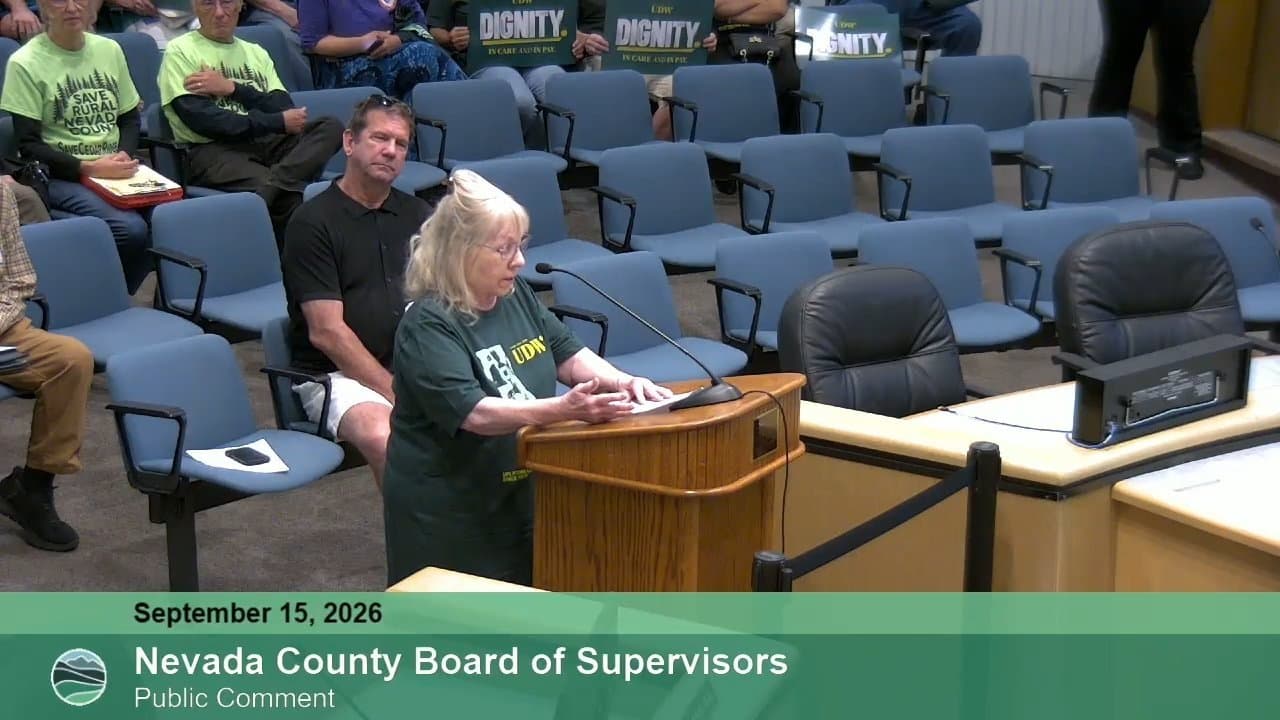
A large delegation of In-Home Supportive Services providers and United Domestic Workers organizers filled the public comment period with deeply personal testimony about the unsustainability of caregiver wages.
Why it matters: IHSS caregivers keep seniors, disabled individuals and special-needs children at home rather than in institutional care — saving the state significant costs — but say rising gas and living expenses make the work untenable.
Where things stand: Speakers included a 14-year caregiver from Plumas County who described driving more than 60 miles to medical appointments, a mother caring for her autistic son who depends on protective supervision to prevent self-harm, and a 30-year caregiver for her adopted nonverbal autistic son. Another provider caring for three adult males with dementia, heart problems and spinal cord injuries described managing a hypoglycemic emergency on the job.
UDW organizer Veronica framed the testimony around ongoing wage negotiations, asking the board to help strengthen the IHSS program. John Lindsay, a UDW representative and Nevada Union High School graduate, emphasized the program's importance for the special needs community.
Decisions: The board took no formal action — the comments came during active labor negotiations — but heard the testimony in full.
Board Denies Tahoe Creek Ranch Appeal, Orders Notification Overhaul
A public hearing on Sandy Korth's appeal of four conditional certificates of compliance and a lot line adjustment in the Tahoe Creek Ranch area near Truckee consumed nearly an hour of board time, ultimately producing both a denial and a systemic reform directive.
The basics: The project is primarily a paperwork exercise — legalizing existing parcels without creating new lots or adding density. Associate Planner Zachary Rubal presented the case as routine, but procedural errors made it contentious.
Why it matters: Korth's appeal centered on an incorrect assessor's parcel number in the public notice — the notice referenced a Penn Valley parcel instead of a Truckee one — along with late or missed notices to Martis Peak area residents, photos excluded from the administrative record, and questions about the CEQA exemption applied to the project. The errors exposed systemic weaknesses in how the county notifies remote rural communities about land use decisions.
Where things stand: Project proponent Martin Wood of SEO Planning and Engineering testified that the property has been in escrow since February, causing significant financial hardship from the seven-month delay.
Supervisor Bullock, who represents the area, acknowledged the APN error and pushed for enhanced notification methods. "I just wanted to make everybody understand that there would be a future process," he said, noting that some public comments referenced subdivisions — "and this is not what we're talking about today." He called for sandwich boards and local newspaper publication for remote-area land use actions.
Decisions: The board voted 5-0 to deny the appeal with corrections to the administrative record (For: Hall, Bullock, Tucker, Hoek, Swarthout; Against: none). The board also issued an order directing staff to return with enhanced notification requirements and potential code amendments.
What's next: Staff will bring back proposed code changes to improve public noticing procedures countywide, with particular attention to remote communities.
Board Endorses NID's $55M Scotts Flat Spillway Rebuild
NID Assistant General Manager Greg Jones and Director of Engineering Gabe Arano presented the Scotts Flat Spillway replacement project — a $55M rebuild of the nearly 80-year-old spillway that lacks modern under-drain safety systems exposed as critical after the 2017 Oroville Dam incident.
Why it matters: The existing spillway, built in the 1940s, was designed before under-drain systems became standard. The Oroville crisis demonstrated how catastrophically aging spillways can fail. Grant funding from Proposition 4 could significantly offset ratepayer costs.
Where things stand: The project will demolish and rebuild the chute and lower plunge pool over two construction seasons — summer 2028 and summer 2029 — requiring closure of campground gate one. NID is pursuing a Department of Energy grant of approximately $5M and the DWR Prop 4 Dam Safety and Climate Resilience solicitation. The project was originally planned for 2026 but was delayed to pursue grant funding.
Supervisor Hall praised NID for presenting the project and encouraged future presentations to keep the board informed.
Decisions: The board unanimously adopted a resolution of support for NID's Prop 4 application (5-0; For: Hall, Bullock, Tucker, Hoek, Swarthout).
ADU Ordinance Adopted to Avoid State Noncompliance
The board adopted an ordinance increasing the number of detached accessory dwelling units allowed on multi-family lots from two to eight, aligning county code with state law after the Department of Housing and Community Development flagged the discrepancy in an October 2025 compliance review.
Why it matters: Failure to act could jeopardize the county's housing element certification and eligibility for CDBG and other state grants.
Where things stand: The Planning Commission voted 5-0 in June to recommend adoption. Associate Planner Zachary Rubal presented the amendment. Supervisor Rob Tucker confirmed the stakes of inaction, including potential housing element decertification and loss of HCD funding eligibility. Supervisor Bullock asked about ADU demand: staff reported reviewing 25-30 ADU permits per year, though none to date on multi-family zoned parcels. No public comment was received.
Decisions: The board voted 5-0 to introduce, waive further reading and adopt the ordinance (For: Hall, Bullock, Tucker, Hoek, Swarthout).
Residents Clash Over Flock Surveillance Cameras
Public comment revealed a growing community divide over the county's contract with Flock Safety for license plate reader cameras, with both supporters and opponents converging on one demand: a transparent public process.
Where things stand: Michael Taylor asked the board to place two items on a future agenda: a comprehensive cost accounting of the failed Measure V and a public workshop on Flock cameras. "I request the public presentation from Audit Controller Gina Will and IGS Director Craig Grishbach providing a comprehensive accounting of the total taxpayer cost of a failed Measure V from its conception through today," Taylor said.
A public commenter detailed a Texas incident in which Flock's network was allegedly used to search for a woman across state lines and accused Flock executives of misrepresenting data practices. The speaker urged the board to follow Grass Valley's lead in removing the cameras.
The other side: Lee French argued Flock is a necessary law enforcement tool and asked the board to set up a review group with the sheriff's department.
What's next: No formal action was taken, but both sides are pressing for a public workshop — a signal the board may need to schedule one.
Over 3,500 Oppose Hidden Grove Project
Two speakers used public comment to challenge the proposed Hidden Grove mixed-use development near Highway 174. Carol Morrison, who lives on Hobart Lane adjacent to the site, raised concerns about septic tank contamination to wells, a projected 400 daily vehicle trips on a dead-end road, fire evacuation safety and noise.
John Vaughn reported more than 3,500 petition signatures against the project and challenged the applicant's legal argument that state density bonus law entitles the project to general plan amendments and spot zoning. "The applicant is telling you you don't get to weigh in on this zoning merits in effect, telling you that it's already decided and telling you the objections of neighbors do not matter," Vaughn said. He urged the board to require a full environmental impact report before any rezone or concession.
No formal action was taken; the project will come before the board at a future hearing.
Disaster Coordination Blueprint Takes Shape
Christine Kelly and Erica Cocina of the Community Foundation of Nevada County presented a completed blueprint for a Community Organizations Active in Disaster network for western Nevada County. The $75,000 planning investment — funded by the county and a League of California Community Foundations grant — engaged 42 organizations and produced a governance and communications framework.
Why it matters: The COAD would serve as connective tissue between the Office of Emergency Services and community organizations before, during and after disasters, managing volunteer coordination, donations and long-term recovery needs that OES is not structured to handle.
Supervisor Bullock drew on his experience with the Tahoe Truckee COAD during Snowmageddon events. "Our COAD has functioned seamlessly and been totally integral to county work," he said. Supervisor Hall pressed for seamless OES integration and requested a county senior executive sit on the Community Foundation board. Placer, Yuba and Plumas counties have expressed interest in a regional model.
The activation phase — estimated at $40,000 to $50,000 — will be funded without additional county dollars through Pioneer Energy sponsorship and continuing grant funds. No action item; informational presentation only.
Food Bank Honored at 40, Board Hears Call for Budget Line Item
Supervisor Sue Hoek presented a certificate recognizing the Nevada County Food Bank's 40th anniversary. The organization distributes 31,000 pounds of fresh produce monthly, serves 20,000 individuals monthly and has invested more than $150,000 in local farms.
Yolanda Cookson, a Food Bank board member, shared a personal story about delivering summer lunches and made a direct ask: "I would just ask you to consider it. I know it's probably five years out, but it's important that we ask" — a reference to adding food as a line item in the county budget.
Supervisor Hall called food security a human right and expressed frustration at the need. "To me it's highly depressing that one of the richest countries in the world has to have this — food is the best way we can keep people healthy. It's a human right in my view," she said.
Rachel Pena, Director of Social Services and the county's care and shelter lead, emphasized the food bank's critical role during emergencies.
Minor Items
- Consent calendar approved 5-0, including a $75,516 ABC alcohol enforcement grant, agricultural economic vitality plan adoption, retirement plan extension and committee appointments.
- Budget Control Override Policy (Item 5) pulled from consent at the request of Supervisor Hall; Deputy CEO Erin Mettler clarified the Workday system tool is administrative and does not delegate spending authority. Approved 5-0.
- County Libraries accepted a $43,400 donation from the Friends of the Nevada County Libraries. County Librarian Nick Wilczek reported the summer program produced 3,700 new library cards, 336 programs, 2,000+ free lunches and 550 teen intern hours. Approved 5-0.
- Centreville Bike Park skatepark addition received $75,898 plus $7,589.80 in administrative costs from AB 1600 recreation mitigation funds. Phase one (pump track) is under construction; phase two (skatepark) targets spring 2028. Approved 4-0 (Supervisor Tucker recused due to indirect financial interest).
- Certificate of Recognition for county workers Shawn Sullivan and Isaac Novander, who rescued an injured family.
- Sanitation District consent calendar approved 5-0.