
Supervisors Open Cannabis Storefront Applications on 4-1 Vote, Add Score Floor
Board of Supervisors • Nevada CountyOctober 6, 2026
Locunity is an independent informational service and is not an official government page for this commission. All information is sourced from public footage and an analysis of official agendas with the aid of responsible, fact-checked AI. to report an error or omission.
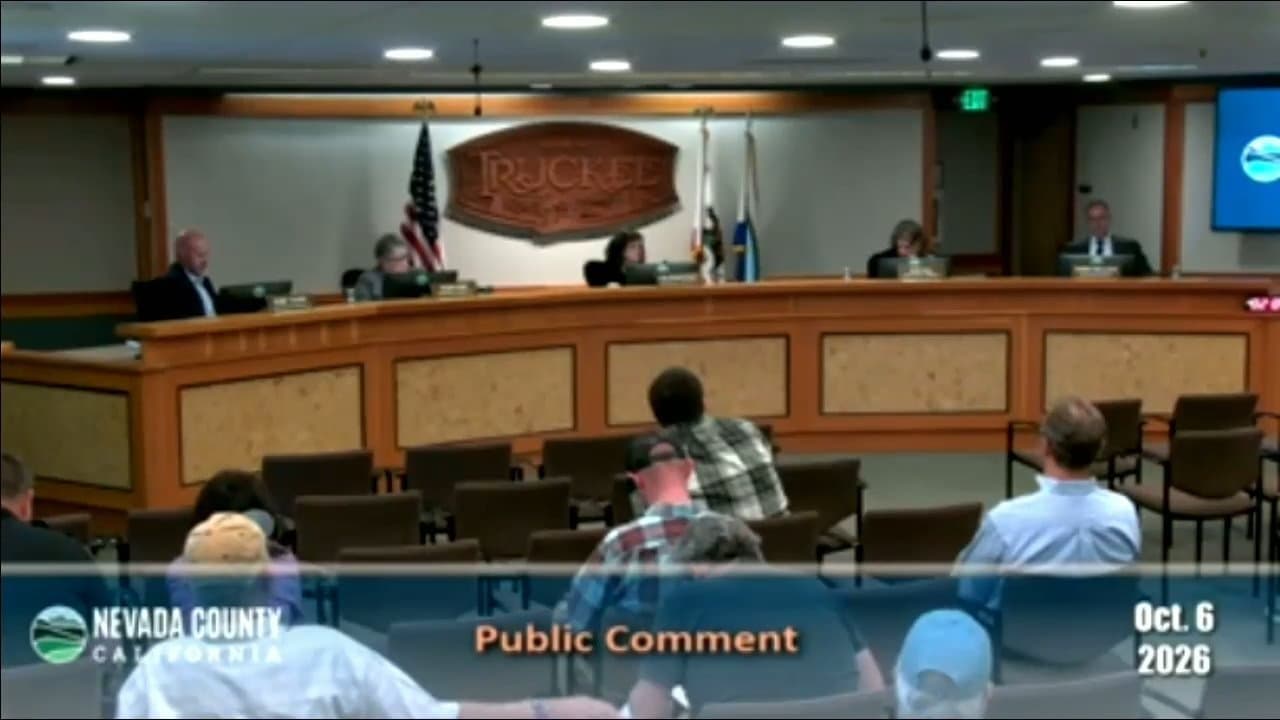
Nevada County is one step closer to its first unincorporated cannabis storefronts, and the fight over Soda Springs is far from settled. At an Oct. 6, 2026, meeting in Truckee, supervisors voted 4-1 to release a competitive application for up to two dispensaries in North San Juan and Soda Springs. They also ordered staff to return with a minimum passing score. The board also unanimously adopted a climate roadmap with no mandates and reviewed a $1.4M plan to keep residents on Medi-Cal.
- Cannabis applications approved 4-1, with a minimum-score threshold returning as a separate item
- Soda Springs splits residents, and neighbors in Placer County's Serene Lakes push back
- Resource Resiliency Roadmap adopted 5-0, with progress updates required every six months
- $1.4M state Medi-Cal plan targets HR 1 changes affecting about 27,000 residents
- Truckee Navigation Center hits 98% occupancy, with a renewal contract targeted for Nov. 17
1 Big Thing: Cannabis Door Opens, With a Floor
The basics: A 2024 county ordinance allows up to two retail storefront dispensaries. It permits no more than one each in the North San Juan and Soda Springs Rural Centers, on M-1, BP, C-1 or C-2 zoned parcels. Applicants compete on merit before anyone can seek a discretionary use permit.
Why it matters: The vote launches the first competitive selection of storefront dispensaries in the county's unincorporated areas. It drew opposition from across the county line, along with arguments over jobs and tax revenue in a seasonal mountain economy.
Where things stand: Matt Kelley, Cannabis and Code Compliance Director, presented a scorecard recommended 5-0 by a seven-member evaluation committee on May 21, with one member absent and one seat vacant. Neighborhood compatibility and community enhancement carries the most weight at 25 points, followed by owner and operator qualifications at 20. Security is weighted lowest because state rules already mandate it. The application will stay open for at least 30 days.
Kelley and Board Chair Swarthout stressed that the vote approves neither a dispensary nor a site. Any selected applicant still faces site-specific CEQA review, a Planning Commission use permit and a possible appeal to the board.
Hardy Bullock, Supervisor, District 5, and Supervisor Sue Hook sit on the cannabis ad hoc committee and represent the districts containing the two sites. They cited roughly 50 prior board votes on cannabis and community meetings in both towns. Bullock said a Serene Lakes petition contained inaccurate information, but he acknowledged that residents there consider Soda Springs part of their community.
“If we go through the process and the RFA yields less than favorable results, I will raise my hand in the public meeting and tell you that I am not for that,” said Bullock. He also proposed that the selected applicant host a community meeting.
The other side: Soda Springs condo owner Dennis Carroll, a public commenter, cited a population of 94 and two existing delivery services. “I'd like to advocate the county pause the effort to promote and publicize an application process for a cannabis dispensary in Soda Springs Rural Center,” he said. Colette, a Soda Springs resident, noted that Truckee chose delivery over storefronts and asked that Soda Springs be removed. “It takes us 2 hours to receive our sheriff response on any given day on a holiday week,” she said.
Supporters included Corey Caldwell of a merchants association, local cannabis farmers and operators, and a commenter who said the area “desperately need[s] year-round full-time jobs.” Daniel, a Donner Summit-area resident, called Serene Lakes “an affluent second homeowner community.” Nevada City Police Chief Dan Foss said community fears subsided after dispensaries opened in his city.
Decisions and stakeholder impacts: Supervisor Rob Tucker asked whether the committee would judge if a lone applicant was viable at all. Kelley said a sole applicant meeting all criteria would advance, and staff said separating the two sites would require an ordinance amendment. That exchange produced the motion's key condition: a minimum score. The chair floated 85 out of 100, while others suggested 80% or 75%. Tucker said he was likely to support North San Juan but not Soda Springs.
The motion passed with For: 4 (District 1, Bullock, District 4, Chair Swarthout), Against: 1 (District 2), Absent: 0. Tucker was the only supervisor to state opposition.
What's next: A separate item setting the minimum threshold returns to the board, with staff targeting Oct. 20 or mid-November.
Climate Roadmap Passes, Strings Attached
Why it matters: Staff said the Resource Resiliency Roadmap makes the county and its partners eligible for state and federal funding. It was shaped by residents' top concerns: wildfire, power outages and the rising cost of living.
Where things stand: Planning Director Brian Foss and consultant presenter Ivana described a 20-year framework covering buildings, mobility, natural and working lands, emergency response and economic resilience. On-road transportation is the largest emissions source. The roadmap aligns with the state's goals of cutting emissions 40% below 1990 levels by 2030 and reaching carbon neutrality by 2045.
Outreach drew 346 survey responses and 165 comments on the draft. Up to 87% of respondents supported bold or moderate county action.
“It is not a commitment to fund or complete every action it includes. It's not a capital improvement plan,” said Foss. Ivana added that the plan includes no mandates, regulations or reach codes.
The other side: Tucker supported the plan as “a roadmap versus a mandate” but said he is wary of chasing state mandates. “The most consistent price of electricity in Utah and Nevada is 12 cents a kilowatt. It's 33 cents here,” said Tucker. Foss named bike lanes, fleet electrification and charging stations as the costliest actions.
Bullock pressed on cost. “My concern is we had a shortfall in our budget last year. We likely will again this year. How do we pay for it?” he said. Tricia Tillotson, Community Development Agency Director, said the work would be absorbed into existing duties, “not really adding much cost at all.”
Decisions and stakeholder impacts: The roadmap passed with For: 5, Against: 0, Absent: 0. Staff had proposed reporting every other year, but the board directed a public dashboard and six-month updates instead. Bullock also asked for grant reporting, citing $15M in Community Resilience Center grants. Joanne Feitz Kaufman, president of the Wildfire Ready Coalition of Nevada County, offered volunteer support, including a planned fire-adapted youth corps.
What's next: The roadmap goes on the agenda for the board's January workshop.
Medi-Cal Clock Starts Ticking
Why it matters: Starting January 2027, federal HR 1 requires Nevada County's roughly 27,000 Medi-Cal recipients to renew every six months. About 11,000 will also have to verify work history. Officials warned that coverage losses would push costs onto emergency rooms and county indigent care.
Where things stand: Ryan Gruver, Health and Human Services Agency Director, said the state will provide about $1.4M, all of which must be spent by June 30, 2027. “Where we failed in advocacy was trying to get permission to spend that over multiple years,” he said. Earlier advocacy did win temporary relief from a CalFresh cost share: $300,000 this year and $400,000 next.
Social Services Director Rachel Peña outlined a three-part plan. It includes outreach through the library and adult services, an expanded volunteer hub contract with Connecting Point, and job readiness programs. The largest piece is workload support: limited-term specialists ending June 19, 2027, acting leads and an overtime bank. The work requirement is 20 hours a week or 80 hours a month, and volunteering counts. “We feel really committed that nobody who qualifies for benefits will lose benefits as a result of the administrative changes,” said Peña.
The other side: Supervisor Heidi questioned where 11,000 jobs would come from and urged outreach near rural grocery stores. Gruver said he believed about 65% of Medicaid recipients nationally already work. Bullock asked when people would fall into county indigent care. Peña said losses could begin about three months after January 2027. Gruver said the County Medical Services Program has about a year of reserves, and he expects its funding to be a big topic in the next legislative cycle.
What's next: The item required a 4/5 vote, but the final outcome could not be confirmed.
Truckee Shelter Pilot Earns Renewal Push
Where things stand: The Truckee Navigation Center opened in February 2026 and is operated by Volunteers of America. The Town of Truckee, Tahoe Forest Hospital and the county fund it equally, with $75,000 from Placer County and Community Foundation donations. Through September, its six interim beds ran at 98% occupancy. The center served nearly 4,000 meals and connected 41 people to treatment. One person has moved into long-term housing.
“Right now, that is the bottleneck and the barrier is availability of housing units after the navigation center,” said Gruver. The Pacific Crest Commons project will add 55 apartments, 10 of them permanent supportive housing.
Decisions and stakeholder impacts: The Tahoe Truckee Action Coalition, which Bullock co-chairs, unanimously deemed the pilot a success. Bullock noted that the county, hospital and town have no direct statutory responsibility for this population. The board accepted the update, and the next phase will pursue CDBG grants and CalAIM Medi-Cal billing.
What's next: If partners commit funding, a renewal contract returns around Nov. 17.
Minor Items
- Truckee library: The project is 77% funded after $2M in new gifts, with groundbreaking targeted for August 2027. The board accepted the update 5-0.
- Hirschdale bridges: The Truckee River bridge is 90% to 95% complete at $10.37M, and the Hinton overpass is tracking to $3.3M. Both are due in November.
- Consent calendar: The board approved Recology's purchase of Tahoe Truckee Disposal, four parking ordinances and $155,012 in assisted-living repairs, without discussion.
- Proclamations: Organ Donation Awareness Month passed 5-0, and Hispanic Heritage Month passed. Clerk-Recorder Armando Salud-Ambriz, the first Hispanic elected to his role, presented both.
- Clean Air Day: Nevada County Connects offered free fares Oct. 7. The resolution was moved and seconded, but its final vote could not be confirmed.
Looking Ahead
The board next meets Oct. 20 in Nevada City. Watch for the cannabis minimum-score item that month or in mid-November, and for the navigation center renewal around Nov. 17.