
Nevada City Council Adopts 25% Annual Water Hikes Despite Resident Outcry
City Council • Nevada CityOctober 15, 2026
Locunity is an independent informational service and is not an official government page for this commission. All information is sourced from public footage and an analysis of official agendas with the aid of responsible, fact-checked AI. to report an error or omission.
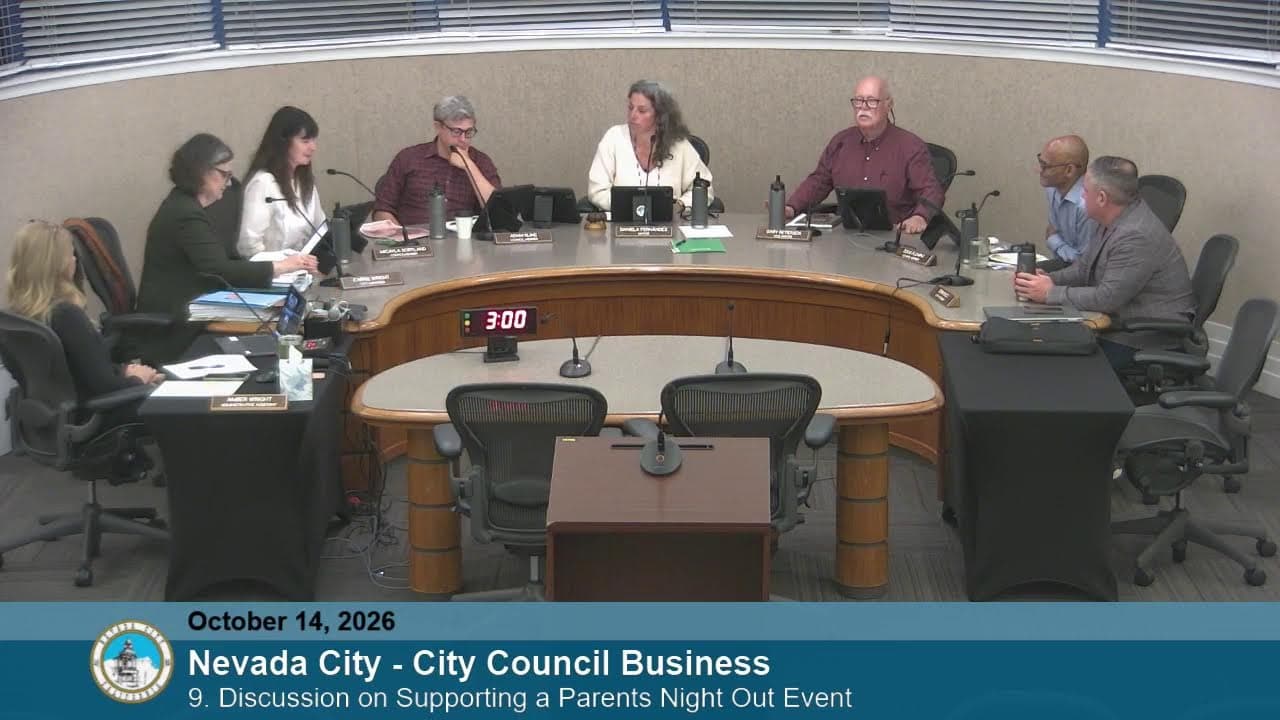
Nevada City customers will pay sharply more for water and sewer service starting Jan. 1, after the City Council unanimously adopted five years of rate increases at a packed Oct. 14 Proposition 218 hearing. Staff said current rates no longer cover operating costs and that reserves are nearly gone. Residents warned that seniors, landlords and small businesses will absorb the hit.
- Water rates rise 25% a year for five years after a 5-0 vote on Resolution 2026-23
- 375 protest letters fell short of the 638 water and 757 sewer parcels needed to block the increases
- Residents pressed for bonds, grants and longer timelines; staff will explore a hardship fund
- $1M state cannabis grant accepted, with $250,000 going to the Nevada County Cannabis Alliance
- State-mandated landscaping ordinance introduced after Nevada City received a corrective-action warning
Council Locks In Five Years of Rate Increases
Why it matters: This is the largest financial change for Nevada City households this year. Staff said the city's general fund has been covering water and wastewater shortfalls, and that the systems include 100-year-old lines.
Where things stand: The council kept a 25% annual water increase over five years. For wastewater, staff offered an alternate funding mechanism that covers costs but does little for capital improvements or reserves. About 42 customers with 3/4-inch meters will pay the 5/8-inch rate. Increases take effect Jan. 1, and the first bills reflecting them arrive in March.
The process began in October 2023. Consultant options followed in January and February 2026, and the council started the Prop 218 process with a July 23 resolution. The consultant had recommended a 65% first-year increase. Staff said the adopted rates collect about $1M less per year than that recommendation.
Council members described a system with almost no cushion: a $20,000 emergency reserve, about $3M in outstanding wastewater debt and restricted funds. The city engineer said regulatory fines tied to the wastewater treatment plant could be steep. "They can easily be half a million dollar fines," he said.
City Manager Carrie Wright said the council can reduce the annual percentages but cannot exceed them. "You can't go above what you vote on today," she said. She will deliver a full review in the first quarter of 2029.
Vice Mayor Gary E. Petersen answered residents' questions about whether the revenue could be diverted. "And that money, by law, cannot come into the general fund and can only be spent on those items, sewer and water," he said.
Decisions and stakeholder impacts: Resolution 2026-23 passed. For: 5 (Mayor Daniela Fernández, Vice Mayor Petersen, Councilmember Doug Fleming, Councilmember Adam Kline, Councilmember Micayla Sortland). Against: 0. Absent: 0.
The vote clearly weighed on the dais. "This is the hardest, ugliest vote I've ever had to make in 6 years," said Councilmember Fleming.
Councilmember Kline framed the decision as long-term stewardship. "The state of things here 10 or 20 years from now depends on what we do tonight," he said.
Mayor Fernández tied the cost squeeze to the city's slow housing growth, citing the hypothetical of 340 units built over the last 25 years. A larger customer base would have spread fixed system costs across more households.
Fixed-income seniors, landlords with multiple meters and downtown businesses bear the most immediate cost. Ratepayers gain a legal guarantee that the revenue stays in the water and sewer funds.
Residents Organize, Propose Alternatives
The basics: Under Prop 218, a statewide rule set by California voters, a majority of affected parcels can block a property-related fee increase by filing written protests.
Where things stand: Deputy City Clerk Amber Wright reported that the city had "received 375 letters that purport to be protests." Nevada City has 1,225 water parcels and 1,512 sewer parcels, so a majority protest required 638 and 757 parcels. Even if every letter was valid and covered both services, the tally fell short.
The other side: Fifteen people spoke during the hearing, and most opposed the increases. Public commenter Don Joy described neighborhood organizing against the hike. He urged longer amortization, prioritized repairs and state and federal grants.
Several speakers attacked the protest design itself. Public commenter Jennifer Tucci, a landlord with low-income tenants and five meters, said she gets only two protest votes. She also objected that silence counts as consent. Public commenter Greg Chapman called the process rushed, and public commenter Steve Benoit, a retiree, pointed to the combined cost of fire-safety clearing and higher water bills. Both men asked the city to spread costs over a 30-year bond.
Others offered specific alternatives:
- Public commenter Mike Field proposed a 10% increase paired with a one-time $250 charge per resident.
- Public commenter Barbara Larson said her co-housing community has 71 adult residents on a single meter.
- Public commenter Jessica Toney, a gallery owner, warned that new Broad Street businesses may close or leave.
Former Councilmember Renette Sinham rejected claims that past councils had "kicked the can." She also questioned new budget spending and asked for a side-by-side comparison of state revolving fund loans, grants and bonds. Public commenter Harry Bennett backed the council, noting the issue has been discussed for decades.
Decisions and stakeholder impacts: City Manager Wright said bonds suit large capital projects. "A majority of what these fee rates are being raised are to cover operations," she said.
Councilmember Fleming said Measure M money is restricted to transportation and that Nevada City does not qualify as a disadvantaged community for water grants. He added that any local tax would face a high bar. "A sales tax for water rates would be a 2/3 vote of the community," he said. Staff will look into the option.
What's next: Wright said staff would like to create a hardship fund and extend the late-payment window. She will report back at mid-year.
$1M Cannabis Grant Funds Detective, Education
Why it matters: The Prop 64 grant, administered through the state BSCC, funds enforcement and education without adding a permanent city position.
Where things stand: Police Chief Voss said most of the money will cover about 70% of an existing detective position. The detective will focus on cases with a cannabis link and work part time at the new Family Justice Center on Searles Avenue. "We want to inform first," he said.
The Nevada County Cannabis Alliance will receive $250,000 to run a five-year program. Campaigns will address youth use, impaired driving and industry responsibility. The grant language describes a new position, but City Manager Wright said the state agency allowed funding an existing one. That change requires a budget amendment.
Councilmember Fleming flagged that "70% of the grant had to go towards enforcement." Vice Mayor Petersen welcomed using an existing position, which avoids the usual risk when funding ends: "the grant goes away, the person goes away." Mayor Fernández asked for data on cannabis-related shoplifting.
Decisions and stakeholder impacts: Fleming moved and Kline seconded. The motion passed. For: 5. Against: 0. Absent: 0.
State-Required Landscape Rules Finally Advance
Why it matters: The state has required a water-efficient landscape ordinance since 1993. Nevada City received a warning letter in August. City Planner Jessica Hankins said the city "could receive corrective action and potentially be barred from state assistance and funding."
Where things stand: The ordinance amends Title 17 and applies mostly to new construction with more than 500 square feet of landscaping. It sets three compliance tiers, gives the director flexibility and accounts for defensible space requirements. The Planning Commission had recommended adoption 5-0.
Councilmember Kline relayed a public suggestion on native plants. "Is that something we can amend with the help of local plant specialists?" he asked. Staff said it will develop a local plant list later with community experts.
Decisions and stakeholder impacts: On Fleming's motion, seconded by Sortland, the council found the ordinance exempt from CEQA review. It introduced the ordinance on first reading. For: 5. Against: 0. Absent: 0.
What's next: Final adoption is scheduled for Oct. 28.
- Cannabis tax fix: Ordinance 2026-06 lets doctor's notes, not just medical cards, qualify for the reduced medical cannabis tax. It was introduced 5-0 with support from Nevada County Cannabis Alliance Executive Director Diana Gamzon.
- Parents Night Out: Staff will plan a one-night December pilot for children ages 6 to 12, supervised by qualified childcare providers. No formal vote was taken. "We give parents and caregivers a few hours to themselves while children enjoy a safe supervised recreation," said Mayor Fernández.
- Fire warning: Vice Mayor Petersen warned of a red flag warning "beginning tonight at midnight" and lasting through at least Saturday. He also reported that Pioneer Energy will grow from 11 to 25 members.
- Zero waste committee deferred: Councilmember Sortland read a county supervisor's letter supporting an ad hoc committee. The mayor said committees will follow strategic planning, likely in January.
- Spending scrutiny: Public commenter Matthew Coulter criticized city credit card spending and public-records copying fees as rates rise.
Looking ahead: The council returns Oct. 28 for final votes on the landscape ordinance and Ordinance 2026-06. A California Arts Council decision on cultural district funding is expected Oct. 23. A staff report on rate hardship relief is due at mid-year.