
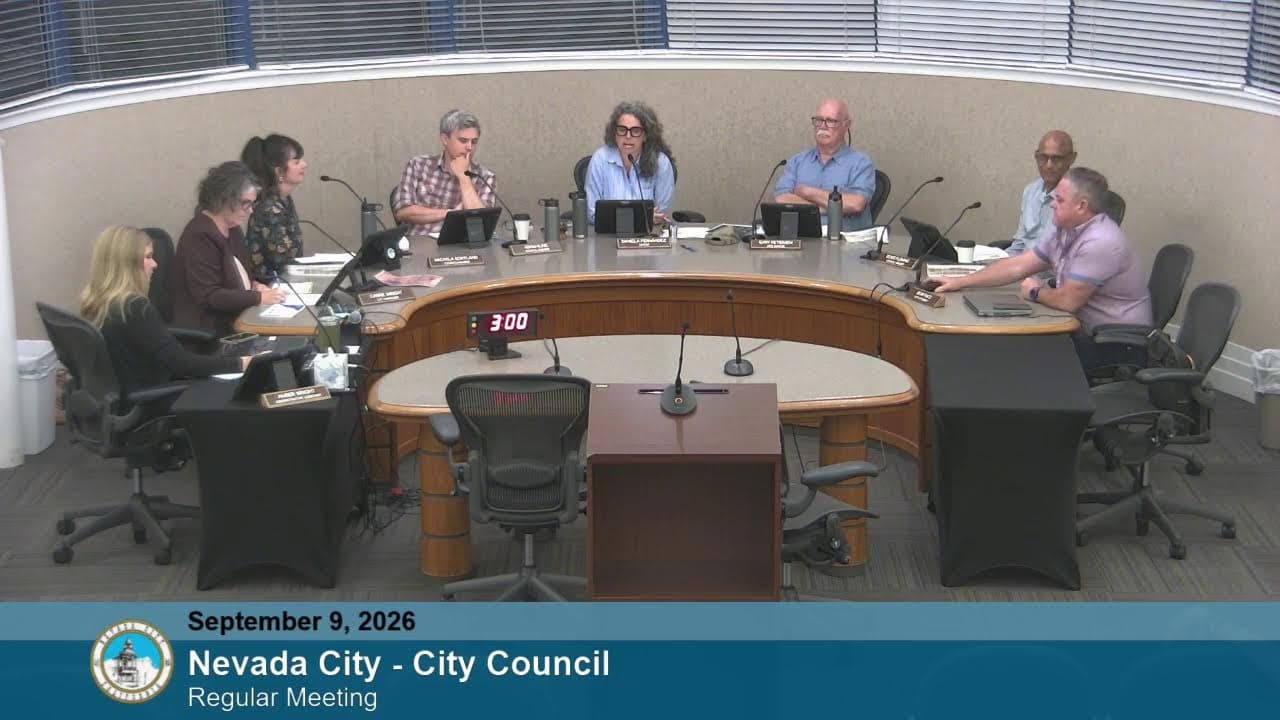
Nevada City Adopts Free ADU Plans to Fast-Track Housing Construction
City Council • Nevada CitySeptember 9, 2026
Locunity is an independent informational service and is not an official government page for this commission. All information is sourced from public footage and an analysis of official agendas with the aid of responsible, fact-checked AI. to report an error or omission.
The Nevada City City Council moved unanimously on a suite of actions Wednesday night that will reshape how homeowners build, how residents recreate, and how one overlooked downtown street shows up on the city's map — all while pressing PG&E on rate hikes and enrollment gaps in customer assistance programs.
Six free, permit-ready ADU plans adopted with a 30-day approval target and waived development impact fees for most units
$91K county grant accepted for the North Pine Pocket Park at the Doris Foley Library, unlocking a larger federal construction award
Council pushes PG&E to boost enrollment in discount programs after learning up to 30% of residents may qualify but aren't signed up
Vice Mayor Petersen blasts PG&E rate hikes — 101% over a decade — and $19M CEO pay, while praising front-line workers
Spring Street to get string lights before a new locals-only Hometown Christmas event Dec. 2
Zero waste committee and parents' night out pilot greenlit for future agendas
Six Free ADU Plans, 30-Day Approvals: A Housing Breakthrough
The basics: Resolution 2026-31 establishes Nevada City's pre-approved accessory dwelling unit plan program under state Government Code Section 65852.27, which requires cities to maintain an inventory of permit-ready ADU designs. Six plan sets — ranging from 462 to nearly 1,200 square feet — were developed by the Co-Housing Company using state REAP 2.0 grant funds and are available to homeowners at no cost.
Why it matters: Four of the six plans are under 750 square feet, which exempts them from development impact fees. One plan comes in under 500 square feet, also dodging school fees. Together, the free designs and fee waivers eliminate the two biggest upfront costs that have discouraged ADU construction in a city with acute workforce housing needs: architectural design and local government fees.
Where things stand: City Planner Jessica Hankins walked the council through the program's mechanics. Plans include attached and detached configurations, storage options, and a garage variant. The Planning Commission pre-approved a palette of historical colors using a light reflectance value of 29 or above, clearing designs for use even in Nevada City's historic district. Slider windows — unusual in historic areas — were approved as an accessibility accommodation. The first six plan sets are free; future additions to the inventory will carry an engineering licensing fee. The target is a 30-day administrative permit approval.
Vice Mayor Gary E. Petersen placed the vote in a longer arc of local housing politics: "The story of this getting to where we are now is just a novel. It began with Measure W and the effort to subvert state law so we didn't have to do any of this." He praised the outcome and urged social media outreach to ensure residents know the plans are available.
Councilmember Adam Kline framed the program as part of a broader strategy: "There's not one magic bullet for fixing our housing problems. It's a lot of little pieces, and this is one of them."
Councilmember Micayla Sortland noted the plans align with the city's housing element and strategic plan goals, "offering support for workforce and affordable housing." She credited Chuck Durrett and the Co-Housing Company for the design work.
Mayor Daniela Fernández articulated the governing philosophy behind the vote: "I think government's role in housing is largely to reduce barriers. And anywhere we can do that, we need to do that. Streamlining administrative processes is a great way to do that."
Decisions: The council voted 5-0 by roll call to find the project exempt from CEQA and adopt Resolution 2026-31. (For: Sortland, Kline, Fleming, Petersen, Fernández; Against: none; Absent: none.)
What's next: Homeowners can begin applying immediately. The city plans to publicize the program through social media and community outreach, and staff will develop a process for adding additional pre-approved plan sets to the inventory over time.
Council Grills PG&E on Rates, Enrollment Gaps
Why it matters: An estimated 20–30% of Nevada City residents may qualify for income-based rate discounts — CARE, FERA, and medical baseline programs — but aren't enrolled. In a community with a significant senior population and rising electricity costs, that gap represents real money left on the table.
Where things stand: Brandon Sanders, PG&E's Sierra Division government affairs representative, presented an overview of customer assistance programs: CARE and FERA rate reductions for income-qualified households, the REACH program for past-due bills, Match My Payment, budget billing, Go Green financing for energy efficiency upgrades, medical baseline discounts, and self-identified vulnerable customer protections. On the wildfire safety side, Sanders covered battery distributions, generator rebates, backup power transfer meters, and the Report It smartphone app.
Vice Mayor Petersen asked for hard data on how many residents are eligible versus enrolled and pressed Sanders to come to community events to sign people up. Councilmember Sortland asked about Go Green financing options for vintage homes. Councilmember Kline praised the programs but had a specific request — that PG&E explain the purpose behind planned outages so residents understand the benefit: "What we're doing is going to make it less likely that you are going to lose power in the winter, or this'll make it less likely when there's a weather event that you're gonna lose power, 'cause we're doing this work today."
Sanders acknowledged the criticism: "We get that feedback a lot that we don't really tell the full story and it leaves people sort of guessing or believing what they see on socials. So I agree, we could certainly do a better job."
The other side: Vice Mayor Petersen delivered the sharpest remarks of the evening, noting that PG&E "fees have gone up 61% in the last five years and 101% in the last 10 years. So a reduction would be nice, but doesn't begin to touch it." He cited CEO compensation of $19 million in salary plus a $15 million stock buyout, then drew a distinction between PG&E as a transmission and distribution company and Pioneer Energy as the city's actual electricity provider through community choice aggregation — all while praising front-line PG&E workers. No vote was taken; the item was informational.
$91K Grant Advances Pocket Park at Doris Foley Library
Why it matters: The county grant isn't just park money — it's the key that unlocks a larger federal award. Nevada County's AB 1600 program awarded $90,986 to the North Pine Pocket Park project, which will serve as the required 50/50 match for a pending federal Land and Water Conservation Fund grant that could fund construction through 2029.
Where things stand: Parks and Recreation Manager Dawn Saidonis explained the city had requested over $160,000 from the county program, but the remainder was allocated to Gold Country Trails Council for the Hoof Trail. Design development drawings are expected by month's end. Environmental review under both CEQA and NEPA has not yet begun but is required for the federal funds. An $8,189 funding gap exists based on original estimates, though actual costs won't be known until architectural and historical reviews are complete. County grant funds expire June 2028; the federal timeline extends construction eligibility through 2029.
Councilmember Sortland highlighted community priorities: seating, native plants, tree preservation, and a dog run. Mayor Fernández connected the dots to nearby businesses: "Councilmember Sortland's expression of the need for seating in that area. I'm thinking about both, you know, our new business Quench, which is fantastic if you haven't been on Commercial Street."
Vice Mayor Petersen praised staff for assembling the layered grant funding and noted that prevailing wage requirements apply to the project.
Decisions: Resolution 2026-32, accepting the grant funds and authorizing the city manager to administer, passed 5-0 by roll call. (For: Sortland, Kline, Fleming, Petersen, Fernández; Against: none; Absent: none.)
What's next: Staff will complete design development drawings and begin CEQA/NEPA environmental review. The federal Land and Water Conservation Fund decision is pending.
Spring Street Gets Its Moment: Lights, Safety, and a New Holiday Event
Why it matters: Spring Street businesses have felt like the forgotten end of Nevada City's downtown for years. String lights — at roughly $1 per foot — address both safety concerns and an identity gap as the street prepares to host a new locals-focused holiday event.
Where things stand: City Manager Carrie proposed installing string lights in the style already used on Commercial Street. Staff tested shielded lights but found them dim and twice as expensive. A Spring Street business owner, Steve, told the council the street is dark and businesses feel excluded from the rest of Nevada City. Lynn Skrugrud of the Nevada City Chamber of Commerce backed the proposal and announced a new Hometown Christmas event launching Dec. 2 on Spring Street as a locals-focused, offline-only alternative to Victorian Christmas.
Councilmember Kline supported the lights but wanted assurance that residents on the mixed-use street were consulted. The city manager confirmed only one affected resident, who is in favor. Vice Mayor Petersen recalled the initial controversy when lights went up on Commercial Street and drew on his own experience: "I once studied string lights. I put them up in alleyways in Salinas and a few other places." He supported extending them to Spring Street for safety benefits.
Decisions: No formal vote was taken. Council gave unanimous direction to staff to proceed with installation before the Dec. 2 event.
Minor Items
Consent calendar approved 5-0, including emergency replacement of six water treatment mixers flagged as a safety issue by the city engineer.
Officer Philip Brooks of the Nevada City Police Department was recognized for being named to the District 3 Congressional Police Honor Roll by Congressman Kevin Kiley during National Police Week. A video of Kiley's House floor remarks was shown. Chief of Police Dan Foss praised Brooks: "I cannot tell you how many times people have gotten pulled over and then wrote an email to me of their great experience with Phil. I've never seen it."
Lynn Skrugrud of the Nevada City Chamber of Commerce announced upcoming ribbon cuttings including Communities Beyond Violence relocating to Nevada City, Gemini Yoga, and Quench.
Gordon Gazuch of Regenesis Planet urged cross-jurisdictional collaboration on housing element analysis, noting roughly 10,000 people in Nevada County need housing, with 11% below the poverty line.
Councilmember Sortland announced the Resilience Project has been selected for the inaugural Resilient California Summit on Oct. 22 and previewed the Nevada City Zero Waste Summit, where 17 artists' work has been installed in the Alpha Building.
Councilmember Kline reminded residents that the second housing element community workshop is at the Miner's Foundry the following evening from 6 to 7:30 p.m.
Looking Ahead
Council agreed to agendize two new initiatives: a zero waste ad hoc committee to develop action plans from the upcoming Zero Waste Summit and align with the county's resource resiliency roadmap before the Board of Supervisors votes this fall, and a parents' night out pilot program proposed by Mayor Fernández — modeled on a New York City initiative — offering "4 hours of free childcare while they can enjoy, you know, the kids come, they enjoy dinner and games and supervised activities." A water rate community event is scheduled for Sept. 14, and an RFP has been issued for underutilized city properties including the 424 site, annex, and Miner's Foundry.