
Nevada City Locks In Costlier Five-Year Dispatch Deal With Sheriff
City Council • Nevada CityOctober 29, 2026
Locunity is an independent informational service and is not an official government page for this commission. All information is sourced from public footage and an analysis of official agendas with the aid of responsible, fact-checked AI. to report an error or omission.
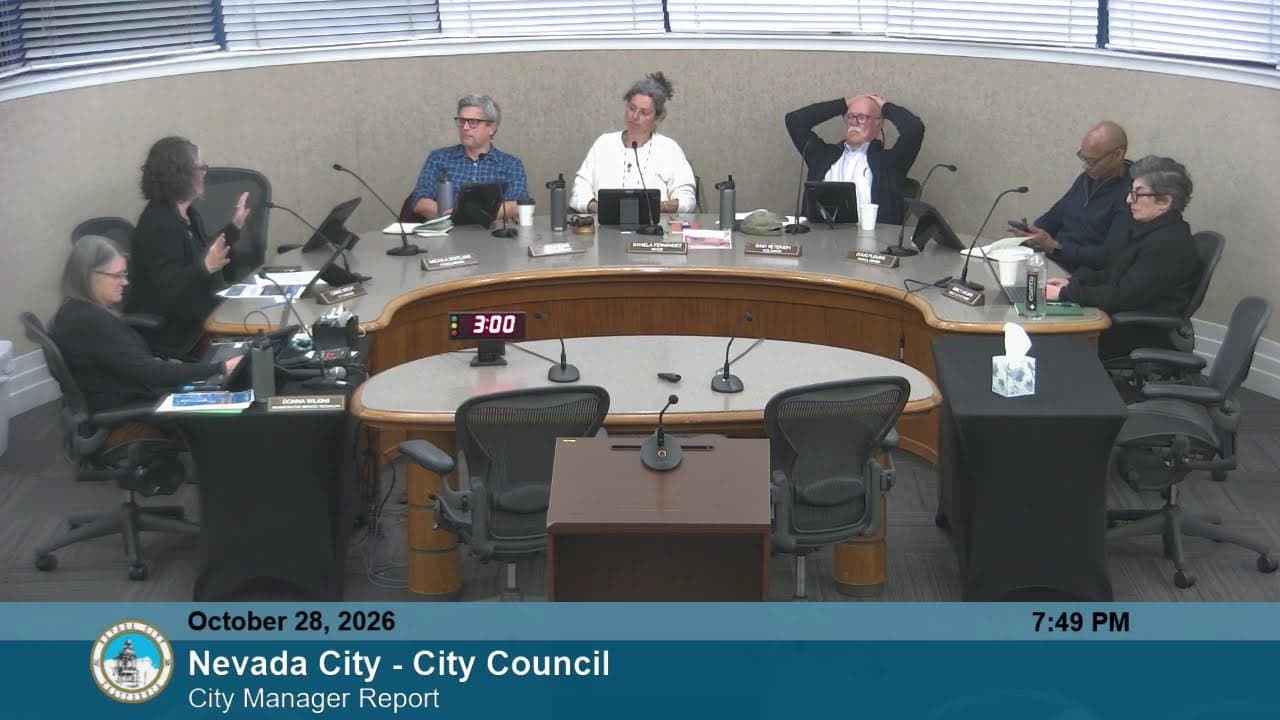
Nevada City's 911 dispatch bill has more than doubled since 2020, and the City Council voted Oct. 28, 2026, to accept five more years of 5% annual increases. The council approved the regional dispatch agreement and a resolution backing the Nevada Irrigation District's (NID) grant bid for a $55M dam spillway rebuild, each by a 4-0 roll call with Councilmember Micayla Sortland absent. Members also previewed a transit overhaul and agreed to change when City Hall opens its doors.
- Dispatch contract approved 4-0: costs climb to about $251,000 by year five
- Council backs NID's grant bid for the $55M Scotts Flat spillway replacement
- Transit study lays out a three-phase plan, but expansion likely needs new local money
- Council meetings move to 6 p.m. and City Hall opens at lunch but closes Fridays, targeted for Dec. 1
- Measure M oversight committee heads to the next agenda after resident questions
Dispatch Deal: Higher Price, Less Risk
Why it matters: Public safety dispatch is a fixed cost the city cannot easily walk away from. The new deal locks in steadily rising payments while city revenue is not growing as fast, according to staff.
Where things stand: The Nevada County Sheriff's Office runs the regional dispatch center serving the county, Grass Valley, Truckee and Nevada City. Negotiations began in February after earlier talks, and city leaders considered leaving the Sheriff's Office arrangement altogether.
City Manager Carrie Wright laid out the trajectory: "In 2020, we were about $96,000-$98,000. This year we're at $207,000, and by year 5, we'll be at $251,000."
The agreement moves from a shared-governance model to a services model. Instead of jointly running the center, the city pays a flat rate that rises 5% a year for five years. Wright said the structure removes surprise capital costs and shifts cost risk to the county. The city also expects to get more data on the service it receives.
The other side: Police Chief Dan Foss was candid that the city has had no ability to govern the contract and dislikes the price. "I won't say that we're thrilled with what we got, but it is what we got," said Foss. He praised the dispatchers and said building a city-run center would be very difficult and a long-term undertaking.
Vice Mayor Gary Petersen said the past relationship produced inadequate responses, but that breaking away had never worked at a city of Nevada City's scale. He said improved relations with the county changed his view. "I'm willing to support this," said Petersen.
Councilmember Doug Fleming asked what service gaps had prompted the review. Foss said he could not recall any specific gaps. Councilmember Adam Kline asked Foss to walk residents through how 911 and non-emergency calls are routed.
Decisions and stakeholder impacts: Petersen moved approval and authorization for the city manager to execute the agreement, and Kline seconded. The motion passed 4-0 (For: Fernández, Petersen, Kline, Fleming; Against: none; Absent: Sortland). No one spoke during public comment.
Residents get continuity of dispatch service and the county absorbs capital surprises. The city trades away its governance role for budget predictability, though "predictable" here means a payment roughly 2.5 times what it was six years ago.
What's next: The city manager is authorized to sign. The five-year term ends with annual payments near $251,000.
Council Backs NID's $55M Spillway Grant Bid
Why it matters: NID's spillway at Scotts Flat sits upstream of Nevada City. Petersen put the downstream risk bluntly: "failure of the Scotts Flat Dam equals a 30-foot wall of water at Nevada Street at the new bridge."
The basics: A spillway safely releases excess water from a reservoir. Federal regulators at FERC and the state Division of Safety of Dams are driving the project.
Where things stand: NID's Director of Engineering, Gabe Barineau, said the spillway dates to the 1940s, has patched concrete and lacks underdrains. Historic peak flows reached about 6,000 cubic feet per second (CFS). The rebuild includes access improvements, rock anchors, a replaced chute and a re-armored lower plunge pool, bringing capacity to about 24,000 CFS.
Barineau put the estimated cost at $55M, mostly funded by ratepayers. NID is on a Department of Energy grant list and is pursuing Proposition 4 dam safety and climate resilience funding. The application has not yet been filed because the state Department of Water Resources has not released its solicitation.
NID Assistant General Manager Greg Jones said the district's board has determined that outside funding would be used "to help offset future rates as we can in the future."
The other side: Construction will close Campground 1 and pedestrian access over the dam bridge, and it will bring traffic and noise. Petersen confirmed pedestrian access would reopen afterward. Fleming asked about fishing; NID said upstream access is unchanged.
Jeff Lauder, executive director of Sierra Streams Institute, said his group reviewed the FERC documents and found NID open about sharing data. He supported the project and said he worries more about a spillway blowout than construction impacts.
Decisions and stakeholder impacts: Fleming moved Resolution 2026-35, and Petersen seconded. It passed 4-0 (For: Fernández, Petersen, Kline, Fleming; Against: none; Absent: Sortland). NID ratepayers stand to benefit most if grants land. Campers and dam-bridge walkers bear the near-term costs.
What's next: NID plans to bid the project in summer 2027, with construction in the summers of 2028 and 2029. Kline asked how residents can help. NID pointed to one-click support letters at nidwater.com and reported 151 letters so far, with notices sent to about 600 people.
Transit Study: Good Ideas, Thin Wallet
Why it matters: Ridership has stayed flat since the pandemic while costs rise. Officials said state and federal operating support is limited.
Where things stand: Aaron Hoyt, deputy executive director of the Nevada County Transportation Commission (NCTC), presented a joint study by the NCTC and Nevada County Transit Services, prepared with consultant Tool Design Group. About 300 people were engaged. Riders asked for more frequent and later service, regional connections, better stops and more awareness of the system. Sixty-nine percent rated service good or great.
The plan has three phases:
- Do Now (1–3 years, current budgets): Routes 1–4 consolidate into three, with 30- to 90-minute frequency, weekend service to 9 p.m. and regional routes trimmed to peak times.
- Do Next (3–5 years, new money): Peak regional service is restored, and a microtransit pilot launches in the Idaho-Maryland area. Microtransit is on-demand, shared van-style service within a defined zone.
- Preferred Future (5–10 years): Frequency improves to 30 to 60 minutes, with more microtransit zones and event shuttles.
The other side: Fleming zeroed in on money. "How are we going to get to the dollars that we need to enact some of those nice concepts like microtransit and things like that?" asked Fleming.
Hoyt answered that revenue ideas include advertising, public-private partnerships, interlocal contracts and a possible sales tax measure. "If we do want improved services, we would probably have to fund it at the local level and not rely on the state or the federal government," said Hoyt.
Decisions and stakeholder impacts: No action was taken. Petersen praised the plan's flexibility and microtransit, Kline asked who was surveyed, and Mayor Daniela Fernández voiced support. Riders on regional routes face trimmed off-peak service in the first phase. Anything beyond that phase points toward a future local revenue debate.
What's next: The draft report goes to a 30-day public review.
City Hall Opens at Lunch, Closes Fridays
Where things stand: The City Hall lobby is now open 8 a.m. to 5 p.m. Monday through Friday and closed from noon to 1 p.m. Residents have complained that the lunch hour is the best time for working people to do city business. Many staff work four 10-hour shifts, which makes Friday coverage difficult, and neighboring cities close on Fridays and stay open at lunch.
Wright framed the choice for the council: "Do you want to be open for lunch? Should we be moving to closed on Fridays, providing more flexibility?" She said the proposal does not change staff work schedules. Staff received it well, though one deputy clerk's schedule is most affected.
Wright also proposed moving winter council meetings from 6:30 to 6 p.m. "I also really like the idea of six o'clock," said Fernández.
Decisions and stakeholder impacts: Fernández, Fleming, Petersen and Kline all supported the changes by consensus, with no formal vote. Kline asked about closing Fridays versus Mondays. Petersen said Monday is better for having staff present in the office. Working residents gain lunch-hour access; Friday walk-in visitors lose it.
What's next: Implementation is targeted for Dec. 1, with public notice.
Residents Press on Water Rates, Measure M
During non-agenda comment, public commenter Rick Beatty apologized for his behavior the prior week. He then said residents still have questions about the Whitewater water rate increase and why alternative funding was not discussed earlier. He also raised Measure M, which provides $500,000 a year for infrastructure, and said residents cannot find records of its citizen oversight committee or year-end audit. "Explain to us what happened to the City Oversight Committee," said Beatty.
Beatty also asked for discussion of a proposed wellness business on Broad Street near a church and schools. Fernández said the council discussed rates openly and has engaged the community for about a year, noting the consultant contract dates to 2024. On the business, she said "it is not council's job to police businesses that come into town, to decide what's appropriate or what's not."
Later, Petersen asked for Measure M information. "We did pass the audit in July, which usually that would trigger an oversight committee meeting," said Wright. She said the committee must be reseated and an ad hoc committee would interview prospective members. By consensus, the item will be on the next agenda.
- Consent calendar and agenda approved 4-0 on a motion by Kline, seconded by Fleming.
- Gordon Gossage of Regenesis Planet urged studying housing, solar or a sculpture-park campground on the city's roughly 100-acre airport land.
- Lauder announced the death of Sierra Streams Institute founder John Vanderveen and the relaunch of Friends of Deer Creek, with a Nov. 12 gathering at the National.
- Council members flagged open seats on the Fire Safety Advisory Committee and noted that ballot drop-off is now available at City Hall.
- A scheduled sister city update was pulled for scheduling reasons.
Looking ahead: The Measure M oversight committee comes back at the next meeting, the transit draft opens for 30 days of public comment, and new City Hall hours are targeted for Dec. 1.