
Plan Bay Area 2060 Preview Draws Pushback on E-Bikes, Megaproject Costs
MTC ABAG Community Advisory Council • Association of Bay Area GovernmentsSeptember 4, 2026
Locunity is an independent informational service and is not an official government page for this commission. All information is sourced from public footage and an analysis of official agendas with the aid of responsible, fact-checked AI. to report an error or omission.
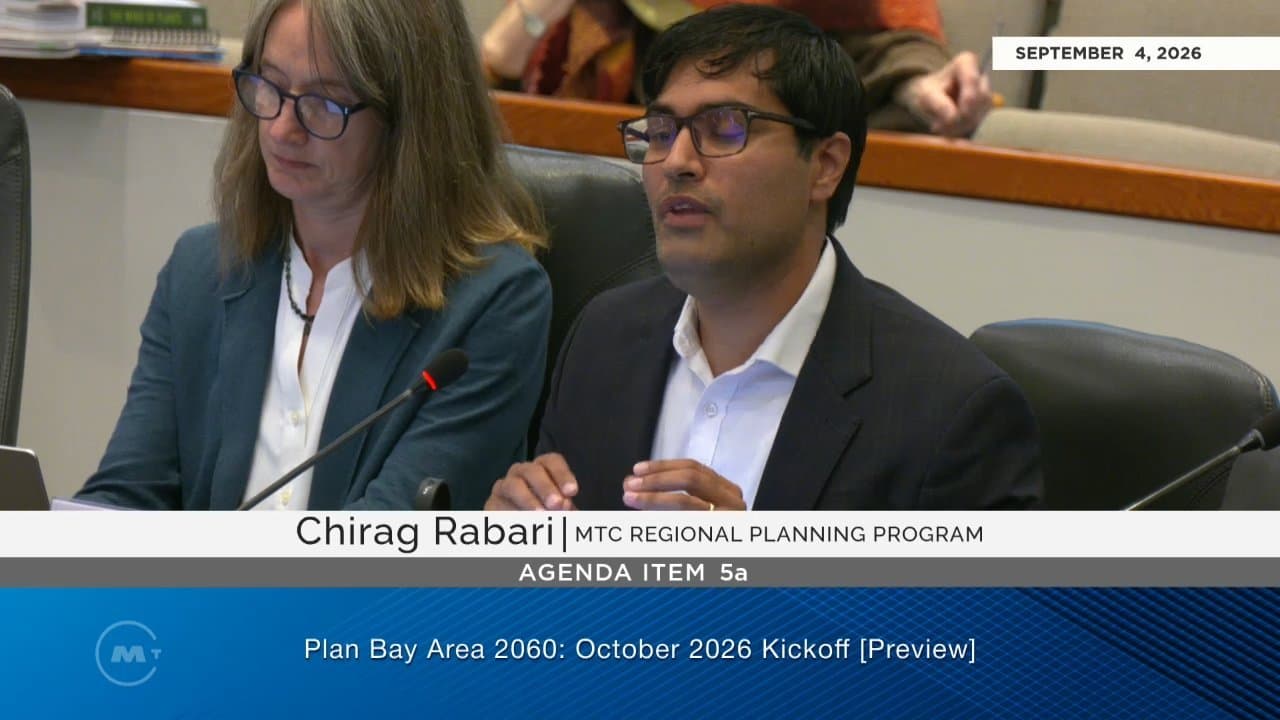
The Bay Area's next long-range plan is still five weeks from its formal launch, and the MTC ABAG Community Advisory Council is already asking how any of it will get built. At its Sept. 4, 2026, meeting, the council heard a preview of Plan Bay Area 2060. Members pressed staff on e-bike safety, sea level rise costs and multibillion-dollar transit projects, then reviewed public input on the region's draft engagement rulebook.
- Plan Bay Area 2060 previewed ahead of the Oct. 9 kickoff, with final adoption anticipated in early 2030
- E-bike and scooter hazards dominate questions; staff concede implementation is the challenge
- About $100 billion is the estimated cost to adapt the Bay to sea level rise through 2050
- 1,300+ people weighed in on the draft Public Participation Plan; members push for business, labor and youth follow-up
Plan Bay Area 2060: Big Vision, Hard Delivery Questions
The basics: Plan Bay Area sets regional direction on transportation, housing and resilience. Its predecessor, Plan Bay Area 2050+, cleared state and federal approvals and the California Environmental Quality Act challenge window without lawsuits. It remains the adopted plan through 2030.
Why it matters: This was the longest discussion of the meeting, roughly 50 minutes. It gave the council an early shot at shaping the plan before the blueprint phases in spring 2028 and 2029 lock in tradeoffs.
Where things stand: Chirag Rabari, Assistant Director of Major Plans, MTC-ABAG Regional Planning Program, outlined four phases: foundations, outlook, blueprint and final plan. Vision adoption is set for spring 2027. Scoping feedback covered:
- Transportation safety
- Housing and land use
- Fiscal scenario planning
- Sea level rise
- Transit prioritization with fewer resources
- AI, automation and e-bikes
Rabari also flagged several outside pressures. These include pending greenhouse gas target updates from the California Air Resources Board, SB 1087 on the governor's desk, AB 2296's effect on Regional Housing Needs Allocation timelines, and uncertain federal funding. One member asked whether federal actions threaten race equity work. "I don't think that our emphasis on equity is going to change in the long-range plan itself," said Rabari. He added that federal requirements for metropolitan planning organizations must still be met.
E-bikes: plans versus enforcement. Member Wong, Member Saunders, Member Cushman and Member Madrid raised e-bike and scooter hazards for pedestrians, including blind residents. Staff floated bike speed limits and possible revisions to Vision Zero and active-transportation strategies. Madrid wanted more than ideas: "Planning implementation is what I'm looking to hear from you," said Madrid. Rabari acknowledged that enforcement rests with cities and operators. "The challenge has been on the implementation side," said Rabari.
Sea level rise, by the numbers. Answering Saunders, Rabari cited work with the Bay Conservation and Development Commission. "It would cost approximately $100 billion or thereabouts looking all the way out to 2050," said Rabari. He put the cost of inaction at two to three times larger. Member Hankerson asked whether flood-prone Highway 37 is a priority. Staff said the fiscally constrained plan includes an interim project, while longer-term adaptation sits on the unconstrained resilience list.
The other side: Member Baldini questioned megaproject costs, citing "spending $6.7 billion to go a couple of miles from 4th Street Station and Caltrain to Salesforce Tower." Member Young questioned whether the region can deliver on its goals. "I see a real gap sometimes between setting regional goals, particularly as it relates to housing, and having the ecosystem needed to actually deliver them," said Young.
Cushman pushed for "deeply affordable housing for people who struggle and either are homeless or close to it." She also asked how rail and bus needs are balanced across 27 transit agencies. Matt Maloney, Deputy Executive Director, Metro Planning and Policy, MTC-ABAG, said the plan sets vision and strategies, while implementation relies on partners. "It doesn't always lend itself to going deep and granular on every single topic," said Maloney.
Decisions and stakeholder impacts: The item was information only, so no vote was taken. Several groups have the most at stake:
- Pedestrians and disability advocates seeking safer sidewalks and trails
- Vallejo-area commuters on Highway 37
- Transit agencies competing for limited dollars
Cities and operators, not MTC, hold the enforcement levers members want pulled.
What's next: The formal kickoff is Oct. 9, followed by a joint workshop Oct. 29. Staff will bring coordination roadmaps with the October kickoff item. Baldini separately requested a future agenda item to "explore establishing tenets for MTC" on cost-benefit review.
Participation Plan Input: 'Close the Loop'
Why it matters: The Public Participation Plan governs how MTC engages residents on Plan Bay Area and the Transportation Improvement Program, the region's list of funded transportation projects. It shapes who gets heard before money moves.
Where things stand: Staff released the draft June 8 for a 45-day comment period. Outreach included focus groups, student discussion groups, two council discussion groups and a trilingual survey. "In all, more than 1,300 people participated," said Veronica Cummings, Principal Public Information Officer for Engagement, MTC. Six themes emerged:
- Transparency
- Meeting people where they are
- Accessibility
- Plain language
- Early partnership with community-based organizations
- Embedded equity
The other side: Members asked who was missing from the input and who will hear back.
- Member Cibranti urged proactive outreach to business and labor, saying "the business community doesn't proactively think to participate in these kinds of processes."
- Member Demong asked staff to report back to youth participants.
- Member Wong suggested a case study on a contentious topic.
- Young flagged that "Attachment B doesn't report who responded."
Cummings said demographic data is voluntary but would be shared. She would not commit to re-contacting every community, though staff will report back. "It's just not me to overpromise and underdeliver," said Cummings.
In public comment, Jane Kramer, a public commenter, echoed the theme. She said much communication is lost online and urged finding a trusted "pipeline" person without co-opting them.
Decisions and stakeholder impacts: The item was information only. Community-based organizations stand to gain a formal early role in engagement. Business, labor and youth constituencies are pressing not to be an afterthought.
What's next: The revised plan goes to the Joint MTC ABAG Legislation Committee, then to the full commission for expected adoption later in September.
Minor Items
- Consent calendar: Aug. 7, 2026, minutes approved (For: 22, Against: 0, Abstain: 1 — Hankerson, Absent: 4 — Madrid, Chang, Gerasimenko, Collins).
- Granicus exit: Staff said the agency is leaving Granicus and will contact blind and visually impaired members about accessible formats for the replacement.
- CBO Partnership Exchange and stipends: The Aug. 24 exchange drew 50 representatives from 37 community-based organizations. Members earn $100 per meeting, up to $500 monthly, and stipends for outside engagement events will be reviewed case by case.
- Advisory group openings: The chair announced spring openings, including a proposed equity priority communities "kitchen cabinet." Cushman asked for a similar body for the disability community, and members must signal interest by December.
- Regional housing measure: Member Trachtenberg flagged South Bay (Sept. 25) and East Bay (Oct. 9) convenings on a possible Bay Area Housing Finance Authority measure as early as 2028. Cibranti requested a council update.
Looking Ahead
The council's next meeting is in October. Plan Bay Area 2060 formally kicks off Oct. 9, with a joint workshop Oct. 29. Alita Dupree, a public commenter, urged a fully Clipper-based fare system that retains cash options, a fare-integration thread Member Lavery also reported from the Regional Network Management Customer Advisory Group.